
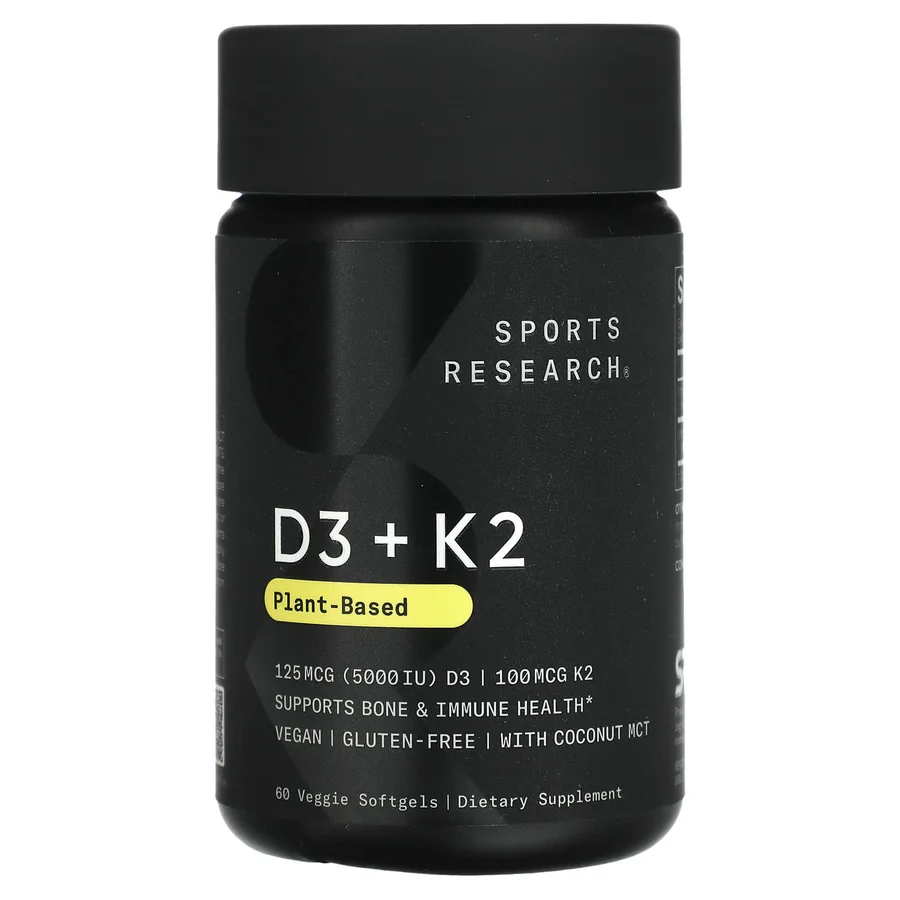
Sports Research D3 + K2 Plant Based 5000 IU
Plant-Based D3 + K2 · 60 veggie softgels
Lichen D3 125 mcg (5,000 IU); chickpea K2 MK-7 100 mcg per label serving.
- Amount
- Lichen D3 125 mcg (5,000 IU); chickpea K2 MK-7 100 mcg
- Format
- Softgels
- Review basis
- Label-based analysis
Good fit
adults who specifically want a vitamin D plus K2 combo in a vegan softgel
Consider another option
you want the lowest cost, a lower dose, or need to avoid K2 because of medication concerns
The product, at a glance
Amounts for the reviewed label serving.
- Reviewed variant
- Plant-Based D3 + K2 · 60 veggie softgels
- Label serving
- 1 softgel
- Servings per reviewed pack
- 60
- Ingredients per label serving
- Lichen D3 125 mcg (5,000 IU); chickpea K2 MK-7 100 mcg
- Other ingredients
- Coconut MCT oil; Plantgel capsule (modified tapioca starch, vegetable glycerin, water, turmeric color); olive oil
Label sources & rating context
~ means approximate; — means no published value in this record. Customer ratings are the named publisher’s snapshot and may include multiple sizes or earlier formulas. The Supplement Explained Score is our source-reviewed editorial assessment out of 25, separate from customer stars. Compare the five criteria and the same intended use; the total is not a clinical ranking. Prices are dated USD offer snapshots; cost uses the reviewed pack and label serving.
- Label clarity: 5/5
- Evidence transfer: 4/5
- Safety fit: 3/5
- Quality proof: 2/5
- Value fit: 3/5
On this pageTable of Contents
- 1Supplement Explained Score
- 2Who it fits — and who should skip it
- 3What is in the formula?
- 4Strengths, tradeoffs, and red flags
- 5Price and value analysis
- 6Is there third-party testing or quality proof?
- 7Use-case fit and evidence limits
- 8What do real users often report?
- 9Alternatives to compare
- 10Alternatives to compare
- 11FAQ
Our editorial assessment
Supplement Explained Score
17/25
Sports Research D3 + K2 Plant Based 5000 IU · Plant-Based D3 + K2 · 60 veggie softgels
Five equally weighted criteria, with a product-specific reason for every point. This is a buying-decision assessment, separate from customer stars and personal medical suitability.
- Label clarity 5/5
- Reviewed Plant-Based D3 + K2 · 60 veggie softgels: 1 softgel; 60 label servings. Lichen D3 125 mcg (5,000 IU); chickpea K2 MK-7 100 mcg.
- Evidence transfer 4/5
- D3 has an inadequacy role; combining 5,000 IU with MK-7 does not establish added benefit for all adults.
- Safety fit 3/5
- The D amount exceeds the routine adult total-intake UL; K2/warfarin and stacked D require review.
- Quality proof 2/5
- Plant sourcing identifies a dietary feature, not an independent finished-softgel potency or purity certificate.
- Value fit 3/5
- One plant-based softgel is convenient, but the high fixed dose reduces flexibility for ordinary intake gaps.
Review basis: Published labels, manufacturer/retailer information, clinical sources and exact-product quality records where available. We did not buy, personally use or laboratory-test this product for this assessment.
Reviewed · Method v2.0 · How we assign points
Sources behind this score
Product labels and independent directory records identify a formula or testing scope. Clinical references concern ingredients or studied regimens unless the explanation explicitly matches the finished formula.
Who it fits — and who should skip it
- Adults who specifically want a vegan vitamin D3 rather than lanolin-based D3
- People who prefer a D3 plus K2 MK-7 combination in one softgel
- Shoppers who value certification and label clarity enough to pay a mid-range price
- People who already know a higher-potency D3 formula makes sense for their situation and want a plant-based version
For practical use, the listing suggests taking it with food. If timing is your main question, see the best time to take vitamin D.
Who should skip it
- Anyone who wants a lower-dose or simpler D-only formula
- People already using another high-dose vitamin D supplement
- People taking anticoagulants such as warfarin, unless a clinician says the formula is appropriate
- Anyone who is pregnant, nursing, has a diagnosed medical condition, or takes prescription medication and has not checked first
- People who need to avoid coconut, since the formula contains coconut-derived ingredients
If your situation is not straightforward, it is usually better to review what blood tests matter before vitamin D and when to talk to a clinician before choosing a 5,000 IU product.
What is in the formula?
The public listing shows one veggie softgel provides vitamin D3 125 mcg, equal to 5,000 IU, sourced from lichen, plus vitamin K2 100 mcg as MK-7 sourced from chickpea. The suggested use is 1 softgel daily with food, or as directed by a qualified healthcare professional.
The softgel also uses coconut MCT oil and olive oil, with a PlantGel capsule made from non-GMO modified tapioca starch, vegetable glycerin, purified water, and turmeric for color. The listing says turmeric is used in the outer shell to help protect the actives from photo-degradation.
If you are comparing labels, our guide on how to read a supplement label can help you look past the front-of-bottle marketing and focus on dose, serving size, source, and overlap.
Serving size
What the label asks you to take
1 veggie softgelThe routine is clean and simple, which is one of the product’s biggest strengths.
Real dose
What the combo actually gives you
5,000 IU D3 + 100 mcg K2This is a meaningful combo, not a tiny add-on blend.
Other ingredients
What changes product fit
Lichen D3, chickpea MK-7, oils, vegan softgelThis is a real plus if vegan sourcing matters to you.
Routine burden
What daily use feels like
Easy routine, narrower fitOne softgel is easy. The harder part is deciding whether you wanted K2 in the formula at all.
Studied dose vs label reality
A vegan D3 and K2 combination may appeal if you need both ingredients, but adding K2 does not make a high vitamin D dose appropriate for everyone. Check the individual doses and your medication list before choosing a combination.
Label dose
What one softgel gives you
5,000 IU D3 + 100 mcg MK-7This is a serious combo serving, not a half-measure.
What people compare
The real dose question
Plain D3 vs D3 + K2 is the main forkMost shoppers are really deciding between simpler standalone D3 and a combo like this one.
Dose verdict
Does the label make sense?
Roughly aligned Strong combo label for the right userThe weak spot is not underdosing. It is that the formula is easier to rule out if K2 or medication context matters.
Biggest catch
What shoppers often miss
Good combo label still does not mean you need the comboA clean vegan D3+K2 product can still be the wrong lane if your real question is basic D3 status.
Strengths, tradeoffs, and red flags
- Plant-based sourcing is the headline feature. Vegan D3 from lichen is the main differentiator for shoppers who do not want lanolin-based D3.
- The K2 form is clearly named. The label specifies MK-7, which is more useful than a vague “vitamin K2” callout.
- The format is simple. One softgel per day is straightforward, and the oil-based softgel format may appeal to people who prefer not to take multiple capsules.
- Quality claims are easy to spot. The listing includes Certified Vegan, Non-GMO Project Verified, Gluten Free, Third Party Tested, and cGMP Compliant.
- Label transparency is decent. The ingredient sources and other ingredients are clearly disclosed.
What looks weak and what the tradeoffs are
The biggest tradeoff is potency. A 5,000 IU vitamin D softgel is not a casual “just in case” amount for everyone, especially if you already take a multivitamin, another D product, or a wellness stack with overlapping ingredients. If you are not sure what your overall intake looks like, start by checking your full label stack and reading about vitamin D side effects.
The second tradeoff is the built-in K2. Some readers want D3 only, not a combo formula. Others take medication where vitamin K deserves extra caution, especially anticoagulants such as warfarin. That does not make this a bad product. It just means the formula is narrower in fit than a plain D3 product. Our comparison on vitamin D alone vs D3 plus K2 is often the better first read if you are undecided.
There is also a cost tradeoff. Vegan sourcing, MK-7, and the softgel format help explain the price, but they also push it above many basic D-only options.
Red flags before you hit buy
These are the things most likely to make the product feel wrong later, even if the label looked fine at first.
- Skip it if you already know you want D3 only. Paying for MK-7 makes no sense if you do not want the combo.
- Pause if vitamin K is a medication issue. This is one of the first things to sort out before buying.
- Do not buy it just because vegan D3 sounds cleaner. Vegan sourcing is useful, but it does not answer whether the combo fits your goal.
Price and value analysis
No matched fresh USD serving-cost benchmark was available for the score review. The reviewed Plant-Based D3 + K2 · 60 veggie softgels supplies 60 label servings of Lichen D3 125 mcg (5,000 IU); chickpea K2 MK-7 100 mcg, using 1 softgel per serving. One plant-based softgel is convenient, but the high fixed dose reduces flexibility for ordinary intake gaps.
What you are paying for is not novelty. It is the combination of plant-based sourcing, vegan certification, MK-7 inclusion, and a fairly clean label presentation. If you only want vitamin D and do not care about K2 or vegan sourcing, cheaper paths are common.
Price per meaningful dose
This product is not cheap, but the price is easier to understand once you remember you are paying for a vegan combo formula, not just a plain D3 capsule.
Per serving
Cost each day you use it
About $0.43That is clearly above basic D3 pricing.
Per combo serving
Cost for the full D3 + K2 package
About $0.43The meaningful-dose math stays the same because one softgel already is the full combo serving.
What you are paying for
Where the premium comes from
Vegan sourcing + combo formulaThe price is mostly about plant-based D3, MK-7, and the cleaner-label positioning.
Is there third-party testing or quality proof?
Proof status: this is a label-based editorial review, not a hands-on lab test by Supplement Explained. The useful quality signals come from the public product listing and label claims, including Certified Vegan, Non-GMO Project Verified, Gluten Free, Third Party Tested, and cGMP Compliant.
The listing describes the product as Certified Vegan, Non-GMO Project Verified, Gluten Free, Third Party Tested, and cGMP Compliant. Those are useful quality signals, especially for shoppers comparing crowded supplement pages.
Still, quality claims on a product page are not the same as a public batch-specific certificate of analysis. The right practical read is that the label looks stronger than average for transparency, but buyers should still use normal label scrutiny and avoid assuming that “third party tested” answers every question.
What this product is really implying
The formula is trying to tell a neat story: cleaner sourcing, stronger combo logic, one softgel, done. That story is appealing, but it still skips the question of whether you needed D3 plus K2 together.
Marketing angle
What the product is trying to say
This is the smarter premium choice if you want vitamin D done right in one vegan softgel.
Evidence reality
What the research actually supports
There is support for vitamin D overall, and interest in K2 context, but not a blanket rule that every buyer needs this exact combo.
Shopping takeaway
What should decide the buy
Buy it if you specifically want vegan D3 plus K2 in one softgel. Skip it if your real question is simpler than that.
Use-case fit and evidence limits
The evidence context here is mostly about vitamin D generally, not this exact branded formula. The NIH Office of Dietary Supplements explains that vitamin D helps the body absorb calcium and is important for bone health. It also makes clear that needs vary, which matters because 5,000 IU is a meaningful daily amount, not a neutral default for every adult.
K2 is included here as MK-7, but that does not mean everyone needs a D3 plus K2 product. In real buying terms, this product makes the most sense for people who already want that pairing and specifically want a vegan softgel. If you are still deciding whether the combo itself makes sense, start with D3 plus K2 versus D alone instead of locking onto a brand first.
| Use Case | Evidence | Typical Time Window |
|---|---|---|
| Vitamin D maintenance with labs | Moderate | Usually judged over weeks to a few months. |
| Plant-based daily routine | Practical fit | That fit is immediate if vegan sourcing is a priority. |
| Combo convenience | Practical fit | One-bottle convenience is immediate, even if outcome questions take longer. |
| Stack-overlap-sensitive routines | Caution | Overlap risk matters right away if you already take D or K elsewhere. |
What do real users often report?
Anecdotal only. This block summarizes recurring public discussion themes, not controlled research and not hands-on testing by us.
Consensus scope: 2 public source pages listed below. Themes are anecdotal and are not a representative customer sample.
Recurring positives
- People like the plant-based D3 angle and the clearer ingredient sourcing
- The one-softgel format is seen as convenient
- Some users view the brand as easier to trust than more generic listings
Recurring negatives
- The 5,000 IU dose feels higher than some users want for routine use
- Some shoppers would rather buy plain D3 and skip added K2
- Price comes up regularly as a reason to compare other options
Overall read
- The general community read is that this looks like a solid niche choice for shoppers who specifically want vegan D3 plus MK-7 in one softgel. It is less appealing for people who want the cheapest vitamin D path or who are unsure whether they need K2 at all.
Public threads reviewed: public community discussions on Reddit at r/Supplements thread 1 and r/Supplements thread 2.
Note: These are summarized recurring themes from public user discussions. They are anecdotal and do not replace clinical evidence or professional guidance.
Alternatives to compare
If you like the Sports Research brand but do not need K2, a simpler D3-only path may be easier to dose and easier to compare on price. If you are not sure whether a combo formula makes sense, do not start with the product page. Start with the broader decision guide on vitamin D alone vs D3 plus K2 or the main vitamin D supplement page.
If your real goal is broader appearance support, this formula may not be the most direct answer. Readers chasing wellness outcomes like hair, skin, and nails often need a different comparison framework than simply “more vitamin D.”
For buyers who just want to compare across brands, our full products hub is usually the faster place to start than staying inside one SKU.
Alternatives at a glance
Use this quick compare if you are deciding between a vegan D3 plus K2 formula, a simpler D3-only option, or a broader guide before buying anything.
| Product | Best For | Main Tradeoff |
|---|---|---|
| NOW Vitamin D3 5000 IU | Simpler D3-only value | No K2 and not plant-based. |
| Doctor's Best Vitamin D3 5000 IU | Longer simple D3 bottle | No K2 and not vegan. |
| Vitamin D Alone vs D3 + K2 | Combo-versus-simple decisions | Less product-specific if the real question is still about formula type. |
Alternatives to compare
We do not yet have two other reviewed products in this exact category. Use the closest reviewed match, the ingredient guide, and the wider product library instead of treating unrelated supplements as direct alternatives.
FAQ
Short answers to the product-specific questions readers most often ask before comparing or buying.
Who is Sports Research D3 + K2 Plant Based 5000 IU best for?
This page frames Sports Research D3 + K2 Plant Based 5000 IU as best for adults who specifically want a vitamin D plus K2 combo in a vegan softgel.
Who should skip Sports Research D3 + K2 Plant Based 5000 IU?
Consider skipping Sports Research D3 + K2 Plant Based 5000 IU if you want the lowest cost, a lower dose, or need to avoid K2 because of medication concerns.
What dose or serving does Sports Research D3 + K2 Plant Based 5000 IU use?
Active dose: vitamin D3 125 mcg (5,000 IU) from lichen plus vitamin K2 100 mcg as MK-7 from chickpea; Form: plant-based veggie softgel with coconut MCT oil and olive oil; Servings: 60 veggie softgels, 1 softgel per serving, 60 servings per container.
What quality or price signals matter for Sports Research D3 + K2 Plant Based 5000 IU?
No matched fresh USD serving-cost benchmark was available for the score review. The reviewed Plant-Based D3 + K2 · 60 veggie softgels supplies 60 label servings of Lichen D3 125 mcg (5,000 IU); chickpea K2 MK-7 100 mcg, using 1 softgel per serving. One plant-based softgel is convenient, but the high fixed dose reduces flexibility for ordinary intake gaps.
Is Sports Research D3 + K2 Plant Based 5000 IU a medical recommendation?
No. This product page is editorial decision support, not personal medical advice. Check the current product label and talk with a qualified clinician if you use medicines, are pregnant, have a medical condition, or are unsure whether the supplement fits your situation.
Editorial information
Reviewed for Trust
- Publisher: Supplement Explained Editorial Team
- Review model: Editorial evidence review; clinician review is shown only when a named clinician is listed.
- Last reviewed: October 7, 2026
- Last updated: October 7, 2026
- Editorial Policy | How We Review Evidence | Research Process | Disclaimer
- Use: Informational only. Not personal medical advice.
Public review mining
What users tend to say across public reviews
This is a synthesis of recurring public-review themes, not our own clinical test and not a copied review feed. Individual results vary, and retailer reviews can be biased by self-selection.
Common praise
- Users usually shortlist D3/K2 products for convenience: one softgel combines a high-dose D3 routine with K2.
- Sports Research brand familiarity, plant-based positioning, and simple daily-use format are common purchase drivers.
- The product fits users who already know they want a D3/K2 combination rather than D3 alone.
Common friction
- The 5,000 IU D3 amount is high enough that lab context matters; user reviews cannot replace 25(OH)D testing.
- K2 can be relevant to medication context, especially anticoagulant use, so this is not a blind add-on for everyone.
- D3/K2 combination products can make dose adjustment harder than separate D3 and K2 products.
Reader takeaway: Best interpreted as a convenient high-dose D3/K2 format for users who already have a reason for that combination and can monitor vitamin D status appropriately.
Review mining date: June 5, 2026. Status: public-review synthesis; not personally tested unless a separate hands-on note appears on this page.
Continue your decision
If this product is not an obvious fit, use one of these routes instead of leaving the decision unfinished.
- Vitamin D guide Use the canonical guide for vitamin D dosing context, testing, and D3/K2 tradeoffs.
- All product analyses Browse the full product analysis library for alternatives and category comparisons.
- Supplement Explained Score See how label clarity, evidence transfer, safety fit, quality proof, and value fit are scored.
- Interaction checklist Check common combination risks before stacking supplements or medications.