
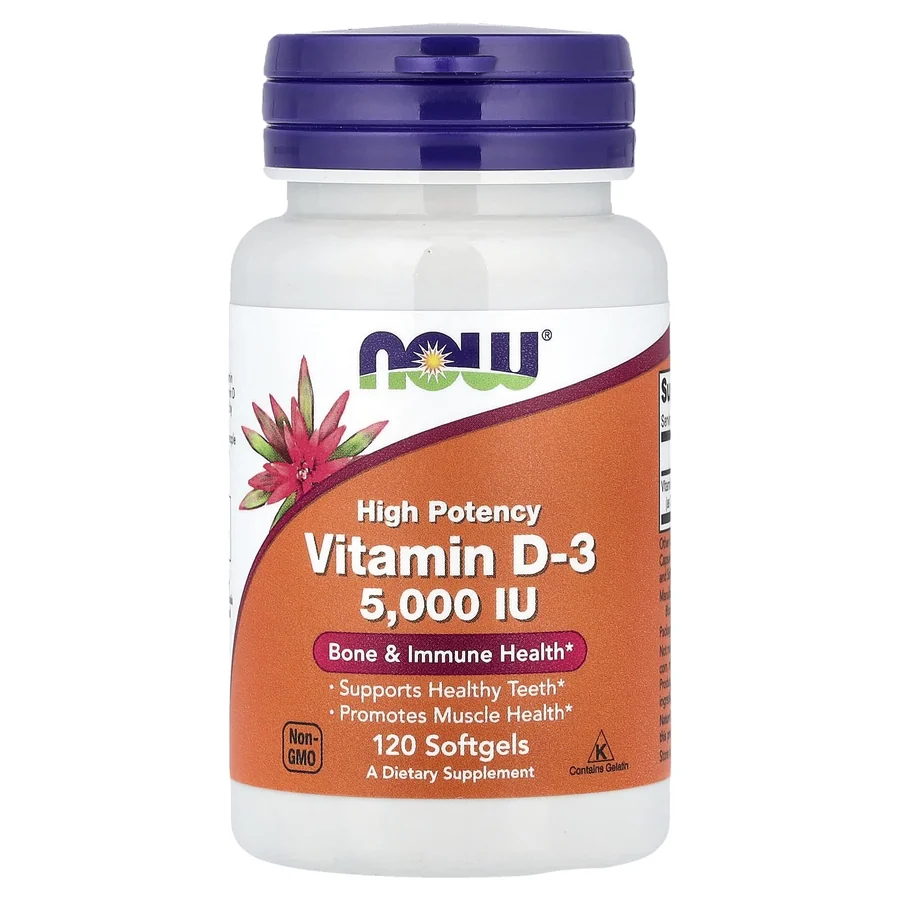
NOW Vitamin D3 5000 IU
Vitamin D3 5,000 IU · 120 softgels
D3 125 mcg (5,000 IU) per label serving.
- Amount
- D3 125 mcg (5,000 IU)
- Format
- Softgels
- Review basis
- Label-based analysis
Good fit
adults specifically looking for a high-potency D3 softgel from a familiar mainstream brand at a value price
Consider another option
you want a lower daily dose, a vegan option, a fish-gelatin softgel, or public batch-by-batch testing documents
The product, at a glance
Amounts for the reviewed label serving.
- Reviewed variant
- Vitamin D3 5,000 IU · 120 softgels
- Label serving
- 1 softgel
- Servings per reviewed pack
- 120
- Ingredients per label serving
- D3 125 mcg (5,000 IU)
- Other ingredients
- Olive oil softgel with gelatin
- Quality & testing
- Label claims: public listing notes Non-GMO, GMP Quality Assured, Halal, and Kosher-contains gelatin
Label sources & rating context
Manufacturer ↗ · Retailer label ↗
~ means approximate; — means no published value in this record. Customer ratings are the named publisher’s snapshot and may include multiple sizes or earlier formulas. The Supplement Explained Score is our source-reviewed editorial assessment out of 25, separate from customer stars. Compare the five criteria and the same intended use; the total is not a clinical ranking. Prices are dated USD offer snapshots; cost uses the reviewed pack and label serving.
- Label clarity: 5/5
- Evidence transfer: 4/5
- Safety fit: 3/5
- Quality proof: 2/5
- Value fit: 3/5
On this pageTable of Contents
- 1Supplement Explained Score
- 2Who it fits — and who should skip it
- 3What is in the formula?
- 4Strengths, tradeoffs, and red flags
- 5Price and value analysis
- 6Is there third-party testing or quality proof?
- 7Use-case fit and evidence limits
- 8What do real users often report?
- 9Alternatives to compare
- 10Alternatives to compare
- 11FAQ
Our editorial assessment
Supplement Explained Score
17/25
NOW Vitamin D3 5000 IU · Vitamin D3 5,000 IU · 120 softgels
Five equally weighted criteria, with a product-specific reason for every point. This is a buying-decision assessment, separate from customer stars and personal medical suitability.
- Label clarity 5/5
- Reviewed Vitamin D3 5,000 IU · 120 softgels: 1 softgel; 120 label servings. D3 125 mcg (5,000 IU).
- Evidence transfer 4/5
- D3 can correct inadequacy, but 5,000 IU is not universal disease prevention or a default dose for replete adults.
- Safety fit 3/5
- One softgel exceeds the adult 4,000 IU routine total-intake UL; an assessed need and monitoring may be necessary.
- Quality proof 2/5
- GMP/non-GMO/dietary claims are not an independently checked potency/purity result for this lot.
- Value fit 3/5
- The $0.06 serving snapshot is low, but the high fixed dose must match the plan rather than drive the decision.
Review basis: Published labels, manufacturer/retailer information, clinical sources and exact-product quality records where available. We did not buy, personally use or laboratory-test this product for this assessment.
Reviewed · Method v2.0 · How we assign points
Sources behind this score
Product labels and independent directory records identify a formula or testing scope. Clinical references concern ingredients or studied regimens unless the explanation explicitly matches the finished formula.
Who it fits — and who should skip it
This product may fit adults who already know they want a high-potency D3 softgel, prefer a simple formula, and care a lot about cost per serving.
- People specifically shopping for D3 alone, not a multi-ingredient bone or wellness formula
- Shoppers who want an oil-based softgel and are comfortable with bovine gelatin
- Readers whose dose choice is being guided by prior lab work or clinical advice rather than guesswork
If dose is still a question mark, start with what blood tests matter before vitamin D and how to understand a vitamin D test.
Who should skip it
- Anyone wanting a lower daily dose: 5,000 IU is not the gentlest starting point.
- Anyone avoiding bovine gelatin: this softgel is not vegetarian or vegan.
- Readers who want D3 plus K2: this is a D3-only formula, so compare it with D3 plus K2 options.
- Readers who want stronger transparency: if public third-party testing or a readable certificate of analysis matters to you, review what third-party tested means and how to read a COA.
- People chasing a broad beauty or wellness goal: if your real question is about nails, skin, or hair support overall, a single high-dose D3 product may be too narrow a place to start; see hair, skin, and nails.
What is in the formula?
The public listing describes a compact formula: vitamin D3 at 125 mcg, or 5,000 IU, in a softgel with extra virgin olive oil. Other listed ingredients include safflower oil and a bovine gelatin capsule with glycerin and water.
- Active ingredient: vitamin D3, 125 mcg per softgel
- Delivery format: oil-based softgel
- Suggested use on listing: one softgel daily with a fat-containing meal
- Not included: no vitamin K2, no magnesium, no extra blend ingredients
That simplicity can be a plus if you want vitamin D alone. If you are specifically comparing D3 by itself with combination products, see vitamin D alone vs. D3 plus K2.
Serving size
What the label asks you to take
1 softgelIt is an easy routine. That is not where the friction lives.
Real dose
How much vitamin D you actually get
125 mcg (5,000 IU)Again, this is firmly in the stronger-D3 lane.
Other ingredients
What changes product fit
Olive oil softgel with gelatinThis is simple, but it still is not a vegan product path.
Routine burden
What daily use feels like
Easy routine, very low costThis is about as low-friction as a high-potency D3 product gets.
Studied dose vs label reality
People usually search for this kind of product with questions like ‘best cheap 5000 IU vitamin D3’ or ‘NOW D3 5000 worth it.’ The practical answer is that the label is clean and cheap, but the dose still needs a reason.
Label dose
What one softgel gives you
5,000 IUYou are not buying a cautious low-dose D3 here.
What people compare
The real comparison lane
Low-dose D3 vs strong daily D3Most buyers are deciding between more conservative daily use and stronger products like this one.
Dose verdict
Does the label make sense?
Roughly aligned Strong plain D3 at a very simple doseThe label is not the problem. The problem would be using a stronger product without checking the rest of your stack.
Biggest catch
What shoppers often miss
Brand familiarity can make the dose feel more casual than it isA mainstream name can make a 5,000 IU softgel feel ordinary when it still deserves a real decision.
Strengths, tradeoffs, and red flags
- Value check: $7.25 for 120 softgels at the checked HerbsPro price.
- Simple formula: no complicated add-ons, just high-potency D3 in an oil-based softgel.
- Practical format: a one-softgel serving is easy to understand, and the listing gives a clear “take with a fat-containing meal” instruction.
- Mainstream brand familiarity: for many shoppers, a familiar brand plus basic manufacturing signals is enough for a low-cost daily staple.
What looks weak and what the tradeoffs are
The biggest tradeoff is simple: 5,000 IU is a high-potency daily dose. That may be appropriate for some people, but it is not a neutral default just because the softgels are cheap.
- High daily potency: good if that is the dose you are intentionally seeking, less good if you only wanted a modest maintenance amount.
- Bovine gelatin softgel: not a fit for vegans, vegetarians, or anyone avoiding bovine gelatin.
- Olive-oil softgel base: practical for an oil-soluble vitamin, but still a softgel format some readers prefer to avoid.
- Quality signals are solid but limited: “GMP Quality Assured” and similar label notes are helpful, but they are not the same thing as public batch-by-batch third-party certificates.
Red flags before you hit buy
These are the things most likely to make the product feel wrong later, even if the label looked fine at first.
- Skip it if you want a lower daily amount. This is still a strong-dose D3 softgel even though it looks simple.
- Skip it if gelatin is a deal-breaker. The price is not the whole story.
- Do not buy it just because NOW feels familiar. Familiar brand does not replace dose context.
Price and value analysis
HerbsPro listed the 5,000 IU, 120-softgel bottle at $7.25 on October 2, 2026, or about $0.06 per softgel. This is inexpensive, but 5,000 IU is not an appropriate routine dose for everyone. Price excludes coupons, tax, and shipping and may change.
The catch is that cheap per softgel does not automatically mean good value for you. If 5,000 IU is more than you need, a lower-dose product can be the smarter buy even if the bottle price is a little higher. The best comparison is price plus dose fit, not price alone.
Price per meaningful dose
The value is one of the clearest positives here. The better question is whether the very low cost is making you say yes to a stronger D3 product faster than you should.
Per serving
Cost each day you use it
About $0.06That is very cheap for a 5,000 IU D3 softgel from a recognizable brand.
Per 1,000 IU
Cost per useful dose unit
About $0.01The D3-per-dollar math is the main reason to shortlist it.
What you are paying for
Where the value comes from
Familiar brand + plain D3This is not a fancy formula. It is a mainstream brand executing a simple high-potency D3 bottle cheaply.
Is there third-party testing or quality proof?
The public listing notes Non-GMO, GMP Quality Assured, Halal, and Kosher-contains gelatin. Those are meaningful label signals, and they are worth checking when you review any supplement label. If you want a quick framework, see how to read a supplement label.
What these signals do not automatically tell you is whether every batch is independently tested with public-facing results. That is the gap between general manufacturing reassurance and stronger transparency. If that distinction matters to you, read what third-party tested means and how to read a COA.
What this product is really implying
The product does not need flashy claims because the price, dose, and brand name already do most of the selling. That can still lead shoppers to move too fast.
Marketing angle
What the product is trying to say
If you want strong vitamin D3 from a known brand at a great price, this is probably the easy answer.
Evidence reality
What the research actually supports
The evidence is for vitamin D as a nutrient and for dose context overall, not for this exact bottle as a uniquely better solution.
Shopping takeaway
What should decide the buy
Buy it if you already want plain 5,000 IU D3 from a familiar brand. Skip it if you are still undecided about dose, format, or overlap.
Use-case fit and evidence limits
The evidence base here is mostly about vitamin D intake, vitamin D status, and how supplementation affects blood 25-hydroxyvitamin D levels overall. It is not, in most cases, evidence on this exact branded softgel. That matters because a familiar brand can make a product feel more “proven” than the underlying evidence really is.
In plain terms: vitamin D supplements can be useful tools when intake or status is low, but the key variable is usually the right dose for the right person, not whether the bottle looks premium. Timing can matter less than consistency, though the product listing does advise taking it with a fat-containing meal; for more on practicality, see the best time to take vitamin D.
| Use Case | Evidence | Typical Time Window |
|---|---|---|
| Vitamin D maintenance routines | Moderate | Usually judged over weeks to months, not days. |
| Low-status follow-up with labs | Moderate | Often monitored over weeks to a few months with repeat testing. |
| Daily convenience | Practical fit | Convenience is immediate, but status and symptom questions take longer. |
| Hair or energy expectations | Limited / indirect | Not a fast visible-result product unless low status was part of the issue. |
What do real users often report?
Anecdotal only. This block summarizes recurring public discussion themes, not controlled research and not hands-on testing by us.
Consensus scope: 3 public source pages listed below. Themes are anecdotal and are not a representative customer sample.
Recurring positives
- Simple once-daily format
- Very low cost per day
- Preference for a plain D3 product instead of a larger blend
Recurring negatives
- Concern that 5,000 IU may be more than needed for routine daily use
- Questions about whether K2 or other nutrients should be added
- Uncertainty about taking a high-potency dose without recent labs
Overall read
- The anecdotal pattern is fairly consistent: people like the simplicity and price, but many become less certain once they start thinking about dose fit, follow-up testing, or whether a different format would suit them better.
Public threads reviewed: public Reddit discussions at reddit.com/r/Supplements/comments/1g47tpq, reddit.com/r/Supplements/comments/1haaq64, and reddit.com/r/Supplements/comments/1s45769/is_it_necessary_to_take_any_other_vitamins.
Note: These are summarized recurring themes from public user discussions. They are anecdotal and do not replace clinical evidence or professional guidance.
Alternatives to compare
If you like the idea of simple vitamin D but not this exact setup, there are a few obvious comparison paths. A lower-dose plain D3 softgel may make more sense if you want gentler daily dosing. A fish-gelatin softgel or liquid D3 drop may suit readers avoiding bovine gelatin. And if your main question is whether you want D3 alone or a paired formula, compare with D3 plus K2.
Some readers should skip product shopping for now and start with the parent guide to vitamin D instead. That is usually the better route if you are not yet sure about dose, testing, side effects, or whether you even need a standalone vitamin D product.
Alternatives at a glance
| Product | Best For | Main Tradeoff |
|---|---|---|
| Doctor's Best Vitamin D3 5000 IU | Long bottle count | Slightly higher upfront spend for a simpler long-run value story. |
| California Gold Nutrition Vitamin D3 5000 IU | Fish gelatin preference | Shorter bottle and thinner mainstream brand footprint. |
| Vitamin D Guide | Dose-first decisions | Less product-specific if the real issue is whether daily 5,000 IU belongs in your stack. |
Also see: products library.
Alternatives to compare
Compare the same decision variables across similar products: active amount, serving burden, quality proof, safety fit, and current value.
- California Gold Nutrition Vitamin D3 5000 IU Open the label-based analysis and compare the tradeoffs on the same basis.
- Doctor’s Best Vitamin D3 1000 IU Open the label-based analysis and compare the tradeoffs on the same basis.
- Doctor’s Best Vitamin D3 5000 IU Open the label-based analysis and compare the tradeoffs on the same basis.
FAQ
Is 5,000 IU a high daily dose?
Yes. This product is clearly positioned as high potency. NIH guidance lists 4,000 IU per day as the tolerable upper intake level for most adults, which is one reason dose decisions should be personalized rather than automatic.
Should I take this with food?
The public listing says to take one softgel daily with a fat-containing meal. That matches the product’s oil-based softgel format and is a practical way to use it.
Does NOW Vitamin D3 5000 IU include K2?
No. Based on the public listing, this is a vitamin D3-only product. If you specifically want a paired formula, compare with vitamin D alone vs. D3 plus K2.
Is this product vegetarian or vegan?
No. The softgel capsule is listed as bovine gelatin, so it is not suitable for vegetarian or vegan use.
What quality signals are actually shown on the listing?
The public listing notes Non-GMO, GMP Quality Assured, Halal, and Kosher-contains gelatin. Those are useful signals, but they are not the same as public batch-by-batch third-party test results.
What should I compare before buying?
Compare five things: dose, form, capsule source, whether you want D3 alone or a combo product, and how much transparency you expect around testing. It is also smart to review vitamin D side effects and when to talk to a clinician before choosing a high-potency daily product.
References
- NOW Foods Vitamin D-3, High Potency, 125 mcg (5,000 IU), 120 Softgels listing
- NIH Office of Dietary Supplements: Vitamin D Fact Sheet for Consumers
- NIH Office of Dietary Supplements: Vitamin D Fact Sheet for Health Professionals
- NCCIH: Vitamin D Important at Every Age
- Reddit discussion source 1
- Reddit discussion source 2
- Reddit discussion source 3
Editorial information
Reviewed for Trust
- Publisher: Supplement Explained Editorial Team
- Review model: Editorial evidence review; clinician review is shown only when a named clinician is listed.
- Last reviewed: October 7, 2026
- Last updated: October 7, 2026
- Editorial Policy | How We Review Evidence | Research Process | Disclaimer
- Use: Informational only. Not personal medical advice.
Public review mining
What users tend to say across public reviews
This is a synthesis of recurring public-review themes, not our own clinical test and not a copied review feed. Individual results vary, and retailer reviews can be biased by self-selection.
Common praise
- Users commonly choose NOW vitamin D because it is inexpensive, widely available, and easy to fit into a routine.
- The 5,000 IU strength is attractive to people who have been told to use a higher-dose D3 product.
- Softgel format and brand familiarity are recurring practical reasons for purchase.
Common friction
- The dose is not a casual default; 5,000 IU should be interpreted with lab context and clinician guidance when used long term.
- User reviews cannot prove correction of deficiency without 25(OH)D blood test context.
- People comparing D3 alone vs D3/K2 should not treat K2 as automatically necessary for every user.
Reader takeaway: Best interpreted as a high-dose, low-friction D3 product where the key decision is lab-guided need rather than brand popularity.
Review mining date: June 5, 2026. Status: public-review synthesis; not personally tested unless a separate hands-on note appears on this page.
Continue your decision
If this product is not an obvious fit, use one of these routes instead of leaving the decision unfinished.
- Vitamin D guide Use the canonical guide for vitamin D dosing context, testing, and D3/K2 tradeoffs.
- All product analyses Browse the full product analysis library for alternatives and category comparisons.
- Supplement Explained Score See how label clarity, evidence transfer, safety fit, quality proof, and value fit are scored.
- Interaction checklist Check common combination risks before stacking supplements or medications.