
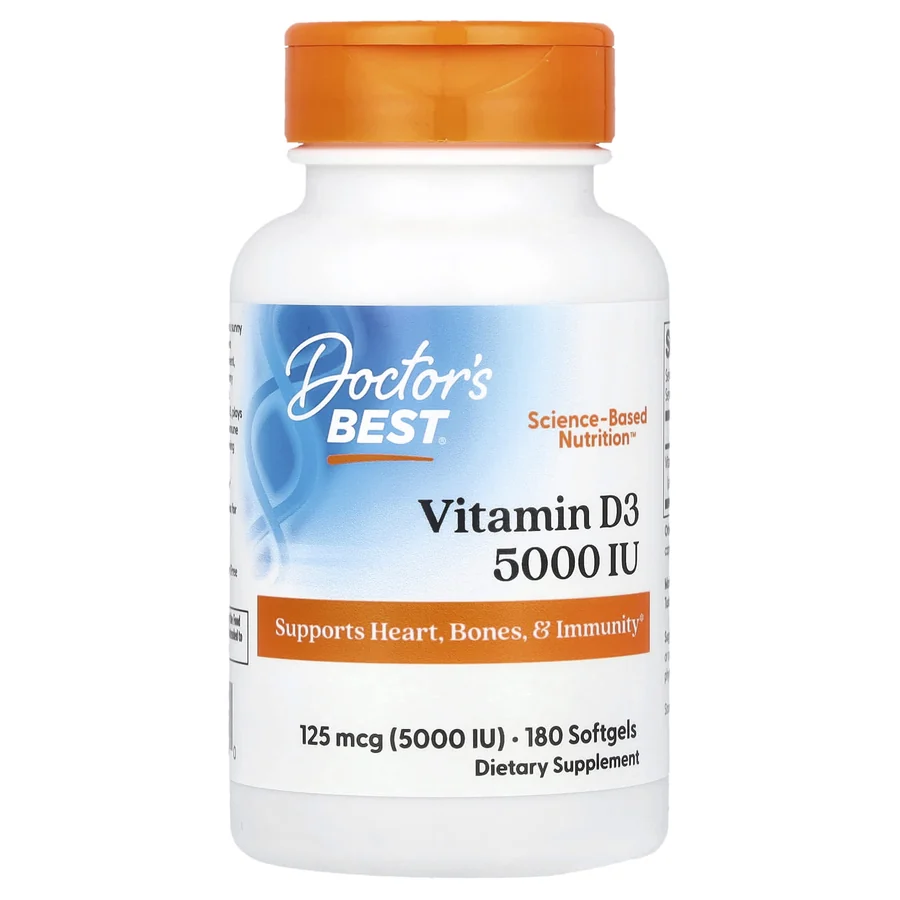
Doctor's Best Vitamin D3 5000 IU
Vitamin D3 5,000 IU · 180 softgels
D3 125 mcg (5,000 IU) per label serving.
- Amount
- D3 125 mcg (5,000 IU)
- Format
- Softgels
- Review basis
- Label-based analysis
Good fit
Adults who already know they want a simple, higher-potency daily vitamin D3 and like a long bottle count.
Consider another option
You want a lower dose, a vegan capsule, a D3 plus K2 formula, or a product page with more visible third-party verification.
The product, at a glance
Amounts for the reviewed label serving.
- Reviewed variant
- Vitamin D3 5,000 IU · 180 softgels
- Label serving
- 1 softgel
- Servings per reviewed pack
- 180
- Ingredients per label serving
- D3 125 mcg (5,000 IU)
- Other ingredients
- Extra virgin olive oil; gelatin softgel; glycerin; purified water
- Quality & testing
- Label claims: Public label notes list Non-GMO, Gluten Free, and Soy Free
Label sources & rating context
~ means approximate; — means no published value in this record. Customer ratings are the named publisher’s snapshot and may include multiple sizes or earlier formulas. The Supplement Explained Score is our source-reviewed editorial assessment out of 25, separate from customer stars. Compare the five criteria and the same intended use; the total is not a clinical ranking. Prices are dated USD offer snapshots; cost uses the reviewed pack and label serving.
- Label clarity: 5/5
- Evidence transfer: 4/5
- Safety fit: 3/5
- Quality proof: 2/5
- Value fit: 3/5
On this pageTable of Contents
- 1Supplement Explained Score
- 2Who it fits — and who should skip it
- 3What is in the formula?
- 4Strengths, tradeoffs, and red flags
- 5Price and value analysis
- 6Is there third-party testing or quality proof?
- 7Use-case fit and evidence limits
- 8What do real users often report?
- 9Alternatives to compare
- 10Alternatives to compare
- 11FAQ
Our editorial assessment
Supplement Explained Score
17/25
Doctor's Best Vitamin D3 5000 IU · Vitamin D3 5,000 IU · 180 softgels
Five equally weighted criteria, with a product-specific reason for every point. This is a buying-decision assessment, separate from customer stars and personal medical suitability.
- Label clarity 5/5
- Reviewed Vitamin D3 5,000 IU · 180 softgels: 1 softgel; 180 label servings. D3 125 mcg (5,000 IU).
- Evidence transfer 4/5
- D3 addresses a relevant gap; a 5,000 IU label is not evidence of better outcomes for every adult.
- Safety fit 3/5
- The amount exceeds the adult routine total-intake UL; count stacked D and review calcium/kidney-related conditions.
- Quality proof 2/5
- Non-GMO/gluten/soy claims identify dietary positioning, not independent finished-softgel verification.
- Value fit 3/5
- A long 180-softgel supply can be excessive for an unassessed high-dose routine; no matched fresh USD cost is recorded.
Review basis: Published labels, manufacturer/retailer information, clinical sources and exact-product quality records where available. We did not buy, personally use or laboratory-test this product for this assessment.
Reviewed · Method v2.0 · How we assign points
Sources behind this score
Product labels and independent directory records identify a formula or testing scope. Clinical references concern ingredients or studied regimens unless the explanation explicitly matches the finished formula.
Who it fits — and who should skip it
- Adults who already know they want a single-ingredient D3 softgel rather than a multi-ingredient blend.
- People who prefer a long-count bottle and do not want to reorder often.
- Shoppers focused on value first, as long as they are comfortable with the 5,000 IU strength.
- People who have already discussed vitamin D intake or blood levels with a clinician and were told a higher-potency option may be reasonable.
If your main question is timing rather than brand choice, our guide on the best time to take vitamin D may be more useful than a product page.
Who should skip it
- Anyone who wants a lower-dose daily product.
- Anyone who wants a vegan or vegetarian capsule.
- Anyone who specifically wants vitamin D paired with K2.
- Anyone who prefers a product with more visible third-party verification on the listing itself.
- Anyone who has had problems with higher-dose vitamin D use and wants a more cautious plan.
If you are unsure whether vitamin D is appropriate for you, or you have a history of side effects, read more on vitamin D side effects and when to talk to a clinician.
What is in the formula?
- Active ingredient: Vitamin D3 125 mcg per softgel, equal to 5,000 IU.
- Suggested use on the public listing: One softgel daily with food.
- Other ingredients: Extra virgin olive oil, gelatin, glycerin, and purified water.
- Bottle size: 180 softgels.
- Label notes shown publicly: Non-GMO, Gluten Free, Soy Free.
The formula is intentionally minimal. There is no bundled K2, magnesium, or other add-on ingredient. That keeps the label simple, but it also means this product will not answer every vitamin D question for every buyer.
Serving size
What the label asks you to take
1 softgel dailyThe routine is very easy. The dose is the part that needs more thought.
Real dose
How much vitamin D you actually get
125 mcg (5,000 IU)This is a stronger daily D3 softgel, not a light maintenance option.
Other ingredients
What changes product fit
Softgel with olive oil baseSimple formula, but still not a vegan product path.
Routine burden
What daily use feels like
Easy routine, strong doseThe bottle is easy to live with if the dose already makes sense for you.
Studied dose vs label reality
A low price is not a reason to choose 5,000 IU of vitamin D daily. Whether that dose is appropriate depends on your vitamin D status, total intake, and clinical advice.
Label dose
What one softgel gives you
5,000 IUThat is high enough that overlap with other products matters fast.
What people compare
The real dose fork
1,000 IU vs 5,000 IU is the common splitMost shoppers are really deciding whether they want a smaller daily amount or a stronger bottle like this one.
Dose verdict
Does the label make sense?
Roughly aligned Makes sense if high-potency D3 is the planThe label is not pretending to be something else. The risk is buying the dose too casually because the value looks good.
Biggest catch
What the label does not solve
Cheap price does not answer the dose questionThis bottle is easy to justify on cost alone, but the real buy-or-skip call is still about fit.
Strengths, tradeoffs, and red flags
- Simple label: One main ingredient and a short list of supporting ingredients makes this easy to compare against other D3 products.
- High potency: 5,000 IU is a meaningful dose for people who have already decided a higher-potency product is appropriate.
- Long count: At one softgel per day, 180 servings covers roughly six months.
- Practical softgel format: Vitamin D is fat-soluble, so an olive-oil softgel is a familiar and convenient format.
- Reasonable value: The combination of low public price and large bottle count is the clearest selling point.
What looks weak and what the tradeoffs are
The main tradeoff is dose flexibility. A 5,000 IU softgel is convenient if that is the strength you want, but it is less flexible if you are unsure about dose, just starting out, or only want a modest daily amount.
- High daily potency can be too much for some people: This is not the most conservative entry point for vitamin D.
- Not vegetarian or vegan: The softgel uses gelatin.
- No especially distinctive certification layer shown on the public listing: The visible quality signals are mostly label simplicity and the brand’s stated claims, rather than a prominently highlighted third-party test badge or posted certificate.
- No built-in extras: Some shoppers prefer a D3 plus K2 formula, while others want D alone. If you are unsure, compare vitamin D alone vs D3 plus K2.
Red flags before you hit buy
These are the things most likely to make the product feel wrong later, even if the label looked fine at first.
- Skip it if you are still unsure about dose. A cheap 5,000 IU bottle is still a 5,000 IU bottle.
- Skip it if you already take multivitamins or bone formulas with vitamin D. Overlap is the easiest mistake here.
- Do not treat the long bottle count like proof of better value for everybody. It is only good value if the dose truly fits your plan.
Price and value analysis
No matched fresh USD serving-cost benchmark was available for the score review. The reviewed Vitamin D3 5,000 IU · 180 softgels supplies 180 label servings of D3 125 mcg (5,000 IU), using 1 softgel per serving. A long 180-softgel supply can be excessive for an unassessed high-dose routine; no matched fresh USD cost is recorded.
The more relevant comparison is not just bottle price, but price per serving at the dose you actually need. If 5,000 IU is more than you want, a cheaper-looking bottle is not automatically the better deal. A lower-dose product or a different format can be smarter if it better matches your plan.
Price per meaningful dose
This product wins the comparison when shoppers care about long bottle count and low per-softgel cost. The fair question is whether cheap high-potency D3 is actually the lane you meant to be in.
Per serving
Cost each day you use it
About $0.06That is why this bottle gets attention so fast.
Per 1,000 IU
Cost per useful dose unit
About $0.01The D3-per-dollar math is strong here.
What you are paying for
Where the value comes from
Long-count plain D3This is not a premium-blend story. It is basic strong D3 at a very low daily cost.
Is there third-party testing or quality proof?
The public listing gives a few basic quality signals: a simple ingredient list plus label notes for Non-GMO, Gluten Free, and Soy Free. That is helpful, but it is not the same thing as a prominently posted third-party test result or certificate of analysis.
We did not see an especially distinctive verification layer in the cited public listing, so readers who prioritize testing transparency should compare labels carefully. Our guides on how to read a supplement label, what third-party tested means, and how to read a COA can help you pressure-test a product beyond the front label.
What this product is really implying
The product quietly implies that if you want 5,000 IU, there is no good reason to pay more somewhere else. That is a tempting pitch, but only after you are sure 5,000 IU is really what you wanted.
Marketing angle
What the product is trying to say
This is the obvious value buy for high-potency daily vitamin D3.
Evidence reality
What the research actually supports
The evidence is about vitamin D intake and status overall, not a special advantage for this exact bottle over any other plain D3 softgel.
Shopping takeaway
What should decide the buy
Buy it if you already know you want strong plain D3. Compare lower-dose or combo formulas first if you are still figuring that out.
Use-case fit and evidence limits
The evidence base here is mainly about vitamin D intake, vitamin D status, and how vitamin D supplementation can affect 25(OH)D levels overall. It is not mostly about this exact branded softgel specifically.
| Use Case | Evidence | Typical Time Window |
|---|---|---|
| Vitamin D maintenance routines | Moderate | Usually judged over weeks to months, not overnight. |
| Low-status follow-up with labs | Moderate | Often monitored over weeks to a few months with repeat testing. |
| Wintertime low-sun routines | Practical fit | Use-case logic is immediate, but status changes still take time. |
| General wellbeing expectations | Mixed | Response varies and is often narrower than marketing implies. |
In plain English, this product makes the most sense when the format and dose already fit your situation: a simple daily D3 softgel, taken with food, in a high-potency amount. If you are not sure whether you need that strength, blood work may matter more than brand choice. See what blood tests matter before vitamin D and our vitamin D test explainer for context.
What do real users often report?
Anecdotal only. This block summarizes recurring public discussion themes, not controlled research and not hands-on testing by us.
Consensus scope: 3 public source pages listed below. Themes are anecdotal and are not a representative customer sample.
Recurring positives
- Users often like the simplicity of one daily softgel, the easy-to-understand label, and the value of a long-count bottle. For people who already know they want a stronger D3 product, convenience is the main upside.
Recurring negatives
- Some users in public discussions say higher-dose vitamin D can feel like too much for them, or that they are unsure whether they should be taking 5,000 IU daily at all. Confusion about whether to add K2 or magnesium also comes up often.
Overall read
- The general pattern is simple: buyers who are confident about dose tend to appreciate this kind of product, while buyers who are still guessing about dose often do better with more context first, a lower strength, or blood-test guidance.
Public threads reviewed: Anecdotal public discussion on Reddit: thread 1, thread 2, thread 3.
Note: These are summarized recurring themes from public user discussions. They are anecdotal and do not replace clinical evidence or professional guidance.
Alternatives to compare
If this product feels close but not quite right, the best alternative depends on what you are trying to improve.
- If price is everything: A lower-cost store-brand or generic vitamin D3 softgel can make sense when you mainly want the cheapest workable D3 option.
- If 5,000 IU feels too aggressive: A lower-dose vitamin D product is often the better starting point.
- If you want a combined formula: Compare D alone against paired formulas in vitamin D alone vs D3 plus K2.
- If you are still not sure what you should buy: The parent vitamin D guide may be more useful than any single product page because it helps with dose, format, testing, and expectations first.
Alternatives at a glance
| Product | Best For | Main Tradeoff |
|---|---|---|
| NOW Vitamin D3 5000 IU | Lower-cost mainstream value | Shorter bottle and bovine gelatin. |
| California Gold Nutrition Vitamin D3 5000 IU | Lower upfront cost | Shorter bottle and fish gelatin instead of olive-oil simplicity. |
| Vitamin D Guide | Dose-first decisions | Less product-specific if the real question is whether 5,000 IU is too much for your routine. |
Also see: product coverage.
Alternatives to compare
Compare the same decision variables across similar products: active amount, serving burden, quality proof, safety fit, and current value.
- California Gold Nutrition Vitamin D3 5000 IU Open the label-based analysis and compare the tradeoffs on the same basis.
- Doctor’s Best Vitamin D3 1000 IU Open the label-based analysis and compare the tradeoffs on the same basis.
- NOW Vitamin D3 5000 IU Open the label-based analysis and compare the tradeoffs on the same basis.
FAQ
Is 5,000 IU of vitamin D3 a high dose?
Yes. For many adults, 5,000 IU is a higher-potency daily amount rather than a casual default. The NIH fact sheets are a better starting point than marketing copy if you are trying to judge whether this strength makes sense for you.
How many servings are in this bottle?
The cited public listing shows 180 softgels and 180 servings, with one softgel daily.
Does this product contain oil?
Yes. The public listing says the softgel uses extra virgin olive oil, which is a practical fit for a fat-soluble vitamin like D.
Should you take it with food?
The public listing says one softgel daily with food. If you want more on timing and routine, see the best time to take vitamin D.
Is this a good choice if you do not know your vitamin D status?
Not always. If you are unsure whether you need a higher-potency product, a blood test and a clinician conversation can be more useful than guessing. See how the vitamin D test works and when to talk to a clinician.
Do you need K2 or magnesium with this product?
Not automatically. This product is just vitamin D3, and official guidance focuses mainly on vitamin D intake and status rather than a universal need to combine it with other supplements. If this is your main question, compare vitamin D alone vs D3 plus K2.
Is this product vegetarian or vegan?
No. The listed softgel ingredients include gelatin, so it is not suitable for vegan users and likely not a fit for many vegetarians either.
References
- Doctor’s Best Vitamin D3 125 mcg 5,000 IU 180 Softgels product listing
- NIH Office of Dietary Supplements: Vitamin D Consumer Fact Sheet
- NIH Office of Dietary Supplements: Vitamin D Health Professional Fact Sheet
- NCCIH: Vitamin D Important at Every Age
- Reddit discussion 1
- Reddit discussion 2
- Reddit discussion 3
Editorial information
Reviewed for Trust
- Publisher: Supplement Explained Editorial Team
- Review model: Editorial evidence review; clinician review is shown only when a named clinician is listed.
- Last reviewed: October 7, 2026
- Last updated: October 7, 2026
- Editorial Policy | How We Review Evidence | Research Process | Disclaimer
- Use: Informational only. Not personal medical advice.
Continue your decision
If this product is not an obvious fit, use one of these routes instead of leaving the decision unfinished.
- Vitamin D guide Use the canonical guide for vitamin D dosing context, testing, and D3/K2 tradeoffs.
- All product analyses Browse the full product analysis library for alternatives and category comparisons.
- Supplement Explained Score See how label clarity, evidence transfer, safety fit, quality proof, and value fit are scored.
- Interaction checklist Check common combination risks before stacking supplements or medications.