
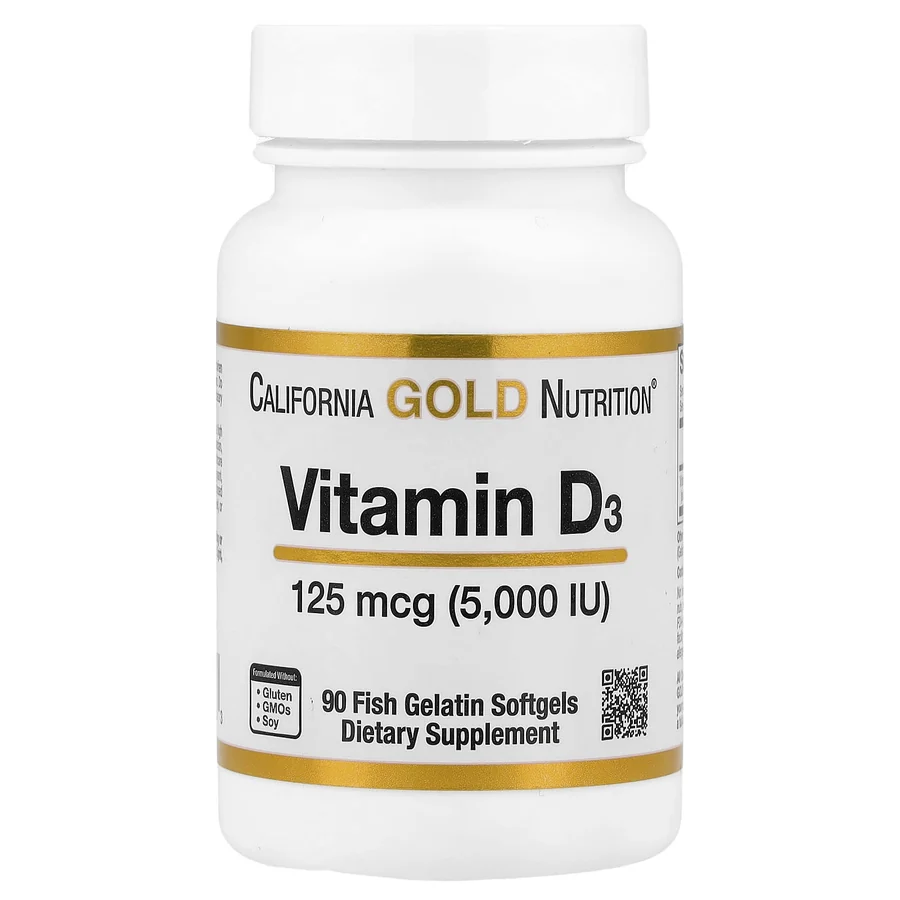
California Gold Nutrition Vitamin D3 5000 IU
Vitamin D3 5,000 IU · 90 fish-gelatin softgels
D3 125 mcg (5,000 IU) per label serving.
- Amount
- D3 125 mcg (5,000 IU)
- Format
- Softgels
- Review basis
- Label-based analysis
Good fit
adults who already want a standalone, higher-potency D3 at a value price
Consider another option
you want vegan or fish-free softgels, a lower daily dose, or you already take other vitamin D products
The product, at a glance
Amounts for the reviewed label serving.
- Reviewed variant
- Vitamin D3 5,000 IU · 90 fish-gelatin softgels
- Label serving
- 1 softgel
- Servings per reviewed pack
- 90
- Ingredients per label serving
- D3 125 mcg (5,000 IU)
- Other ingredients
- Safflower oil; tilapia fish-gelatin softgel; vegetable glycerin; purified water
Label sources & rating context
~ means approximate; — means no published value in this record. Customer ratings are the named publisher’s snapshot and may include multiple sizes or earlier formulas. The Supplement Explained Score is our source-reviewed editorial assessment out of 25, separate from customer stars. Compare the five criteria and the same intended use; the total is not a clinical ranking. Prices are dated USD offer snapshots; cost uses the reviewed pack and label serving.
- Label clarity: 5/5
- Evidence transfer: 4/5
- Safety fit: 3/5
- Quality proof: 2/5
- Value fit: 3/5
On this pageTable of Contents
- 1Supplement Explained Score
- 2Who California Gold Nutrition Vitamin D3 5000 IU may fit
- 3Who should skip California Gold Nutrition Vitamin D3 5000 IU
- 4California Gold Nutrition Vitamin D3 5000 IU label facts snapshot
- 5What is in the formula?
- 6Price and value analysis
- 7Is there third-party testing or quality proof?
- 8Use-case fit and evidence limits
- 9Better alternatives or compare this instead
- 10FAQ
Our editorial assessment
Supplement Explained Score
17/25
California Gold Nutrition Vitamin D3 5000 IU · Vitamin D3 5,000 IU · 90 fish-gelatin softgels
Five equally weighted criteria, with a product-specific reason for every point. This is a buying-decision assessment, separate from customer stars and personal medical suitability.
- Label clarity 5/5
- Reviewed Vitamin D3 5,000 IU · 90 fish-gelatin softgels: 1 softgel; 90 label servings. D3 125 mcg (5,000 IU).
- Evidence transfer 4/5
- D3 has a nutrient-gap role; 5,000 IU is not a universal preventive dose or a guarantee of improved health.
- Safety fit 3/5
- The amount exceeds the adult routine total-intake UL; fish-gelatin source and total D intake also matter.
- Quality proof 2/5
- The exact fish-gelatin formula is identified, but an independent finished-lot potency/purity result was not verified.
- Value fit 3/5
- One softgel is convenient; a high fixed amount should be justified before buying a 90-serving supply.
Review basis: Published labels, manufacturer/retailer information, clinical sources and exact-product quality records where available. We did not buy, personally use or laboratory-test this product for this assessment.
Reviewed · Method v2.0 · How we assign points
Sources behind this score
Product labels and independent directory records identify a formula or testing scope. Clinical references concern ingredients or studied regimens unless the explanation explicitly matches the finished formula.
Who California Gold Nutrition Vitamin D3 5000 IU may fit
- Readers who already know they want a standalone D3 rather than a multi-ingredient formula
- Shoppers focused on value and low cost per serving
- Adults following a clinician-guided or lab-guided plan that calls for a higher-potency D3
- People who are fine with fish gelatin and want one-softgel simplicity
If you are choosing vitamin D based on bloodwork, it helps to understand which blood tests matter before vitamin D and how a vitamin D test is usually interpreted.
Who should skip California Gold Nutrition Vitamin D3 5000 IU
- Anyone who wants a vegan, vegetarian, or fish-free formula
- Anyone already taking a multivitamin, bone formula, or another supplement with vitamin D unless they have checked the total dose carefully
- Readers who want a gentler daily amount rather than a high-potency softgel
- People who are not sure whether they need vitamin D at all, or are unsure what dose makes sense for them
- Shoppers whose real goal is a broader beauty formula rather than a single nutrient, such as those browsing hair, skin, and nails supplements
If dose, side effects, lab interpretation, or medicine interactions feel unclear, use our guide on when to talk to a clinician before starting a higher-potency vitamin D product.
What is in the formula?
- Vitamin D3: 125 mcg (5,000 IU) per softgel
- Carrier oil: safflower oil
- Softgel shell: fish gelatin from tilapia, vegetable glycerin, purified water
- Allergen note: contains fish (tilapia)
The public listing says to take one softgel daily with food and not to exceed one daily. It also warns against casually combining it with other vitamin D supplements. That matters because this is a high-potency, single-nutrient product, not a flexible low-dose maintenance option.
Studied dose vs label reality
This page is answering the questions people actually search: ‘is 5,000 IU too much’, ‘do I need this much D3’, and ‘is this just cheap vitamin D or a smart buy?’ The short answer is that the label is clear, but the dose still needs a real reason.
Label dose
What one softgel gives you
5,000 IUThat is not a low-dose everyday product. It is a deliberate higher-potency D3 softgel.
What people compare
The real dose question
1,000 to 5,000 IU is the common comparison laneMost shoppers are really comparing lower daily maintenance doses against stronger products like this one.
Dose verdict
Does the label make sense?
Roughly aligned Works if high-potency D3 is actually the planThe main concern is choosing a high dose before knowing whether you need it.
Biggest catch
What the label does not solve
Cheap does not mean low-riskA low bottle price can make people forget they are still taking a meaningful vitamin D dose every day.
What looks strong
No matched fresh USD serving-cost benchmark was available for the score review. The reviewed Vitamin D3 5,000 IU · 90 fish-gelatin softgels supplies 90 label servings of D3 125 mcg (5,000 IU), using 1 softgel per serving. One softgel is convenient; a high fixed amount should be justified before buying a 90-serving supply.
Second, the formula is simple. There is no long ingredient story here. You are getting D3 in a softgel with oil, plus a clearly disclosed fish gelatin shell. For some shoppers, that simplicity is a plus because it makes label comparison easier.
Third, the listing gives some useful quality signals. iTested Verified and the stated FDA-registered, third-party audited, cGMP-compliant facility are positive checkpoints, even if they are not the same thing as proving this product is clinically superior to other D3 softgels.
What looks weak and what the tradeoffs are
The biggest tradeoff is the dose. A 5,000 IU softgel is convenient if that is the amount you mean to take. It is less convenient if you are still figuring out your target intake. The NIH lists 4,000 IU per day as the tolerable upper intake level for most adults, so this product sits above that general reference point and deserves a deliberate choice rather than a casual purchase.
The second tradeoff is the softgel source. Fish gelatin from tilapia will be a quick no for vegans, vegetarians, some religious dietary patterns, and anyone avoiding fish allergens.
The third tradeoff is that it is D3 only. That is a strength if you want a clean standalone product. It is a weakness if you specifically want a combo formula, such as D3 with K2. If that is your question, compare vitamin D alone versus D3 plus K2 before you buy.
Red flags before you hit buy
These are the things most likely to make the product feel wrong later, even if the label looked fine at first.
- Skip it if you already take vitamin D somewhere else. This is the kind of product that makes overlap easy to miss.
- Skip it if fish gelatin is a hard no. The price is not worth it if the softgel source already rules it out.
- Do not buy it just because it is cheap. The real question is whether 5,000 IU fits your plan, not whether the bottle price looks great.
Price and value analysis
No matched fresh USD serving-cost benchmark was available for the score review. The reviewed Vitamin D3 5,000 IU · 90 fish-gelatin softgels supplies 90 label servings of D3 125 mcg (5,000 IU), using 1 softgel per serving. One softgel is convenient; a high fixed amount should be justified before buying a 90-serving supply.
That is the main reason to shortlist it. You are not paying for a complex formula, a broad premium-certification story, or extra ingredients. You are paying for a plain, high-potency D3 softgel at a low cost.
The catch is simple: a cheap bottle is only a good value if the dose actually fits your needs. If 5,000 IU is more than you mean to take, the low per-softgel price can be misleading.
Cost for the reviewed serving
No matched fresh USD serving-cost benchmark was available for the score review. The reviewed Vitamin D3 5,000 IU · 90 fish-gelatin softgels supplies 90 label servings of D3 125 mcg (5,000 IU), using 1 softgel per serving. One softgel is convenient; a high fixed amount should be justified before buying a 90-serving supply.
Is there third-party testing or quality proof?
The public listing states that this product is iTested Verified and produced in an FDA-registered, third-party audited, cGMP-compliant facility. Those are useful manufacturing and verification signals.
Still, quality language can sound stronger than many shoppers realize. A smart comparison includes the supplement facts panel, serving size, allergen disclosure, and any testing details that are actually shown. If you want a practical framework, read how to read a supplement label, what third-party tested means, and how to read a COA.
What this product is really implying
The product is basically implying one thing: why pay more when this already gives you a high D3 dose in a simple softgel? That is partly fair and partly where people get too casual.
Marketing angle
What the product is trying to say
This is the easy smart value buy if you want standalone vitamin D3.
Evidence reality
What the research actually supports
The evidence is about vitamin D status and intake overall, not special proof that this exact cheap softgel is the right call for every shopper.
Shopping takeaway
What should decide the buy
Buy it if you already know you want plain high-potency D3. Compare lower-dose or combo options first if you are still sorting that out.
Use-case fit and evidence limits
The evidence base here is mainly about vitamin D intake, vitamin D status, and how D3 affects blood 25(OH)D overall, not head-to-head clinical trials of this exact branded softgel. Official NIH and NCCIH guidance supports vitamin D as an important nutrient, and vitamin D3 products are commonly used to help raise or maintain vitamin D status when intake or levels are low.
That means this product makes the most sense when you have already decided that a high-potency D3-alone product fits your plan. If you are still deciding between D3 alone, D3 plus K2, or a different dose, this exact bottle may be less helpful than the broader category guides. You can also check best time to take vitamin D and vitamin D side effects for basic decision support.
| Use Case | Evidence | Typical Time Window |
|---|---|---|
| Vitamin D maintenance routines | Moderate | Usually judged over weeks to months, not days. |
| Low-status follow-up with labs | Moderate | Often monitored over weeks to a few months with repeat testing. |
| Hair or mood expectations | Limited / indirect | Not a fast cosmetic or mood product unless low status was part of the picture. |
| Simple daily compliance | Practical fit | Convenience shows up right away even if meaningful outcome questions take longer. |
Better alternatives or compare this instead
If you want a better-known national brand, compare this product against labels from brands such as Nature Made or NOW Foods. For some shoppers, broader brand familiarity is worth more than the lowest possible price.
You may also want a different format entirely: a lower-potency daily D3, a vegan capsule, or a D3-plus-K2 product. And if you are not yet sure which version of vitamin D fits your goals, the broader vitamin D guide may be more useful than this specific product page.
Alternatives at a glance
| Product | Best For | Main Tradeoff |
|---|---|---|
| NOW Vitamin D3 5000 IU | Mainstream high-potency value | Bovine gelatin and slightly stronger brand familiarity tradeoffs. |
| Doctor's Best Vitamin D3 5000 IU | Long bottle count | Less budget-friendly upfront than the 90-count option. |
| Vitamin D Guide | Source-first decisions | Less product-specific if you are still deciding whether 5,000 IU daily makes sense at all. |
FAQ
Is 5,000 IU too much for daily use?
It is a higher-potency daily amount. The NIH lists 4,000 IU per day as the tolerable upper intake level for most adults, so a 5,000 IU softgel should be a deliberate choice rather than a casual default. If you are unsure, start with your vitamin D test context and talk to a clinician when needed.
Can I take this with a multivitamin?
Only after checking the total vitamin D you are already getting. The public listing says not to exceed one softgel daily and not to casually combine it with other vitamin D supplements. This is one of the easiest ways people accidentally overshoot their intended intake.
Is this product vegetarian or vegan?
No. The softgel uses fish gelatin from tilapia, and the listing names fish as an allergen.
Does it contain vitamin K2?
No. This is a standalone vitamin D3 product. If you are specifically comparing combo formulas, see vitamin D alone versus D3 plus K2.
When should I take it?
The public directions say one softgel daily with food. If you want a more practical timing guide, read best time to take vitamin D.
What quality signals does it have?
The public listing says iTested Verified and says the product is produced in an FDA-registered, third-party audited, cGMP-compliant facility. Those are helpful signals, but they are not the same as proof that this product works better than other D3 softgels.
Editorial information
Reviewed for Trust
- Publisher: Supplement Explained Editorial Team
- Review model: Editorial evidence review; clinician review is shown only when a named clinician is listed.
- Last reviewed: October 7, 2026
- Last updated: October 7, 2026
- Editorial Policy | How We Review Evidence | Research Process | Disclaimer
- Use: Informational only. Not personal medical advice.
Public review mining
What users tend to say across public reviews
This is a synthesis of recurring public-review themes, not our own clinical test and not a copied review feed. Individual results vary, and retailer reviews can be biased by self-selection.
Common praise
- Public review themes emphasize affordability, small softgels, and convenience for people intentionally using a 5,000 IU D3 product.
- Large review volume makes practical themes like swallowability, packaging, and perceived value easier to detect.
- iTested-style documentation is a useful label-support signal when comparing house-brand value products.
Common friction
- The 5,000 IU dose should not be treated as a casual default; lab context and duration matter.
- User reviews cannot prove deficiency correction unless blood test context is available.
- Fish gelatin softgels may not fit vegan or fish-avoidant users.
Reader takeaway: Best interpreted as a low-cost high-dose D3 option where the key question is whether 5,000 IU is actually appropriate for the reader.
Review mining date: June 5, 2026. Status: public-review synthesis; not personally tested unless a separate hands-on note appears on this page.
Continue your decision
If this product is not an obvious fit, use one of these routes instead of leaving the decision unfinished.
- Vitamin D guide Use the canonical guide for vitamin D dosing context, testing, and D3/K2 tradeoffs.
- All product analyses Browse the full product analysis library for alternatives and category comparisons.
- Supplement Explained Score See how label clarity, evidence transfer, safety fit, quality proof, and value fit are scored.
- Interaction checklist Check common combination risks before stacking supplements or medications.