Magnesium Product Analysis
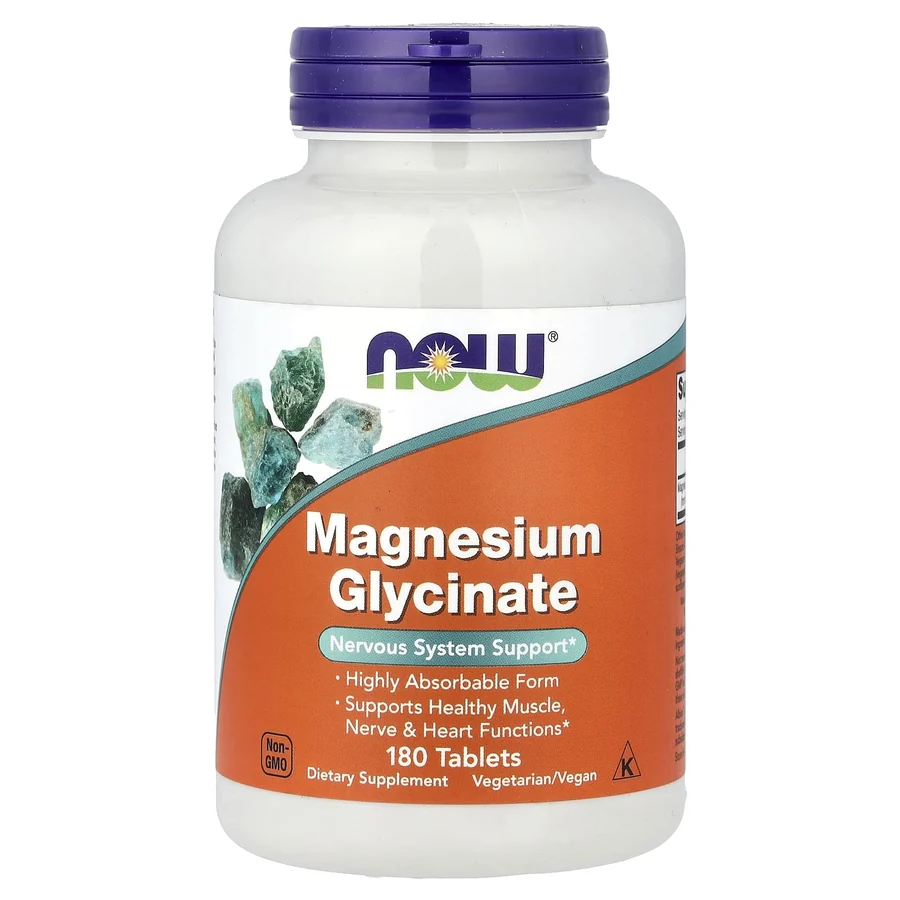
NOW Magnesium Glycinate Tablets
Value-first magnesium glycinate tablets with clear serving math and practical tablet tradeoffs.
NOW Magnesium Glycinate Tablets
This label-based review covers NOW Magnesium Glycinate Tablets, a practical value-oriented option for people who want a clearly labeled chelated magnesium form without paying premium-powder prices. Its strongest points are the magnesium bisglycinate form, straightforward labeling, and solid quality markers. Its main tradeoffs are a 2-tablet serving, possible 4-tablet day at the high end of suggested use, and a longer tablet ingredient list than minimalist powders.
- Best for: shoppers who want a branded magnesium bisglycinate tablet with decent value and clear label details
- Skip if: you want a one-pill routine, a powder, or the shortest possible other-ingredients list
- Form: magnesium bisglycinate, listed as Albion TRAACS
- Active dose: 200 mg magnesium per 2-tablet serving
- Servings: 90 servings in the 180-tablet bottle
- Quality markers: Intertek GMP, Non-GMO, Vegan, Kosher, Halal; made and quality tested in the USA with globally sourced ingredients
- Price band: mid-range to value-oriented for a chelated magnesium tablet
Retail check
Check the current iHerb listing before you decide.
Use the retailer page for the latest price, package size, availability, shipping details, and label images. We use this as a decision check, not a guarantee that the product is right for you.
Live retailer page, new tab, affiliate disclosure below.
Disclosure: This button may use a retail partner link. If it does, Supplement Explained may earn a commission at no extra cost to you.
Quick decision snapshot
A fast read before the full analysis: score, evidence boundary, safety gate, value snapshot, and quality proof are separated so the page does not blur marketing claims into a buying recommendation.
Affiliate note: retailer links may earn a commission at no extra cost to you. The score is editorial decision support, not a medical recommendation or guarantee of results.
On this pageTable of Contents
- 1Who NOW Magnesium Glycinate Tablets may fit
- 2Who should skip NOW Magnesium Glycinate Tablets
- 3NOW Magnesium Glycinate Tablets label facts snapshot
- 4Supplement Explained Score
- 5What is in the formula?
- 6Price and value analysis
- 7Is there third-party testing or quality proof?
- 8Use-case fit and evidence limits
- 9What do real users often report?
- 10Better alternatives or compare this instead
- 11FAQ
Quick decision snapshot
NOW Magnesium Glycinate Tablets make the most sense if you want a value-oriented chelated magnesium tablet and can tolerate a 2-tablet serving. The main tradeoff is routine burden: the label can become 4 tablets per day at the higher suggested use.
- Proof status: label-based editorial review, not a hands-on lab test.
- Active dose: 200 mg elemental magnesium per 2 tablets.
- Compare next: Thorne Magnesium Bisglycinate if powder format and NSF Certified for Sport matter more.
Who NOW Magnesium Glycinate Tablets may fit
This product may fit people who want a branded magnesium glycinate tablet with a clear elemental magnesium dose, a recognizable chelated raw material, and a price that stays in the practical range.
It is especially reasonable for buyers who are comparing many products and do not want to overpay for “premium” positioning when the core question is simply form, dose, and quality markers. It may also fit people who want to stay within the magnesium forms most often discussed for gentler everyday use, while still wanting a mainstream brand.
If your main question is routine and timing rather than brand, see the best time to take magnesium.
Who should skip NOW Magnesium Glycinate Tablets
Skip this one if you know you dislike multi-tablet serving sizes, want the shortest possible ingredient list, or would rather use a powder. A premium powder-style magnesium glycinate product can make more sense if you care more about fewer excipients than about lowest daily cost.
You may also want to skip it if you are highly sensitive to tablet extras, if you already know another magnesium form suits you better, or if your main goal is finding the cheapest possible magnesium regardless of chelation. In that case, the broader comparison path through our magnesium guide and the form comparison on magnesium citrate vs oxide may be more useful.
If you take prescription medicines or have a medical reason to be cautious with supplements, read magnesium interactions, the Magnesium Interaction Timing Map, and when to talk to a clinician before deciding.
NOW Magnesium Glycinate Tablets label facts snapshot
This is the label reality check: how many tablets you take, how much magnesium you actually get, and what changes if you follow the higher end of the suggested use.
Serving size
What the label actually asks you to take
2 tabletsThat is the listed serving. The official directions also allow 2 tablets one to two times daily, which can turn this into a 4-tablet day for some people.
Real magnesium
How much magnesium you really get
200 mg per 2 tabletsThat is the number worth comparing, not just the chelate name on the front of the bottle.
Other ingredients
What changes the formula feel
Standard tablet helpersHydroxypropyl cellulose, croscarmellose sodium, coating ingredients, and similar tablet helpers are part of the routine here. Nothing shocking, but not minimalist either.
Routine burden
What daily use feels like
2 to 4 tablets a dayThis is the real tradeoff. A label can look clean on paper and still feel annoying if you hate multi-tablet routines.
Supplement Explained Score
Supplement Explained Score: 24/25. This is our editorial buying-decision score, not a lab certificate, customer rating, medical recommendation, or proof that the product will work for you.
Review proof status: Label-based editorial review. This page uses label facts, retailer data, public quality signals, and evidence boundaries. The score still varies by product, but it is not a hands-on lab test or personal-use review unless the page explicitly says so.
- Label clarity: 5/5 Serving size, form, active amount, and formula details are checked before the page makes a fit judgment.
- Evidence transfer: 5/5 The page should separate ingredient-level evidence from claims about this exact bottle.
- Safety fit: 5/5 Skip points, interaction context, tolerance issues, and clinician-referral language carry extra weight.
- Quality proof: 5/5 Specific testing, certification, COA, or clearly stated missing-proof language is stronger than vague quality wording.
- Value fit: 4/5 Price, cost per useful serving, serving burden, and premium-versus-budget fit are weighed together.
How to read it: the score summarizes label clarity, evidence fit, safety fit, quality proof, and value fit. It does not replace current labels, clinician input, or first-hand product proof.
See the score method or use the interaction checklist before combining products.
Why this product exists on the site
At SupplementExplained, we use the product library to help readers decide when a supplement looks like a sensible buy, when it looks merely average, and when the tradeoffs are not worth it. This page exists because NOW Magnesium Glycinate Tablets sit in a useful middle ground: not a luxury pick, not a bargain-bin form, but a practical product many people will compare while shopping the broader magnesium category.
It also makes a good case study in how to read magnesium labels well. The form signal looks good, the price is fairly approachable, and the tradeoffs are the kind that matter in daily use. If you want the broader framework we use, see how to compare magnesium products.
What is in the formula?
The official NOW Foods listing for the 180-tablet size shows a serving size of 2 tablets, 90 servings per container, and 200 mg of magnesium from magnesium bisglycinate labeled as Albion TRAACS.
That form matters. “Bisglycinate” generally means magnesium is chelated to glycine, and “Albion TRAACS” is a recognized branded mineral chelate name. Those are positive form signals because they suggest attention to raw material identity. They are not proof this is automatically the best magnesium for every person.
The suggested use on the official page is 2 tablets 1 to 2 times daily with food. In real life, that means some users may take 2 tablets per day, while others may take 4 tablets per day depending on the plan they follow.
The other ingredients listed on the official page are hydroxypropyl cellulose, stearic acid from a vegetable source, croscarmellose sodium, vegetarian coating, silicon dioxide, and magnesium stearate from a vegetable source. None of that is unusual for a compressed tablet, but it is more than you would see in a bare-bones powder.
Studied dose vs label reality
A lot of real searches here are basically “is 200 mg enough?” or “how many magnesium glycinate pills do I need?” The best answer is still use-case first, not magic-number first.
Label dose
What one full serving gives you
200 mgThis is a reasonable everyday number for shoppers who want a mainstream magnesium add-on, not a mega-dose product.
What people compare
The dose range shoppers really look at
100 to 350 mg is the common laneThat does not mean every goal uses the same number. It means people usually compare total supplemental magnesium, stomach comfort, and how many pills the label asks for.
Dose verdict
Does the serving hold up?
Roughly aligned Reasonable for a daily magnesium tabletThe label dose is fine. The real friction is serving burden, not obvious underdosing.
Biggest catch
What shoppers often miss
2 tablets is not the whole storyIf you follow the upper end of the suggested use, the cost and pill count change fast. That matters more than the glycinate buzzword.
What looks strong
Clear form and dose. The label states 200 mg magnesium per 2-tablet serving from magnesium bisglycinate. That is easier to interpret than labels that bury the actual magnesium amount or rely on vague blend language.
Good raw-material signal. Albion TRAACS and bisglycinate together are meaningful positives for shoppers who specifically want a chelated magnesium form. That does not guarantee better outcomes for everyone, but it does help explain why this product attracts attention.
Useful quality markers. The official listing includes Intertek GMP, Non-GMO, Vegan, Kosher, and Halal, and states the product is made and quality tested in the USA with globally sourced ingredients.
Value positioning. For the 180-tablet bottle, the official listing shows a sale price of $25.59 and regular price of $31.99. For a chelated magnesium tablet from a large mainstream brand, that reads as reasonable rather than inflated.
What looks weak and what the tradeoffs are
The serving is not light. A full serving is 2 tablets, and the suggested use allows 2 tablets 1 to 2 times daily. If you end up following the higher end, this can become a 4-tablet-per-day routine. For some buyers, that is the main deal-breaker.
The ingredient list is standard, not minimalist. The tablet format requires several tableting ingredients. Many people do fine with that. Some do not care for it and would rather pay more for a powder with fewer extras.
“Chelated” does not mean “best for all.” Magnesium bisglycinate is often favored by shoppers who want a gentler form, but tolerance still varies by person, dose, timing, and total intake. If you are deciding between common forms, our comparison of magnesium glycinate vs citrate can help.
Tablet burden is a real user-experience issue. Even when the formula is sensible on paper, daily convenience matters. If you strongly prefer drink mixes or capsules, a tablet-based product may feel less appealing over time.
Red flags before you hit buy
These are the friction points most likely to make you regret the purchase later, even if the label looked good at first.
- Skip this if you already know you hate multi-pill routines. The label is honest, but the real-world burden is still there.
- Do not confuse Albion TRAACS with a magic outcome upgrade. It is a useful form signal, not proof that this tablet will work better for your sleep or stress questions.
- If you want the shortest ingredient list possible, this is not that product. It is a normal compressed tablet, not a stripped-down powder.
Price and value analysis
The official NOW Foods page lists the 180-tablet bottle at $25.59 on sale and $31.99 regular price. With 90 servings per container, that works out to roughly $0.28 per serving at the sale price and about $0.36 per serving at the regular price.
That is why this product lands in the mid-range to value-oriented lane for a chelated magnesium tablet. It is not the absolute cheapest way to buy magnesium, but it is cheaper than many premium-positioned glycinate products while still giving a form many buyers actively want.
At the suggested use of 2 tablets once daily, the bottle lasts about 90 days. At 2 tablets twice daily, it lasts about 45 days. That difference matters more than the sticker price when comparing real monthly cost.
Price per meaningful dose
This product looks value-friendly, but the fair way to compare it is by elemental magnesium delivered and by how many tablets you will really use.
Per serving
Cost at the sale price
About $0.28That is solid for a branded chelated magnesium tablet if you stay at one serving a day.
Per 100 mg
Cost per usable magnesium amount
About $0.14This lets you compare it more fairly with labels that split magnesium into smaller per-tablet numbers.
What changes the value
The part shoppers miss
4-tablet days double the burnIf you use the higher end of the directions, the bottle empties much faster. That changes the “good value” story in a hurry.
Is there third-party testing or quality proof?
The official listing gives several useful quality and fit markers: Intertek GMP, Non-GMO, Vegan, Kosher, and Halal. It also states that the product is made and quality tested in the USA with globally sourced ingredients.
The practical nuance is that these markers are helpful, but they do not all mean the same thing. GMP-style verification speaks to manufacturing practices and quality systems. It is not automatically the same as a USP or NSF finished-product certification seal. If that distinction matters to you, read USP vs NSF and what third-party tested means.
If you want a deeper look at what testing can and cannot tell you for magnesium supplements, see magnesium testing explained.
What this product is really implying
The strongest sales pitch here is simple: chelated magnesium, decent quality markers, and a mainstream brand price. The point of this block is to show where that pitch is fair and where it gets stretched.
Marketing angle
What the bottle wants to be
A clean, trustworthy glycinate-style magnesium tablet from a big brand, without the premium price pain.
Evidence reality
What the science really supports
The support is mainly for magnesium intake and form-level logic. It is not special proof that this exact NOW tablet is the best option for cramps, sleep, or feeling calm.
Shopping takeaway
What should decide the buy
If you want a mainstream glycinate tablet and the pill count does not bother you, this is a practical option. If pill count does bother you, the rest of the story barely matters.
Use-case fit and evidence limits
| Use Case | Evidence | Typical Time Window |
| General magnesium support | Moderate | Usually days to weeks in routine use. |
| Bedtime routine support | Mixed | Often framed as days to a few weeks. |
| Muscle comfort or cramp questions | Mixed | Depends on cause, intake, and context. |
| Label-first value shopping | Practical fit | Decision usually happens immediately, not after a long study window. |
Strength of evidence: the evidence base is much stronger for magnesium as an essential mineral and supplement category than for this exact branded product. NIH fact sheets are the right grounding here: they explain magnesium’s role, dietary context, upper-limit issues for supplements, and medication interactions. They do not tell us that this specific NOW tablet is superior to all alternatives.
Where the form may matter: many shoppers choose glycinate or bisglycinate because they want a chelated form that is often discussed as easier to tolerate than some other options. That is a reasonable preference, but it is still a preference supported more by form-level thinking and user experience than by proof that one branded glycinate tablet is universally best.
Where the use case gets overstated: magnesium products are often bought around concerns like cramping, relaxation, or sleep. Those are common reasons people shop, but this page is not a claim that this product has direct evidence for those outcomes. If that is your main goal, read the broader context in our sleep guide and keep expectations grounded.
Safety context: the NIH fact sheets note that high supplemental magnesium intake can cause gastrointestinal side effects in some people. If that is a concern, see can magnesium cause diarrhea. If medicines, kidney caution, or mineral stacking are involved, use the Magnesium Interaction Timing Map. Tolerance varies by dose, form, and person.
What do real users often report?
Anecdotal only. This block summarizes recurring public discussion themes, not controlled research and not hands-on testing by us.
Recurring positives
- Price is often seen as fair for a chelated magnesium tablet from a familiar brand.
- Albion TRAACS on the label gives some shoppers more confidence in the form story.
- The 200 mg per serving math feels straightforward for label-comparison shoppers.
Recurring negatives
- A 2-tablet serving is still a deal-breaker for some people.
- The longer tablet ingredient list feels less clean than powders or minimalist capsules.
- People disagree heavily on whether glycinate tablets feel meaningfully different from cheaper options.
Overall read
- The conversation is mostly about value, brand familiarity, and tablet tolerance.
- Very little in user chatter suggests this is a uniquely special product beyond practical label-fit reasons.
Public threads reviewed: good pure magnesium bisglycinate, best magnesium brand, best magnesium glycinate brand.
Note: These are summarized recurring themes from public user discussions. They are anecdotal and do not replace clinical evidence or professional guidance.
Better alternatives or compare this instead
If your main priority is fewer excipients and no tablet burden, a premium magnesium glycinate powder is the clearest alternative path. You will often pay more, but you may prefer the simpler formula and adjustable serving style.
If your main priority is value over chelation, start with the broader form comparisons rather than forcing yourself into glycinate. Our guides on magnesium glycinate vs citrate and magnesium citrate vs oxide are usually the fastest way to decide whether you should even stay in the glycinate lane.
If you are still shopping broadly, go back to the main magnesium guide or browse the wider product hub.
Alternatives at a glance
| Product | Best For | Main Tradeoff |
| Thorne Magnesium Bisglycinate | Powder + certification-focused buyers | Much higher price band. |
| Doctor's Best High Absorption Magnesium | Budget-first magnesium shoppers | Higher potential pill burden. |
| Magnesium Guide | Form-first decisions | Less product-specific if you already want a tablet. |
FAQ
Short answers to the questions readers most often ask before taking the next step.
How much magnesium is in a serving?
The official NOW Foods listing shows 200 mg of magnesium per 2-tablet serving.
Is this really magnesium glycinate?
The label lists magnesium bisglycinate, specifically Albion TRAACS. In everyday shopping language, people often group bisglycinate under the magnesium glycinate umbrella.
How many tablets would I take in a day?
The official suggested use is 2 tablets 1 to 2 times daily with food. That means some people may take 2 tablets daily, while others may take 4.
Is this a good value?
For a chelated magnesium tablet, it looks fairly priced rather than premium-priced. The 180-tablet bottle is listed at $25.59 on sale and $31.99 regular on the official site, which is why we describe it as value-oriented within the glycinate category.
Does it have a minimalist ingredient list?
No. It uses several standard tablet ingredients, including hydroxypropyl cellulose, stearic acid, croscarmellose sodium, vegetarian coating, silicon dioxide, and magnesium stearate. That is normal for tablets, but it is not a minimalist powder-style formula.
Does Albion TRAACS mean it is automatically the best magnesium?
No. It is a positive form and sourcing signal, but it does not prove this product is the best fit for every person. The best choice still depends on tolerance, dosing preference, budget, and whether you prefer tablets, capsules, or powders.
Could this form be easier on the stomach?
Some shoppers choose glycinate or bisglycinate for that reason, but responses vary. The broader evidence is about magnesium forms and supplemental magnesium in general, not a guarantee about this exact product for every user.
References
- NOW Foods: Magnesium Glycinate Tablets
- NIH ODS: Magnesium Fact Sheet for Consumers
- NIH ODS: Magnesium Fact Sheet for Health Professionals
- Reddit discussion: looking for good pure magnesium bisglycinate
- Reddit discussion: what is the best magnesium brand
- Reddit discussion: best magnesium glycinate brand
Source and evidence mapPage purpose, source types, and evidence boundaries
Page purpose: NOW Magnesium Glycinate Tablets is reviewed as a label-based supplement decision page. It separates dose, value, quality proof, evidence boundaries, safety context, and retailer checks instead of treating the product page as a medical recommendation.
Sources are used for grounding and verification context. A source can support label accuracy, regulatory context, or evidence type without proving that a specific supplement is right for every reader.
- NIH Office of Dietary Supplements Official nutrient fact sheetPrimary fact sheets for vitamins, minerals, upper limits, deficiency context, and safety notes.
- FDA Dietary Supplements Official regulatory sourceU.S. regulatory context for supplement labels, claims, safety alerts, and dietary ingredient rules.
- PubMed Biomedical literature / PMID sourceBiomedical literature database used for human trials, systematic reviews, safety papers, and PMID-backed references.
- Supplement Explained Sources and Methodology External referenceSite-specific rules for evidence weighting, update cadence, citations, and uncertainty language.
- www.reddit.com External referencePage-specific external reference used for additional source context.
Evidence and freshness facts
These page-level claims keep the practical takeaway, evidence type, freshness risk, and source context together so readers can see what is supported, what may change, and where extra caution is needed.
| Claim | Evidence type | Freshness risk | Source context |
|---|---|---|---|
| NOW Magnesium Glycinate Tablets is evaluated as a buying decision, not as a medical recommendation. | Editorial method + product page analysis | Medium | Current page, score method, retailer snapshot |
| Ingredient-level evidence does not automatically prove that this exact product will work for an individual reader. | Evidence boundary | Low | How we review evidence + linked sources |
| Price, stock, serving count, and label presentation can change after publication. | Retailer/product metadata | High | Retailer page and page modified date |
Freshness note: Last page update: May 21, 2026. Product prices, labels, stock, regulations, and safety context can change; use current labels and clinician input where relevant.
What changed in this update
This page was tightened to make the buy-or-skip decision faster, plainer, and less dependent on brand hype.
- Serving-burden math was moved up. The page now makes the 2-to-4-tablet routine easier to see before you buy.
- Value was reframed around elemental magnesium. The per-100-mg comparison is clearer than bottle price alone.
- TRAACS language was put in context. It stays as a useful form signal, not a shortcut to “best magnesium” claims.
Reviewed for Trust
- Publisher: Supplement Explained Editorial Team
- Review model: Editorial evidence review; clinician review is shown only when a named clinician is listed.
- Last reviewed: May 21, 2026
- Last updated: May 21, 2026
- Editorial Policy | How We Review Evidence | Research Process | Disclaimer
- Use: Informational only. Not personal medical advice.