
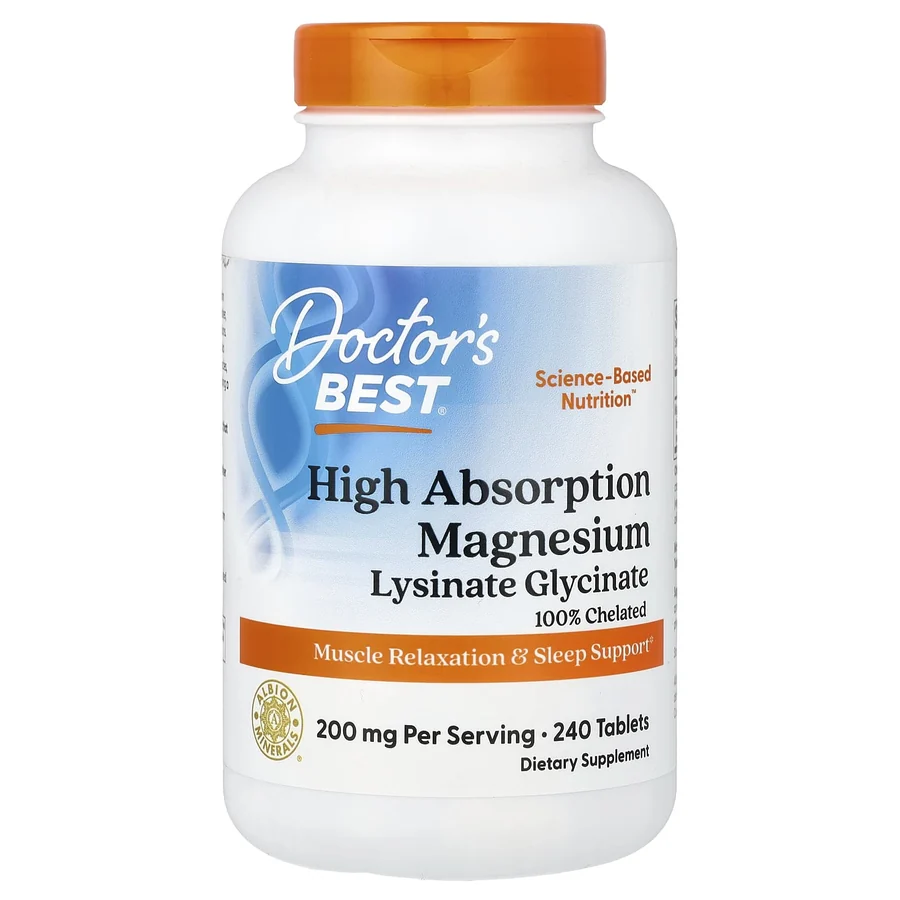
Doctor's Best High Absorption Magnesium
High Absorption Magnesium · 240 tablets
Elemental magnesium 200 mg; lysinate/glycinate chelate per label serving.
- Amount
- Elemental magnesium 200 mg; lysinate/glycinate chelate
- Format
- Tablets
- Review basis
- Label-based analysis
Check medicines and kidney-health concerns before use. Review the safety context.
Good fit
price-conscious shoppers who want a chelated magnesium from a widely available brand
Consider another option
you want a one-pill routine, a very minimalist formula, or a clear NSF/USP-style certification signal
The product, at a glance
Amounts for the reviewed label serving.
- Reviewed variant
- High Absorption Magnesium · 240 tablets
- Label serving
- 2 tablets
- Servings per reviewed pack
- 120
- Ingredients per label serving
- Elemental magnesium 200 mg; lysinate/glycinate chelate
- Other ingredients
- Microcrystalline cellulose, croscarmellose sodium, magnesium stearate (vegetable source), stearic acid, hydroxypropyl cellulose, silicon dioxide, hypromellose
- Storage
- Store in a cool dry place
- Quality & testing
- Label claims: Albion TRAACS, 100% chelated claim, Non-GMO, Gluten Free, Soy Free, Vegan
Label sources & rating context
Manufacturer ↗ · Retailer label ↗
~ means approximate; — means no published value in this record. Customer ratings are the named publisher’s snapshot and may include multiple sizes or earlier formulas. The Supplement Explained Score is our source-reviewed editorial assessment out of 25, separate from customer stars. Compare the five criteria and the same intended use; the total is not a clinical ranking. Prices are dated USD offer snapshots; cost uses the reviewed pack and label serving.
- Label clarity: 5/5
- Evidence transfer: 4/5
- Safety fit: 4/5
- Quality proof: 3/5
- Value fit: 4/5
On this pageTable of Contents
- 1Supplement Explained Score
- 2Who it fits — and who should skip it
- 3What is in the formula?
- 4Strengths, tradeoffs, and red flags
- 5Price and value analysis
- 6Is there third-party testing or quality proof?
- 7Use-case fit and evidence limits
- 8What do real users often report?
- 9Alternatives to compare
- 10Alternatives to compare
- 11FAQ
Our editorial assessment
Supplement Explained Score
20/25
Doctor's Best High Absorption Magnesium · High Absorption Magnesium · 240 tablets
Five equally weighted criteria, with a product-specific reason for every point. This is a buying-decision assessment, separate from customer stars and personal medical suitability.
- Label clarity 5/5
- Reviewed High Absorption Magnesium · 240 tablets: 2 tablets; 120 label servings. Elemental magnesium 200 mg; lysinate/glycinate chelate.
- Evidence transfer 4/5
- Two tablets provide 200 mg elemental magnesium; chelation identifies the form but does not establish guaranteed sleep or superior clinical outcomes.
- Safety fit 4/5
- The amount is below the adult supplemental UL; renal impairment, GI tolerance and medicine spacing still matter.
- Quality proof 3/5
- Albion TRAACS identifies a branded chelate; it is not an independent finished-tablet purity or potency certificate.
- Value fit 4/5
- The $0.23 200 mg serving snapshot and 120-serving pack are clear; the comparable NOW tablet snapshot is $0.22.
Review basis: Published labels, manufacturer/retailer information, clinical sources and exact-product quality records where available. We did not buy, personally use or laboratory-test this product for this assessment.
Reviewed · Method v2.0 · How we assign points
Sources behind this score
Product labels and independent directory records identify a formula or testing scope. Clinical references concern ingredients or studied regimens unless the explanation explicitly matches the finished formula.
Who it fits — and who should skip it
This product may fit you if you want a chelates-first magnesium at a reasonable price and you are comfortable with tablets. It also makes sense for shoppers who like familiar brands and want a formula that is easy to find again.
It can be a practical choice if your main goal is general magnesium supplementation rather than chasing a luxury formula. If you are exploring form differences more broadly, our parent guide to magnesium is the better first stop.
It may be especially appealing if you have already decided that a glycinate-leaning chelate is the type of magnesium you want, but you do not want to pay top-tier pricing for a cleaner-feeling capsule option.
Who should skip it
You may want to skip this one if you dislike taking multiple tablets, prefer very short inactive-ingredient lists, or want a product that prominently shows stronger verification language. If that sounds like you, read how to compare magnesium products, USP vs NSF, and what third-party tested means before deciding.
You should also be more careful if you take medicines that can interact with magnesium, or if you have a reason to ask whether magnesium supplementation is appropriate for you. Our guide to magnesium interactions, the Magnesium Interaction Timing Map, and this page on when to talk to a clinician are the right next reads.
What is in the formula?
The official 240-tablet Doctor’s Best listing shows 100 mg elemental magnesium per tablet. A labeled serving is 2 tablets, which provides 200 mg elemental magnesium from 2,000 mg magnesium lysinate glycinate chelate.
The brand states that this formula is made with Albion TRAACS and is 100% chelated. In plain English, that means the magnesium is provided in an amino-acid-chelated form rather than a simpler salt like oxide. That is a formulation choice many shoppers look for, but it is not proof that this exact product will work better for every person.
The official listing also highlights Non-GMO, Gluten Free, Soy Free, and Vegan.
For inactive ingredients, the cited iHerb 120-tablet listing includes microcrystalline cellulose, croscarmellose sodium, magnesium stearate, stearic acid, hydroxypropyl cellulose, silicon dioxide, and hypromellose. That does not make it unusual for a tablet, but it does mean this is not a stripped-down minimalist formula.
Real magnesium
How much magnesium you really get
200 mg per 2 tabletsEach tablet gives 100 mg elemental magnesium. That makes dose math pretty easy, which is one of the product’s real strengths.
Other ingredients
What changes the formula feel
Standard tablet formulaMicrocrystalline cellulose, croscarmellose sodium, coating agents, and similar tablet helpers are part of the deal. It is normal for tablets, but it is not a minimalist label.
Routine burden
What daily use feels like
Cheap serving, heavier routineThis is the classic tradeoff: the price looks good, but the experience can feel less clean or less convenient than premium capsule or powder options.
Studied dose vs label reality
A lot of shoppers land here after searching things like “best magnesium glycinate brand” or “Doctor’s Best magnesium dose.” The hard part is not reading the dose. The hard part is deciding whether the routine is worth it.
Label dose
What one serving gives you
200 mgThat is a normal, easy-to-compare amount for a daily magnesium supplement.
What people compare
The real dose question
100 to 350 mg is the common comparison laneMost buyers are comparing total supplemental magnesium, GI comfort, and cost per usable amount. They are not comparing one universally accepted “sleep dose.”
Dose verdict
Does the label hold up?
Roughly aligned Dose looks fine for basic magnesium useThe label itself is not the weak spot. The real tradeoff is the tablet count and the less premium quality-verification story.
Biggest catch
What shoppers often overlook
Cheap per serving can hide a clunky routineA product can be well-dosed and still be the wrong fit if you already know multiple tablets annoy you.
Strengths, tradeoffs, and red flags
- Matched HerbsPro snapshot, 2026-10-02: $27.80 for the reviewed pack, approximately $0.23 per label serving, before shipping, tax or discounts. The reviewed High Absorption Magnesium · 240 tablets supplies 120 label servings of Elemental magnesium 200 mg; lysinate/glycinate chelate, using 2 tablets per serving. The $0.23 200 mg serving snapshot and 120-serving pack are clear; the comparable NOW tablet snapshot is $0.22.
- The elemental dose is easy to read. You know each tablet gives 100 mg, which makes it easier to scale up or down.
- The Albion TRAACS callout adds transparency. It tells you the brand is leaning into a specific chelated ingredient identity rather than vague magnesium branding.
- Dietary-fit markers are clear. Vegan, gluten-free, soy-free, and non-GMO claims are prominently listed on the official product page.
- It comes from a familiar mainstream supplement brand. For many buyers, that lowers the friction compared with obscure marketplace listings.
What looks weak and what the tradeoffs are
- Tablet burden can be the biggest downside. The labeled serving is 2 tablets, and some retail guidance for other bottle sizes suggests 2 tablets twice daily. In practice, that can make this feel like a 4-tablet-per-day product.
- The inactive-ingredient list is longer than premium minimalist alternatives. That is common in tablets, but some shoppers strongly prefer simpler capsule formulas.
- The chelate story is a positive, not a guarantee. Albion TRAACS is a meaningful formulation signal, but it does not automatically make the product superior for sleep, muscle comfort, or tolerance in every user.
- There is no prominent NSF- or USP-style certification claim on the cited product pages. That may not matter to everyone, but it can matter a lot for athletes, highly risk-averse buyers, or people who specifically want stronger verification language.
Red flags before you hit buy
These are the friction points most likely to make you regret the purchase later, even if the label looked good at first.
- Do not buy this just because it says chelated. The Albion story is real, but it does not erase the routine burden.
- If you want stronger testing language, pause. This page’s quality story is more about ingredient identity than a big NSF-or-USP finished-product badge.
- If you need very simple labels, compare away first. This is a practical tablet, not a “cleanest possible formula” product.
Price and value analysis
HerbsPro listed the 240-tablet bottle at $27.80 on October 2, 2026. With 120 label servings, that is about $0.23 per 200 mg serving or $0.12 per tablet. Price excludes coupons, tax, and shipping and may change.
That is why this product often gets framed as a value pick. The catch is that your real cost depends on how many tablets you actually use. At 2 tablets daily, a 240-tablet bottle lasts 120 days. At 4 tablets daily, it lasts 60 days and your daily cost effectively doubles.
So yes, the low price-per-serving story is real. But if you strongly prefer a lower pill burden, a more expensive capsule may still feel like the better value in daily life.
Price per meaningful dose
The reason this product keeps showing up in comparisons is simple: the per-serving math is attractive. The reason people still leave it on the shelf is just as simple: the daily routine is not always attractive.
Per serving
Cost for 200 mg
About $0.17That is strong value on paper for a branded chelated magnesium product.
Per 100 mg
Cost per useful magnesium amount
About $0.09This is the cleaner comparison number when you are stacking products with different tablet counts or serving sizes.
What changes the value
Where the cheap math gets softer
Higher tablet use changes everythingIf your plan drifts toward four tablets a day, the bottle life and daily cost change fast. That is where some shoppers decide a pricier but easier format is worth it.
Is there third-party testing or quality proof?
From a formulation-transparency standpoint, the strongest signal here is the Albion TRAACS ingredient branding plus the product-page statement that the magnesium is 100% chelated. Those are useful details because they tell you more than a generic front label would.
What we do not see on the cited product pages is a prominent USP, NSF, or NSF Certified for Sport style certification claim. That does not mean the product is poor quality. It means the quality story on the public-facing pages leans more on ingredient identity and dietary claims than on the kind of third-party certification some shoppers want.
If quality verification is your deciding factor, compare this with our explainers on USP vs NSF, what third-party tested means, and magnesium testing explained.
What this product is really implying
Doctor’s Best is not making the wildest pitch in the category. The angle is more down-to-earth: chelated form, known raw material, and a fair price. That is good, but it still needs context.
Marketing angle
What the label is really selling
Chelated magnesium with Albion TRAACS, at a price that feels more sane than premium competitors.
Evidence reality
What the research can actually support
Magnesium matters. Form can matter. But the product still lives inside the same broader evidence limits as the rest of the category.
Shopping takeaway
What should decide the buy
If you want a value-first chelated tablet and do not mind the format, this works. If you want a low-friction routine, keep comparing before you spend.
Use-case fit and evidence limits
| Use Case | Evidence | Typical Time Window |
|---|---|---|
| General magnesium support | Moderate | Usually days to weeks in routine use. |
| Bedtime routine support | Mixed | Often framed as days to a few weeks. |
| Tablet-based budget routine | Practical fit | Decision shows up immediately in cost and pill burden. |
| Constipation relief | Lower-fit form | People usually compare citrate first for that goal. |
The evidence base here is mostly about magnesium as a nutrient and about magnesium forms, not about this exact branded product. The NIH fact sheets are the best grounding point: magnesium supports many basic functions in the body, and total intake matters more than brand marketing.
In practice, people often choose glycinate-leaning chelates like this when they want a form that is commonly seen as gentler than some lower-cost options. But that is a form-level preference, not a guarantee of a specific outcome. If you are comparing options, see magnesium glycinate vs citrate and magnesium citrate vs oxide.
If your main question is whether magnesium fits into an evening routine, read the best time to take magnesium and our goal guide on sleep. If your main concern is side effects, start with can magnesium cause diarrhea.
One practical note: because each tablet provides 100 mg elemental magnesium, a 4-tablet daily routine reaches 400 mg supplemental magnesium. That is one more reason to think about tolerability, your total intake, and the Magnesium Interaction Timing Map if medicines or mineral stacks are involved.
What do real users often report?
Anecdotal only. This section summarizes recurring themes from public discussion threads and user chatter. It is helpful for tradeoffs, not for proving effects.
Consensus scope: 3 public source pages listed below. Themes are anecdotal and are not a representative customer sample.
Recurring positives
- Many users describe it as a dependable value pick they would repurchase.
- The Doctor’s Best name plus Albion TRAACS branding feels reassuring to label-focused shoppers.
- People who want a cheaper chelated magnesium option often shortlist this quickly.
Recurring negatives
- Tablet format and possible higher daily tablet count are common complaints.
- Certification-minded shoppers often wish the testing story were stronger and easier to verify.
- Some people still prefer powders or simpler-looking formulas even at a higher price.
Overall read
- Discussion around this product is mainly a value-versus-convenience conversation.
- Personal effect reports are mixed, which is exactly why anecdote should stay separate from evidence.
Public threads reviewed: good pure magnesium bisglycinate, best magnesium brand, best magnesium glycinate brand for sleep.
Note: These are summarized recurring themes from public user discussions. They are anecdotal and do not replace clinical evidence or professional guidance.
Alternatives to compare
If you like the basic idea here but want something more premium and cleaner-feeling, compare this against a magnesium glycinate capsule that uses fewer inactive ingredients and makes its testing standards more visible. You will usually pay more, but you may get a simpler daily experience.
If you are still not sure which magnesium form fits your goal, skip product shopping for a minute and go back to the parent guide on magnesium. That is the better route if you are still deciding between chelates, citrate, or other forms.
And if your comparison is really about function rather than brand, start with glycinate vs citrate and citrate vs oxide.
Alternatives at a glance
| Product | Best For | Main Tradeoff |
|---|---|---|
| NOW Magnesium Glycinate Tablets | Mainstream value with broader dietary markers | Higher price per serving. |
| Thorne Magnesium Bisglycinate | Powder + NSF Certified for Sport | Much higher price band. |
| Magnesium Guide | Form-first decisions | Less specific if you already know you want a tablet. |
Alternatives to compare
Compare the same decision variables across similar products: active amount, serving burden, quality proof, safety fit, and current value.
- Garden of Life Dr. Formulated Magnesium Gummies Open the label-based analysis and compare the tradeoffs on the same basis.
- Life Extension Neuro-Mag Magnesium L-Threonate 90 Capsules Open the label-based analysis and compare the tradeoffs on the same basis.
- Nature Made Magnesium Glycinate 60 Capsules Open the label-based analysis and compare the tradeoffs on the same basis.
FAQ
Is this basically magnesium glycinate?
It is close to that lane, but the label specifically says magnesium lysinate glycinate chelate, not a plain single-ingredient glycinate label. The official serving provides 200 mg elemental magnesium from 2 tablets.
What does Albion TRAACS mean here?
It is a branded chelated mineral ingredient platform. On this product, it works as a useful transparency signal about the magnesium form, but it is not proof that this exact product will be best for every person.
How many tablets would I actually take?
The official 240-tablet Doctor’s Best page lists a 2-tablet serving. A cited iHerb listing for the 120-tablet version suggests 2 tablets twice daily. So the real-world routine can feel like anywhere from 2 to 4 tablets per day depending on the version and how you use it.
Is this a good choice if I am mainly thinking about sleep?
Maybe, but keep expectations realistic. Evidence is mostly about magnesium in general or magnesium forms in general, not this exact branded product. If sleep is your main goal, read our sleep guide and best time to take magnesium.
Can this cause diarrhea or stomach upset?
Any magnesium supplement can cause GI side effects in some people. Many shoppers choose chelated forms because they hope for a gentler experience, but that is not guaranteed. See can magnesium cause diarrhea.
Is it third-party tested like NSF or USP?
The cited product pages highlight Albion TRAACS and dietary attributes, but we did not see a prominent NSF- or USP-style certification claim on those pages. If that matters to you, read USP vs NSF and what third-party tested means.
Can magnesium interact with medicines?
Yes, it can. If you take prescription medicines or have a reason to be cautious, read magnesium interactions and when to talk to a clinician.
References
- Doctor’s Best official product listing, 240 tablets
- iHerb product listing, 120 tablets
- NIH Office of Dietary Supplements: Magnesium Consumer Fact Sheet
- NIH Office of Dietary Supplements: Magnesium Health Professional Fact Sheet
- Reddit discussion: looking for good pure magnesium bisglycinate
- Reddit discussion: what is the best magnesium brand
- Reddit discussion: best magnesium glycinate brand for sleep
Editorial information
Reviewed for Trust
- Publisher: Supplement Explained Editorial Team
- Review model: Editorial evidence review; clinician review is shown only when a named clinician is listed.
- Last reviewed: October 7, 2026
- Last updated: October 7, 2026
- Editorial Policy | How We Review Evidence | Research Process | Disclaimer
- Use: Informational only. Not personal medical advice.
Public review mining
What users tend to say across public reviews
This is a synthesis of recurring public-review themes, not our own clinical test and not a copied review feed. Individual results vary, and retailer reviews can be biased by self-selection.
Common praise
- Public review themes often mention sleep support, muscle comfort, and a gentler magnesium experience than cheaper oxide-style products.
- Value and brand familiarity are recurring reasons people shortlist this as a mainstream chelated magnesium option.
- The clear elemental magnesium amount makes it easier to compare than products that emphasize only compound weight.
Common friction
- Large tablets are a common practical complaint, so swallowability should be part of the buying decision.
- Some users prefer capsule formats or powders to reduce pill burden.
- Magnesium can still require medication spacing and kidney-context caution even when the form is marketed as gentle.
Reader takeaway: Best interpreted as a mainstream value chelated-magnesium option where pill size and medication spacing are the main checks before buying.
Review mining date: June 5, 2026. Status: public-review synthesis; not personally tested unless a separate hands-on note appears on this page.
Continue your decision
If this product is not an obvious fit, use one of these routes instead of leaving the decision unfinished.
- Magnesium guide Check forms, dose logic, tolerance issues, and who should be careful.
- All product analyses Browse the full product analysis library for alternatives and category comparisons.
- Supplement Explained Score See how label clarity, evidence transfer, safety fit, quality proof, and value fit are scored.
- Interaction checklist Check common combination risks before stacking supplements or medications.