
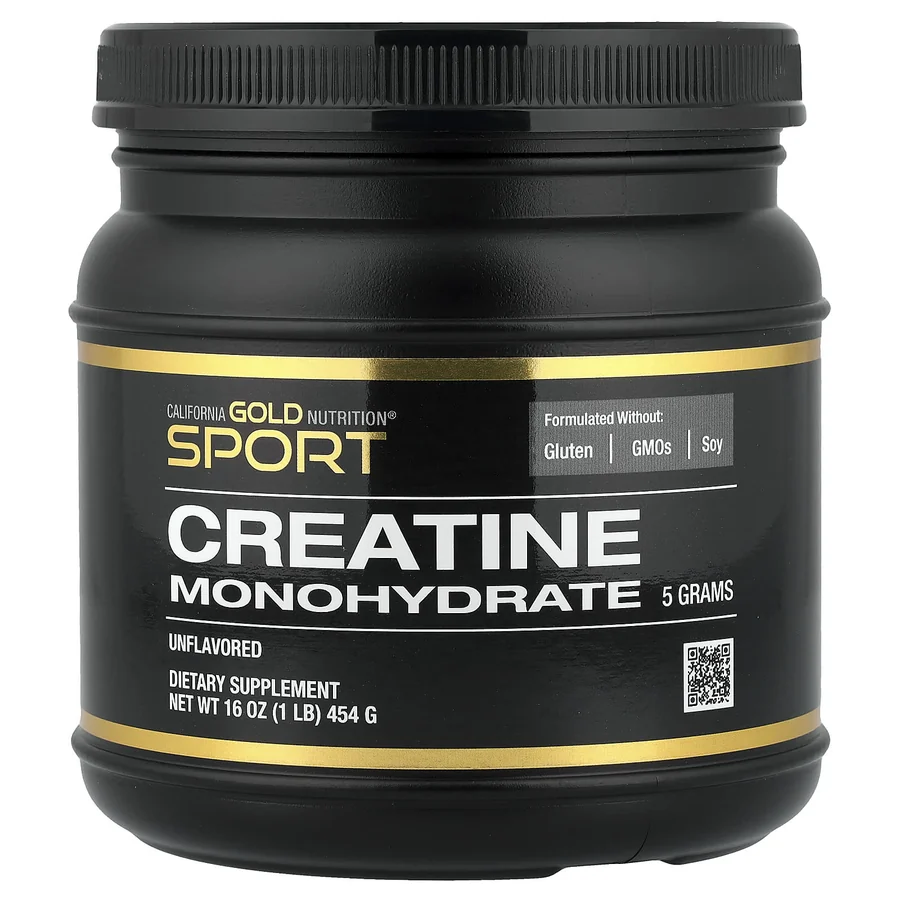
California Gold Nutrition Sport Pure Creatine Monohydrate
SPORT Pure Creatine · Unflavored · 454 g
Creatine monohydrate 5 g per label serving.
- Amount
- Creatine monohydrate 5 g
- Format
- Powder
- Review basis
- Label-based analysis
Good fit
Budget-conscious buyers who want plain creatine monohydrate powder
Consider another option
You want NSF Certified for Sport or Informed Sport style reassurance, flavored powder, or a formula beyond basic monohydrate
The product, at a glance
Amounts for the reviewed label serving.
- Reviewed variant
- SPORT Pure Creatine · Unflavored · 454 g
- Label serving
- 1 scoop (5 g)
- Servings per reviewed pack
- ~91
- Ingredients per label serving
- Creatine monohydrate 5 g
- Other ingredients
- No other ingredients listed
Label sources & rating context
Retailer label ↗ · Retailer label ↗
~ means approximate; — means no published value in this record. Customer ratings are the named publisher’s snapshot and may include multiple sizes or earlier formulas. The Supplement Explained Score is our source-reviewed editorial assessment out of 25, separate from customer stars. Compare the five criteria and the same intended use; the total is not a clinical ranking. Prices are dated USD offer snapshots; cost uses the reviewed pack and label serving.
- Label clarity: 5/5
- Evidence transfer: 5/5
- Safety fit: 4/5
- Quality proof: 2/5
- Value fit: 3/5
On this pageTable of Contents
- 1Supplement Explained Score
- 2Who California Gold Nutrition Sport Pure Creatine Monohydrate may fit
- 3Who should skip California Gold Nutrition Sport Pure Creatine Monohydrate
- 4California Gold Nutrition Sport Pure Creatine Monohydrate label facts snapshot
- 5What is in the formula?
- 6Price and value analysis
- 7Is there third-party testing or quality proof?
- 8What do real users often report?
- 9Alternatives to compare
- 10FAQ
Our editorial assessment
Supplement Explained Score
19/25
California Gold Nutrition Sport Pure Creatine Monohydrate · SPORT Pure Creatine · Unflavored · 454 g
Five equally weighted criteria, with a product-specific reason for every point. This is a buying-decision assessment, separate from customer stars and personal medical suitability.
- Label clarity 5/5
- Reviewed SPORT Pure Creatine · Unflavored · 454 g: 1 scoop (5 g); ~91 label servings. Creatine monohydrate 5 g.
- Evidence transfer 5/5
- The 5 g monohydrate serving is a close match to strong creatine research; SPORT in the name is not efficacy evidence.
- Safety fit 4/5
- Water-weight/GI changes and kidney/medication concerns still require review despite a simple formula.
- Quality proof 2/5
- No exact independent finished-product record was verified; SPORT wording alone is not certification.
- Value fit 3/5
- About 91 plain servings in 454 g support comparison, with no eligible matched current USD price.
Review basis: Published labels, manufacturer/retailer information, clinical sources and exact-product quality records where available. We did not buy, personally use or laboratory-test this product for this assessment.
Reviewed · Method v2.0 · How we assign points
Sources behind this score
Product labels and independent directory records identify a formula or testing scope. Clinical references concern ingredients or studied regimens unless the explanation explicitly matches the finished formula.
Who California Gold Nutrition Sport Pure Creatine Monohydrate may fit
- Readers who want plain creatine monohydrate and do not need bells and whistles
- People comparing value and price per serving first
- Shoppers who prefer a one-ingredient label they can read in seconds
- Anyone building a simple routine around training support and basic workout recovery goals
- People who are comfortable choosing a mainstream monohydrate powder without paying extra for premium certification positioning
Who should skip California Gold Nutrition Sport Pure Creatine Monohydrate
- Competitive athletes or cautious buyers who specifically want a sport-certification claim on the product
- People who want a flavored powder or a more polished drinking experience
- Anyone still unsure whether they want monohydrate at all, rather than another form or delivery style
- Readers who need more personalized guidance because of medical history, medications, pregnancy, breastfeeding, or clinician advice to limit supplements; start with when to talk to a clinician
Proof status for this review
This is a label-based editorial review, not a hands-on lab test of the product. We use the public product listing, Supplement Facts, serving size, active dose, price context, quality claims, and relevant ingredient evidence to judge whether the label supports the product’s positioning.
If we later add personal use notes, updated label photos, or third-party test documentation, this section should be updated so readers can tell which evidence comes from the label and which evidence comes from direct verification.
What is in the formula?
- Ingredient: Creatine monohydrate
- Amount: 5 g per serving
- Other ingredients: None listed
- Flavor: Unflavored
- Suggested use on listing: 1 rounded scoop daily
- Container size: 1 lb or 454 g
That is the entire pitch: one well-known ingredient category, one standard serving size, and no blend dressing around it. If you are deciding whether cheap plain monohydrate is enough, the Creatine Form Decision Matrix shows how to compare it with HCl, capsules, gummies, blends, and premium testing signals.
Studied dose vs label reality
People usually land here with questions like ‘best cheap creatine monohydrate’ or ‘is 5 g creatine enough?’ The simple answer is that 5 g is a very normal daily monohydrate amount, but the bigger decision is whether you want the cheapest plain tub or more testing and brand reassurance.
Label dose
What one serving gives you
5 gThat is the classic plain-creatine serving people expect from a monohydrate powder.
What people compare
The real shopping lane
3 to 5 g is the common daily laneMost buyers are not comparing mystery performance hacks. They are comparing standard daily monohydrate, price, and whether the product feels annoying to use.
Dose verdict
Does the label hold up?
Roughly aligned The dose is not the weak spotThe real question is not underdosing. It is whether plain low-cost monohydrate is enough for your priorities.
Biggest catch
What the label does not solve
No premium testing layerThe ingredient is standard. What you do not get is a stronger sports-certification or premium-trust story around it.
What looks strong
- Clean label simplicity: No sweeteners, flavors, fillers, or proprietary blend language on the listing.
- Standard ingredient choice: Creatine monohydrate is the ingredient form most often used in the evidence base, even though that evidence is about creatine monohydrate in general, not this exact branded tub.
- No matched fresh USD serving-cost benchmark was available for the score review. The reviewed SPORT Pure Creatine · Unflavored · 454 g supplies ~91 label servings of Creatine monohydrate 5 g, using 1 scoop (5 g) per serving. About 91 plain servings in 454 g support comparison, with no eligible matched current USD price.
- Useful everyday size: About 91 servings is long enough for routine daily use without moving into oversized bulk territory.
- Simple stacking: Unflavored powder is easier to add to shakes or drinks if you do not want a flavored pre-workout style product.
What looks weak and what the tradeoffs are
The strengths here are also the limits. This is inexpensive, plain creatine monohydrate, but there is no special formula edge beyond that. If you are paying attention to banned-substance testing, athlete-focused certification, or premium brand assurance, this listing does not present that as the main story.
- No sport-certification angle: A third-party audited cGMP facility is a useful baseline, but it is not the same thing as an NSF Certified for Sport or Informed Sport finished-product claim.
- No formula differentiation: If you want capsules, flavored options, or a different form, this product will feel basic by design.
- No special monohydrate advantage: If you are deciding between forms, our creatine monohydrate vs HCl comparison is a better place to sort that out than this single-product page.
Red flags before you hit buy
These are the friction points most likely to make you regret the purchase later, even if the label looked good at first.
- Skip it if tested-sport reassurance is your main priority. This is the value lane, not the premium certification lane.
- Do not buy it expecting a special monohydrate edge. The story here is cheap and simple, not uniquely better creatine science.
- Pause if you already hate unflavored powders. A clean label does not help if you know you will hate scooping and mixing every day.
Price and value analysis
No matched fresh USD serving-cost benchmark was available for the score review. The reviewed SPORT Pure Creatine · Unflavored · 454 g supplies ~91 label servings of Creatine monohydrate 5 g, using 1 scoop (5 g) per serving. About 91 plain servings in 454 g support comparison, with no eligible matched current USD price.
When you compare it with other products, focus on total grams, servings at a true 5 g dose, and whether you are paying extra for flavoring, capsules, or certification. For readers learning how to compare labels cleanly, our guide on how to read a supplement label can help.
Cost for the reviewed serving
No matched fresh USD serving-cost benchmark was available for the score review. The reviewed SPORT Pure Creatine · Unflavored · 454 g supplies ~91 label servings of Creatine monohydrate 5 g, using 1 scoop (5 g) per serving. About 91 plain servings in 454 g support comparison, with no eligible matched current USD price.
Is there third-party testing or quality proof?
The listing says the product is produced in an FDA-registered, third-party audited, cGMP-compliant facility. It also says there are no other ingredients and that it is not manufactured with milk, eggs, fish, shellfish, tree nuts, peanuts, wheat, soy, sesame, or gluten, though the facility may process other products containing those ingredients.
That is useful quality context, but it is not the same as a premium sports certification. In practical terms, this looks like a reasonable baseline quality story for a value product, not a top-tier testing story for readers who want the strongest possible verification signal.
What this product is really implying
The pitch is simple enough that it can sound more scientific than it really is. Cheap, pure, and no filler can all be true without proving this is the smartest pick for every shopper.
Marketing angle
What the product is trying to say
You do not need a fancy creatine. You just need a clean cheap monohydrate tub and you are done.
Evidence reality
What the research actually supports
Creatine monohydrate has a strong mainstream evidence base as an ingredient category. That does not mean this exact tub is better than every other plain monohydrate.
Shopping takeaway
What should decide the buy
Buy this if your top goal is basic monohydrate at a low daily cost. If you want more reassurance or easier routine design, compare upmarket options first.
What do real users often report?
Anecdotal only. This block summarizes recurring public discussion themes, not controlled research and not hands-on testing by us.
Consensus scope: 3 public source pages listed below. Themes are anecdotal and are not a representative customer sample.
Recurring positives
- Reviewers repeatedly value the single-ingredient formula, unflavored format, and low price compared with many branded creatine powders.
Recurring negatives
- Mixing is not universally smooth, and public discussions still include the usual creatine-monohydrate complaints about grit, water retention, or digestive discomfort in people who do not tolerate it well.
Overall read
- The public pattern is value-first rather than feature-first: shoppers tend to choose it because plain creatine monohydrate is simple and inexpensive, not because this specific tub has a unique performance advantage.
Public review sources: iHerb customer reviews, Reddit value discussion, Reddit brand discussion.
Note: These are summarized recurring themes from public user discussions. They are anecdotal, may include incentivized or syndicated retailer reviews, and do not replace clinical evidence or professional guidance.
Alternatives to compare
Compare the same decision variables across similar products: active amount, serving burden, quality proof, safety fit, and current value.
- Momentous Creatine Monohydrate 450 g Open the label-based analysis and compare the tradeoffs on the same basis.
- Nutricost Creatine Monohydrate Creapure 500 g Open the label-based analysis and compare the tradeoffs on the same basis.
- Optimum Nutrition Micronized Creatine Powder Open the label-based analysis and compare the tradeoffs on the same basis.
FAQ
Short answers to the product-specific questions readers most often ask before comparing or buying.
Who is California Gold Nutrition Sport Pure Creatine Monohydrate best for?
This page frames California Gold Nutrition Sport Pure Creatine Monohydrate as best for Budget-conscious buyers who want plain creatine monohydrate powder.
Who should skip California Gold Nutrition Sport Pure Creatine Monohydrate?
Consider skipping California Gold Nutrition Sport Pure Creatine Monohydrate if You want NSF Certified for Sport or Informed Sport style reassurance, flavored powder, or a formula beyond basic monohydrate.
What dose or serving does California Gold Nutrition Sport Pure Creatine Monohydrate use?
Active dose: 5 g creatine monohydrate per serving; Form: Unflavored powder; Servings: About 91 servings per 1 lb container.
What quality or price signals matter for California Gold Nutrition Sport Pure Creatine Monohydrate?
No matched fresh USD serving-cost benchmark was available for the score review. The reviewed SPORT Pure Creatine · Unflavored · 454 g supplies ~91 label servings of Creatine monohydrate 5 g, using 1 scoop (5 g) per serving. About 91 plain servings in 454 g support comparison, with no eligible matched current USD price.
Is California Gold Nutrition Sport Pure Creatine Monohydrate a medical recommendation?
No. This product page is editorial decision support, not personal medical advice. Check the current product label and talk with a qualified clinician if you use medicines, are pregnant, have a medical condition, or are unsure whether the supplement fits your situation.
Editorial information
Reviewed for Trust
- Publisher: Supplement Explained Editorial Team
- Review model: Editorial evidence review; clinician review is shown only when a named clinician is listed.
- Last reviewed: October 7, 2026
- Last updated: October 7, 2026
- Editorial Policy | How We Review Evidence | Research Process | Disclaimer
- Use: Informational only. Not personal medical advice.
Continue your decision
If this product is not an obvious fit, use one of these routes instead of leaving the decision unfinished.
- Creatine guide Review dose, loading, timing, and who should ask a clinician first.
- All product analyses Browse the full product analysis library for alternatives and category comparisons.
- Supplement Explained Score See how label clarity, evidence transfer, safety fit, quality proof, and value fit are scored.
- Interaction checklist Check common combination risks before stacking supplements or medications.