
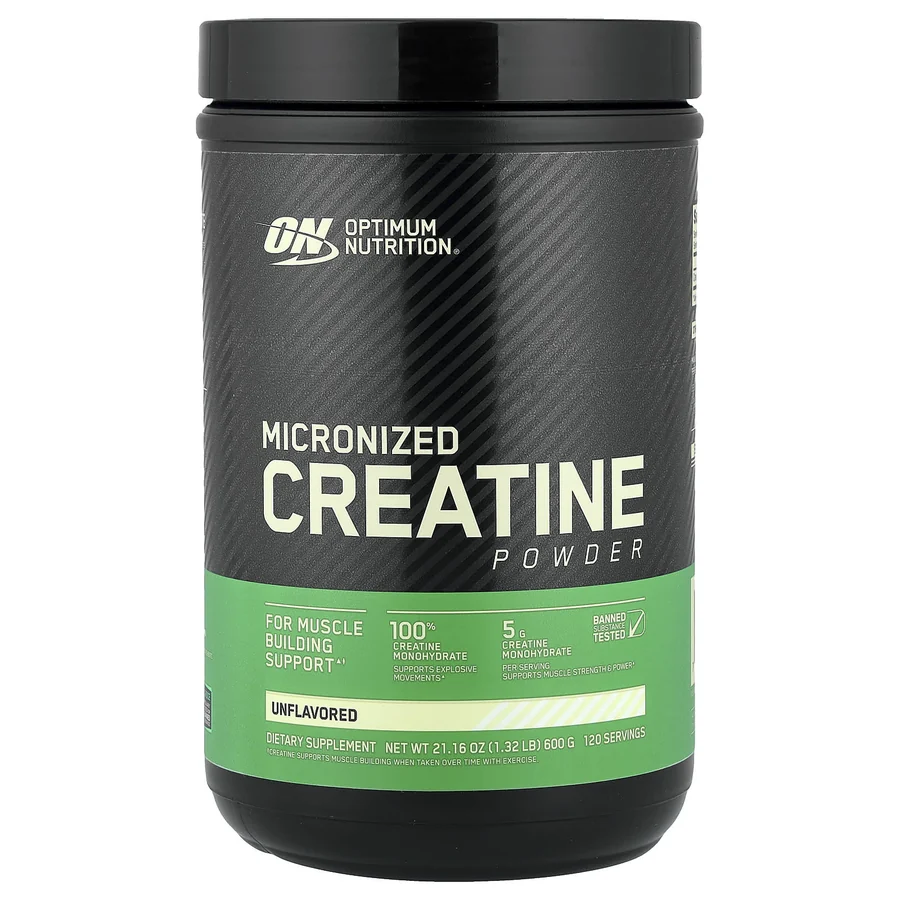
Optimum Nutrition Micronized Creatine Powder
Micronized Creatine · Unflavored · 600 g
Creatine monohydrate 5 g per label serving.
- Amount
- Creatine monohydrate 5 g
- Format
- Powder
- Review basis
- Label-based analysis
Good fit
people who want plain creatine monohydrate in a large, unflavored tub with a sports-testing marker
Consider another option
you want flavored creatine, capsule convenience, or a more premium certification-first option
The product, at a glance
Amounts for the reviewed label serving.
- Reviewed variant
- Micronized Creatine · Unflavored · 600 g
- Label serving
- 1 rounded teaspoon (5 g)
- Servings per reviewed pack
- 120
- Ingredients per label serving
- Creatine monohydrate 5 g
- Other ingredients
- No other ingredients listed
- Quality & testing
- Informed Choice · unflavored batch records · North America Source ↗
Label sources & rating context
Retailer label ↗ · Label source ↗
~ means approximate; — means no published value in this record. Customer ratings are the named publisher’s snapshot and may include multiple sizes or earlier formulas. The Supplement Explained Score is our source-reviewed editorial assessment out of 25, separate from customer stars. Compare the five criteria and the same intended use; the total is not a clinical ranking. Prices are dated USD offer snapshots; cost uses the reviewed pack and label serving.
- Label clarity: 5/5
- Evidence transfer: 5/5
- Safety fit: 4/5
- Quality proof: 4/5
- Value fit: 3/5
On this pageTable of Contents
Our editorial assessment
Supplement Explained Score
21/25
Optimum Nutrition Micronized Creatine Powder · Micronized Creatine · Unflavored · 600 g
Five equally weighted criteria, with a product-specific reason for every point. This is a buying-decision assessment, separate from customer stars and personal medical suitability.
- Label clarity 5/5
- Reviewed Micronized Creatine · Unflavored · 600 g: 1 rounded teaspoon (5 g); 120 label servings. Creatine monohydrate 5 g.
- Evidence transfer 5/5
- Five grams of monohydrate matches strong strength/power evidence; micronization is not assigned extra performance credit.
- Safety fit 4/5
- GI symptoms and water-weight changes can occur; kidney/medicine concerns still need individualized review.
- Quality proof 4/5
- Informed Choice lists unflavored batches and North America; the record's market/flavor scope is retained.
- Value fit 3/5
- A 600 g tub provides 120 plain 5 g servings; no matched current USD cost advantage is inferred.
Review basis: Published labels, manufacturer/retailer information, clinical sources and exact-product quality records where available. We did not buy, personally use or laboratory-test this product for this assessment.
Reviewed · Method v2.0 · How we assign points
Sources behind this score
Product labels and independent directory records identify a formula or testing scope. Clinical references concern ingredients or studied regimens unless the explanation explicitly matches the finished formula.
Who Optimum Nutrition Micronized Creatine Powder may fit
- Regular gym-goers: especially if you want a simple creatine monohydrate tub without a long ingredient list.
- Value-minded buyers: the large serving count helps if you plan to use creatine consistently.
- Athletes who care about testing signals: the Informed Choice note may matter if banned-substance screening is part of your buying checklist.
- People who already use shakes: unflavored powder fits easily into a protein shake or flavored beverage.
If your main goal is support around training output or workout recovery, this kind of basic monohydrate product is often the first form shoppers compare before moving to more specialized options.
Proof status for this review
This is a label-based editorial review, not a hands-on lab test of the product. We use the public product listing, Supplement Facts, serving size, active dose, price context, quality claims, and relevant ingredient evidence to judge whether the label supports the product’s positioning.
If we later add personal use notes, updated label photos, or third-party test documentation, this section should be updated so readers can tell which evidence comes from the label and which evidence comes from direct verification.
What is in the formula?
The formula is simple: 5 g of creatine monohydrate per serving, listed as one rounded teaspoon, with no other ingredients. The public product listing describes it as unflavored micronized powder and suggests adding it to a protein shake or flavored beverage.
The key point is that this is still creatine monohydrate. “Micronized” describes particle size, not a separate ingredient class with its own stronger evidence base. If you are comparing forms rather than brands, our guide to creatine monohydrate vs HCL and the Creatine Form Decision Matrix are better next reads.
Studied dose vs label reality
People usually search for things like ‘best creatine powder 5 g’ or ‘is micronized creatine better?’ The honest answer is that the 5 g part is standard, while the micronized part is more about handling and mixing than a whole new evidence category.
Label dose
What one serving gives you
5 gThis is the mainstream monohydrate serving buyers expect on a plain creatine tub.
What people compare
The real shopping lane
3 to 5 g is the common daily laneWhat usually decides the buy is not dose novelty. It is tub size, testing signal, and whether the plain powder format still feels easy to live with.
Dose verdict
Does the label hold up?
Roughly aligned The dose is exactly what you expectThis is a standard monohydrate label done in a practical large-tub format.
Biggest catch
What the label does not prove
Micronized is not a magic upgradeSome people like the mixability story, but the evidence discussion is still mostly about monohydrate itself, not a separate micronized science tier.
What looks strong
- Ingredient simplicity: one active ingredient and no extras makes the label easy to understand.
- Practical dose: the 5 g serving matches the standard amount many shoppers expect from a basic monohydrate powder.
- Large tub: 120 servings is convenient for regular users who do not want to reorder often.
- Quality signal: the listing says Informed Choice regularly tested for banned substances, which may matter to athletes and teams.
- Flexible use: unflavored powder is easy to add to shakes or a flavored drink if you do not want a sweetened pre-mixed formula.
What looks weak and what the tradeoffs are
The same simplicity that makes this product appealing can also make it feel basic. There are no flavoring agents, no convenience features beyond the tub format, and no added ingredients that might make it more pleasant for people who dislike plain powders.
The “micronized” angle should also be kept in proportion. Smaller particles may help handling or mixing for some users, but micronized creatine is not a separate evidence category from creatine monohydrate itself. In other words, this is still mostly a value judgment about a plain monohydrate tub, not a special science-backed upgrade.
Another tradeoff is user experience. Some people expect micronized powder to disappear completely in water, but anecdotal reports across creatine products still mention settling, slight grit, or occasional odor concerns. Those reports are not proof of a product defect, but they are a reminder that plain creatine powder is not always a perfect sensory experience.
Red flags before you hit buy
These are the friction points most likely to make you regret the purchase later, even if the label looked good at first.
- Skip it if you do not want a large tub. The value case depends partly on using a lot of servings over time.
- Do not let micronized do too much work in your head. It may help the user experience, but it does not turn this into a different ingredient category.
- Pause if you want the strongest possible certification story. Informed Choice is useful, but some shoppers will still want an NSF-style route instead.
Cost for the reviewed serving
No matched fresh USD serving-cost benchmark was available for the score review. The reviewed Micronized Creatine · Unflavored · 600 g supplies 120 label servings of Creatine monohydrate 5 g, using 1 rounded teaspoon (5 g) per serving. A 600 g tub provides 120 plain 5 g servings; no matched current USD cost advantage is inferred.
What this product is really implying
The label is pretty fair overall, but micronized can still sound more transformative than it really is when people are in full comparison mode.
Marketing angle
What the label wants you to think
This is a smoother, smarter, better-handled creatine pick from a major sports brand.
Evidence reality
What the research actually supports
The meaningful evidence is still for creatine monohydrate overall. The product’s edge is mostly user experience and testing reassurance, not a different ingredient outcome story.
Shopping takeaway
What should decide the buy
Buy this if you want a large practical tub with a recognizable testing marker. Skip it if you want either the absolute cheapest tub or the most premium certification-first product.
What do real users often report?
Anecdotal only. This block summarizes recurring public discussion themes, not controlled research and not hands-on testing by us.
Consensus scope: 3 public source pages listed below. Themes are anecdotal and are not a representative customer sample.
Recurring positives
- Users often describe it as a familiar, dependable, single-ingredient creatine with broad availability and a long brand track record.
Recurring negatives
- Grit and incomplete mixing are recurring complaints, and some shoppers think the brand premium is unnecessary because plain creatine monohydrate is a commodity ingredient.
Overall read
- The public read is ‘safe familiar choice’ rather than ‘uniquely effective formula.’ Authentic retailer sourcing, current price per 5 g, and tolerance matter more than brand recognition alone.
Public review sources: Reddit mixing discussion, Reddit texture discussion, Reddit brand discussion.
Note: These are summarized recurring themes from public user discussions. They are anecdotal, may include incentivized or syndicated retailer reviews, and do not replace clinical evidence or professional guidance.
Alternatives to compare
Compare the same decision variables across similar products: active amount, serving burden, quality proof, safety fit, and current value.
- California Gold Nutrition Sport Pure Creatine Monohydrate Open the label-based analysis and compare the tradeoffs on the same basis.
- Momentous Creatine Monohydrate 450 g Open the label-based analysis and compare the tradeoffs on the same basis.
- Nutricost Creatine Monohydrate Creapure 500 g Open the label-based analysis and compare the tradeoffs on the same basis.
FAQ
Short answers to the product-specific questions readers most often ask before comparing or buying.
Who is Optimum Nutrition Micronized Creatine Powder best for?
This page frames Optimum Nutrition Micronized Creatine Powder as best for people who want plain creatine monohydrate in a large, unflavored tub with a sports-testing marker.
Who should skip Optimum Nutrition Micronized Creatine Powder?
Consider skipping Optimum Nutrition Micronized Creatine Powder if you want flavored creatine, capsule convenience, or a more premium certification-first option.
What dose or serving does Optimum Nutrition Micronized Creatine Powder use?
Active dose: 5 g creatine monohydrate per serving; Form: micronized creatine powder, unflavored; Servings: 120 per 600 g container.
What quality or price signals matter for Optimum Nutrition Micronized Creatine Powder?
Quality markers noted on the page: public listing says Informed Choice regularly tested for banned substances; other ingredients listed as none Price band: value to mid-range.
Is Optimum Nutrition Micronized Creatine Powder a medical recommendation?
No. This product page is editorial decision support, not personal medical advice. Check the current product label and talk with a qualified clinician if you use medicines, are pregnant, have a medical condition, or are unsure whether the supplement fits your situation.
Editorial information
Reviewed for Trust
- Publisher: Supplement Explained Editorial Team
- Review model: Editorial evidence review; clinician review is shown only when a named clinician is listed.
- Last reviewed: October 7, 2026
- Last updated: October 7, 2026
- Editorial Policy | How We Review Evidence | Research Process | Disclaimer
- Use: Informational only. Not personal medical advice.
Continue your decision
If this product is not an obvious fit, use one of these routes instead of leaving the decision unfinished.
- Creatine guide Review dose, loading, timing, and who should ask a clinician first.
- All product analyses Browse the full product analysis library for alternatives and category comparisons.
- Supplement Explained Score See how label clarity, evidence transfer, safety fit, quality proof, and value fit are scored.
- Interaction checklist Check common combination risks before stacking supplements or medications.