
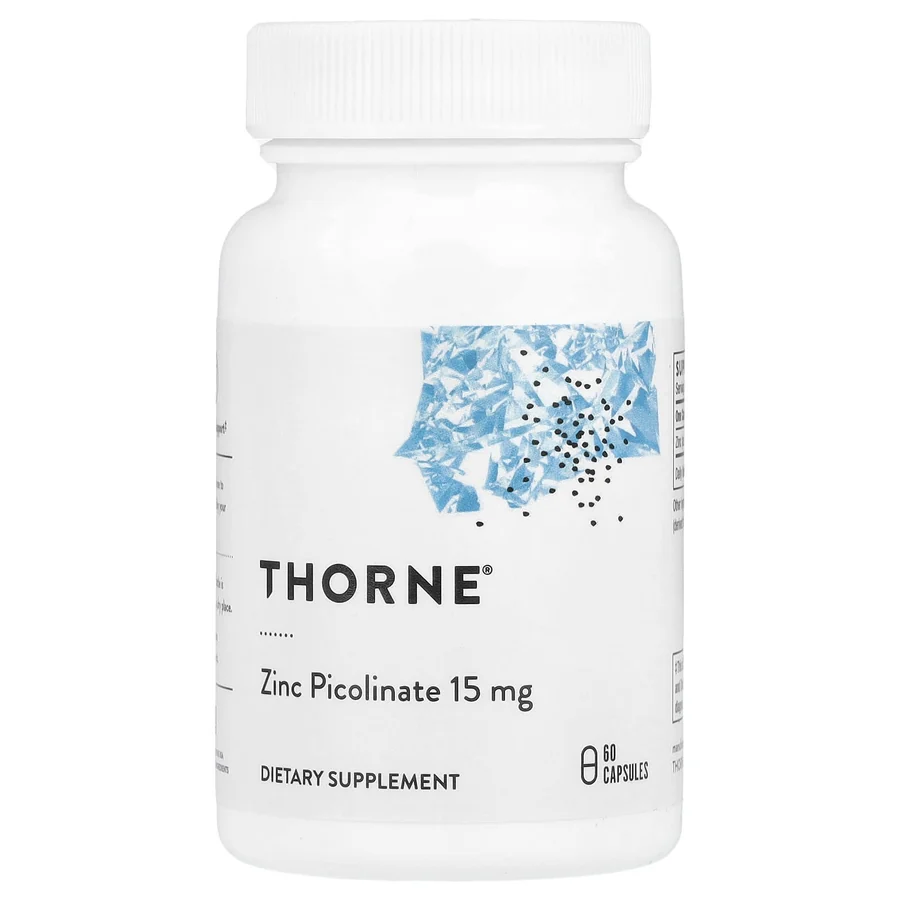
Thorne Zinc Picolinate 15 mg
Zinc Picolinate 15 mg · 60 capsules
Elemental zinc 15 mg per label serving.
- Amount
- Elemental zinc 15 mg
- Format
- Capsules
- Review basis
- Label-based analysis
Good fit
people who want a low-dose zinc picolinate capsule and prefer a straightforward single-mineral formula
Consider another option
you want copper included, a broader multi-nutrient product, or a stronger public certification story
The product, at a glance
Amounts for the reviewed label serving.
- Reviewed variant
- Zinc Picolinate 15 mg · 60 capsules
- Label serving
- 1 capsule
- Servings per reviewed pack
- 60
- Ingredients per label serving
- Elemental zinc 15 mg
- Other ingredients
- Microcrystalline cellulose; hypromellose capsule; leucine; silica
- Quality & testing
- Label claims: gluten free, short inactive ingredient list, manufactured in the USA using U.S. and imported ingredients
Label sources & rating context
~ means approximate; — means no published value in this record. Customer ratings are the named publisher’s snapshot and may include multiple sizes or earlier formulas. The Supplement Explained Score is our source-reviewed editorial assessment out of 100, separate from customer stars. Five criteria are scored 1–5; their sum is multiplied by four. The total is not a clinical ranking or an effectiveness percentage. Prices are dated USD offer snapshots; cost uses the reviewed pack and label serving.
- Label clarity: 5/5
- Evidence transfer: 4/5
- Safety fit: 4/5
- Quality proof: 2/5
- Value fit: 4/5
On this pageTable of Contents
- 1Supplement Explained Score
- 2Who Thorne Zinc Picolinate 15 mg may fit
- 3Who should skip Thorne Zinc Picolinate 15 mg
- 4Thorne Zinc Picolinate 15 mg label facts snapshot
- 5What is in the formula?
- 6Price and value analysis
- 7Is there third-party testing or quality proof?
- 8Use-case fit and evidence limits
- 9Better alternatives or compare this instead
- 10FAQ
Our editorial assessment
Supplement Explained Score
76/100
Thorne Zinc Picolinate 15 mg · Zinc Picolinate 15 mg · 60 capsules
Five equally weighted criteria, with a product-specific reason for every point. This is a buying-decision assessment, separate from customer stars and personal medical suitability.
- Label clarity 5/5
- Reviewed Zinc Picolinate 15 mg · 60 capsules: 1 capsule; 60 label servings. Elemental zinc 15 mg.
- Evidence transfer 4/5
- Fifteen milligrams of elemental zinc fits an assessed nutrient-gap comparison; picolinate does not establish extra testosterone or immune benefit.
- Safety fit 4/5
- Count other zinc and separate relevant antibiotics; prolonged use still needs an appropriate intake reason.
- Quality proof 2/5
- The specific simple capsule is identified, but a certificate from another Thorne product is not transferred.
- Value fit 4/5
- The $0.30 capsule snapshot and 60 servings support a straightforward low-burden comparison at 15 mg.
Review basis: Published labels, manufacturer/retailer information, clinical sources and exact-product quality records where available. We did not buy, personally use or laboratory-test this product for this assessment.
Reviewed · Method v2.0 · How we assign points
Sources behind this score
Product labels and independent directory records identify a formula or testing scope. Clinical references concern ingredients or studied regimens unless the explanation explicitly matches the finished formula.
Who Thorne Zinc Picolinate 15 mg may fit
- Adults who want a modest standalone zinc supplement rather than a high-dose product
- People comparing low-dose zinc picolinate options
- Shoppers who prefer a simple capsule with minimal extras
- People who do not want a large multivitamin and only need zinc contextually
It may be especially reasonable for readers who already know they want a separate zinc product and are trying to avoid going too high on dose. If timing is your main question, see best time to take zinc.
Who should skip Thorne Zinc Picolinate 15 mg
- People who want copper included in the same product
- People who would rather use a multivitamin or broader mineral formula than a single-ingredient zinc
- People already getting zinc from several supplements and foods who have not checked their total intake
- Pregnant individuals who have not spoken with a health-care practitioner first, since the product warning advises consultation
If you are already dealing with side effects, medication questions, or a more complex health picture, it is worth reading zinc side effects and when to talk to a clinician before adding another zinc product.
Proof status for this review
This is a label-based editorial review, not a hands-on lab test of the product. We use the public product listing, Supplement Facts, serving size, active dose, price context, quality claims, and relevant ingredient evidence to judge whether the label supports the product’s positioning.
If we later add personal use notes, updated label photos, or third-party test documentation, this section should be updated so readers can tell which evidence comes from the label and which evidence comes from direct verification.
What is in the formula?
Each capsule provides 15 mg of zinc as zinc picolinate. The listed other ingredients are microcrystalline cellulose, hypromellose capsule, leucine, and silicon dioxide.
The label positioning is simple: dietary supplement, foundational, and immune support. The suggested use on the public listing is 1 capsule one to two times daily or as recommended by a health-care practitioner.
That matters because the formula is intentionally narrow. It is not trying to be a multivitamin, a cold-and-flu stack, or a high-strength mineral blend. It is a single-mineral capsule with a modest dose.
Studied dose vs label reality
This page is mostly answering ‘is 15 mg enough’, ‘is 50 mg too much’, and ‘do I need copper with zinc?’ The first thing to say is that this product is clearly built for shoppers who want the conservative lane.
Label dose
What one capsule gives you
15 mg zincThat is a more moderate daily number than high-dose zinc products built around 50 mg.
What people compare
The real dose fork
15 mg vs 50 mg is the big splitMost buyers are really deciding between conservative everyday zinc and more aggressive high-dose zinc.
Dose verdict
Does the label make sense?
Roughly aligned Makes sense for moderate standalone zincThe label works well if your goal is modest standalone zinc, not a heavy-dose correction mindset.
Biggest catch
What the label does not solve
No copper built inThat is not automatically bad, but it does mean the product is not trying to solve the whole long-term balance question for you.
What looks strong
- Conservative dose: 15 mg is easier to fit into a routine than very high-dose zinc products.
- Simple formula: one active ingredient and a short inactive ingredient list makes comparison easier.
- Capsule format: many shoppers prefer smaller, simpler capsules over large multi-ingredient tablets.
- Cost per capsule: about $0.30 at the checked HerbsPro price.
- Clear use case: this is aimed at people who want standalone zinc, not an all-in-one supplement.
For decision support, that first point is the biggest one. If you are specifically looking for low-dose zinc picolinate, this product is built around that idea.
What looks weak and what the tradeoffs are
The same conservative design creates the main tradeoffs. If you wanted a more aggressive zinc product, this may feel underpowered. If you wanted a broader formula, this gives you only zinc.
There is also no copper in the formula. That does not make the product bad, but it does mean shoppers using zinc regularly should think about total intake and context rather than treating any single product as automatically balanced. If you are unsure how to think through that, use the Zinc Copper Balance Map, then review our guides on how to read a supplement label and how to choose a supplement.
Finally, based on the source notes here, the public quality story is solid but not unusually detailed. You get gluten-free labeling, USA manufacturing disclosure, and a clean ingredient list, but not a stronger public certification narrative from the materials reviewed for this page.
Red flags before you hit buy
These are the things most likely to make the product feel wrong later, even if the label looked fine at first.
- Skip it if you already know you want zinc plus copper in one bottle. This is a simple zinc-only lane.
- Skip it if you want an obviously high-dose zinc product. This page is about the calmer dose range.
- Do not buy it just because Thorne sounds premium. The most important part here is the dose strategy, not the label prestige.
Price and value analysis
HerbsPro listed the 15 mg, 60-capsule bottle at $18.23 on October 2, 2026. That is about $0.30 per capsule. Compare the zinc amount and total intake from other products before choosing a bottle. Price excludes coupons, tax, and shipping and may change.
Whether it feels like a good buy depends on what you are comparing it with. If you specifically want a branded, simple 15 mg zinc picolinate capsule, the price is fairly approachable. If you are open to a multivitamin or another zinc format, cost-per-serving is only one part of the decision.
Cost for the reviewed serving
Matched HerbsPro snapshot, 2026-10-02: $18.23 for the reviewed pack, approximately $0.30 per label serving, before shipping, tax or discounts. The reviewed Zinc Picolinate 15 mg · 60 capsules supplies 60 label servings of Elemental zinc 15 mg, using 1 capsule per serving. The $0.30 capsule snapshot and 60 servings support a straightforward low-burden comparison at 15 mg.
Is there third-party testing or quality proof?
From the public listing reviewed for this page, the product discloses the zinc form, dose, capsule count, suggested use, inactive ingredients, gluten-free status, and manufacturing note. That is a good baseline for label transparency.
What we cannot say from these source notes is that it has a stronger public verification story than competitors. So the practical read is: solid label clarity, but not a standout on public certification detail from the information reviewed here.
If you compare this with other products, use the same checklist each time: active form, dose, serving size, inactive ingredients, and whether the label tells a clear quality story. Our guide on how to read a supplement label walks through that process.
What this product is really implying
The product quietly suggests that a cleaner, lower-dose zinc capsule is the smarter adult choice. That can be true, but it still depends on why you are shopping for zinc in the first place.
Marketing angle
What the product is trying to say
This is the cleaner, more balanced way to do standalone zinc.
Evidence reality
What the research actually supports
The useful evidence is about zinc status and total intake, not about this exact brand being a uniquely better answer.
Shopping takeaway
What should decide the buy
Buy it if you want moderate standalone zinc with less dose drama. Skip it if your real question is copper balance or higher-dose zinc.
Use-case fit and evidence limits
The evidence base here is mostly about zinc as a nutrient, not this exact branded product. According to NIH fact sheets, zinc is an essential mineral involved in immune function and many normal body processes. The strongest general case for zinc supplementation is when intake is low or needs are not being met, not simply because a product is popular.
For someone who wants a modest zinc supplement, this product fits that evidence context better than very high-dose formulas. For someone already covering zinc through diet or a multivitamin, the case is less clear. Long-term total intake also matters, which is part of why some shoppers want copper context before choosing a standalone zinc product.
| Use Case | Evidence | Typical Time Window |
|---|---|---|
| Modest daily zinc support | Moderate | Usually judged over weeks, not overnight. |
| Gentler dose routines | Practical fit | The lower dose is part of the appeal right away. |
| Immune-season self-experimenting | Mixed | Many people use zinc this way, but expectations often run ahead of the evidence. |
| Aggressive repletion expectations | Limited fit | Some shoppers aiming for stronger short-term dosing may compare higher-potency options instead. |
Strength of evidence
Stronger: zinc as an essential nutrient, especially when intake may be inadequate.
More limited: claims that this exact branded product is meaningfully better than other reasonable zinc products based only on the source notes reviewed here.
Better alternatives or compare this instead
If your main goal is simply to cover nutritional bases, a broader multivitamin or mineral formula may make more sense than a standalone zinc product. That path can be especially appealing if you are also thinking about copper, iron, magnesium, or other nutrients at the same time.
If your main goal is choosing the right zinc approach rather than this exact product, start with the parent zinc guide. That is often more useful than narrowing in on one bottle too early.
And if you are still in the compare phase, our general primer on how to choose a supplement can help you decide whether to prioritize dose, form, simplicity, price, or broader nutrient coverage.
Alternatives at a glance
| Product | Best For | Main Tradeoff |
|---|---|---|
| Zinc Guide | Ingredient-first decisions | Less product-specific if you still need to decide whether zinc belongs in your stack at all. |
| Doctor's Best High Absorption Magnesium | Brand-style comparison only | Different ingredient, so it helps more with brand shopping than zinc shopping. |
| How to Choose a Supplement | Broader decision framework | Not a direct zinc product comparison. |
FAQ
Short answers to the product-specific questions readers most often ask before comparing or buying.
Who is Thorne Zinc Picolinate 15 mg best for?
This page frames Thorne Zinc Picolinate 15 mg as best for people who want a low-dose zinc picolinate capsule and prefer a straightforward single-mineral formula.
Who should skip Thorne Zinc Picolinate 15 mg?
Consider skipping Thorne Zinc Picolinate 15 mg if you want copper included, a broader multi-nutrient product, or a stronger public certification story.
What dose or serving does Thorne Zinc Picolinate 15 mg use?
Active dose: 15 mg zinc per capsule; Form: zinc picolinate in a capsule; Servings: 60 capsules; label use is 1 capsule one to two times daily, so about 30 to 60 days depending on how it is used.
What quality or price signals matter for Thorne Zinc Picolinate 15 mg?
Matched HerbsPro snapshot, 2026-10-02: $18.23 for the reviewed pack, approximately $0.30 per label serving, before shipping, tax or discounts. The reviewed Zinc Picolinate 15 mg · 60 capsules supplies 60 label servings of Elemental zinc 15 mg, using 1 capsule per serving. The $0.30 capsule snapshot and 60 servings support a straightforward low-burden comparison at 15 mg.
Is Thorne Zinc Picolinate 15 mg a medical recommendation?
No. This product page is editorial decision support, not personal medical advice. Check the current product label and talk with a qualified clinician if you use medicines, are pregnant, have a medical condition, or are unsure whether the supplement fits your situation.
Editorial information
Reviewed for Trust
- Publisher: Supplement Explained Editorial Team
- Review model: Editorial evidence review; clinician review is shown only when a named clinician is listed.
- Last reviewed: October 7, 2026
- Last updated: October 7, 2026
- Editorial Policy | How We Review Evidence | Research Process | Disclaimer
- Use: Informational only. Not personal medical advice.
Continue your decision
If this product is not an obvious fit, use one of these routes instead of leaving the decision unfinished.
- Zinc guide Check dose, copper balance, long-term use concerns, and interaction cautions.
- All product analyses Browse the full product analysis library for alternatives and category comparisons.
- Supplement Explained Score See how label clarity, evidence transfer, safety fit, quality proof, and value fit are scored.
- Interaction checklist Check common combination risks before stacking supplements or medications.