~ means approximate; — means no published value in this record. Customer ratings are the named publisher’s snapshot and may include multiple sizes or earlier formulas. The Supplement Explained Score is our source-reviewed editorial assessment out of 100, separate from customer stars. Five criteria are scored 1–5; their sum is multiplied by four. The total is not a clinical ranking or an effectiveness percentage. Prices are dated USD offer snapshots; cost uses the reviewed pack and label serving.
Label clarity: 4/5
Evidence transfer: 4/5
Safety fit: 4/5
Quality proof: 2/5
Value fit: 3/5
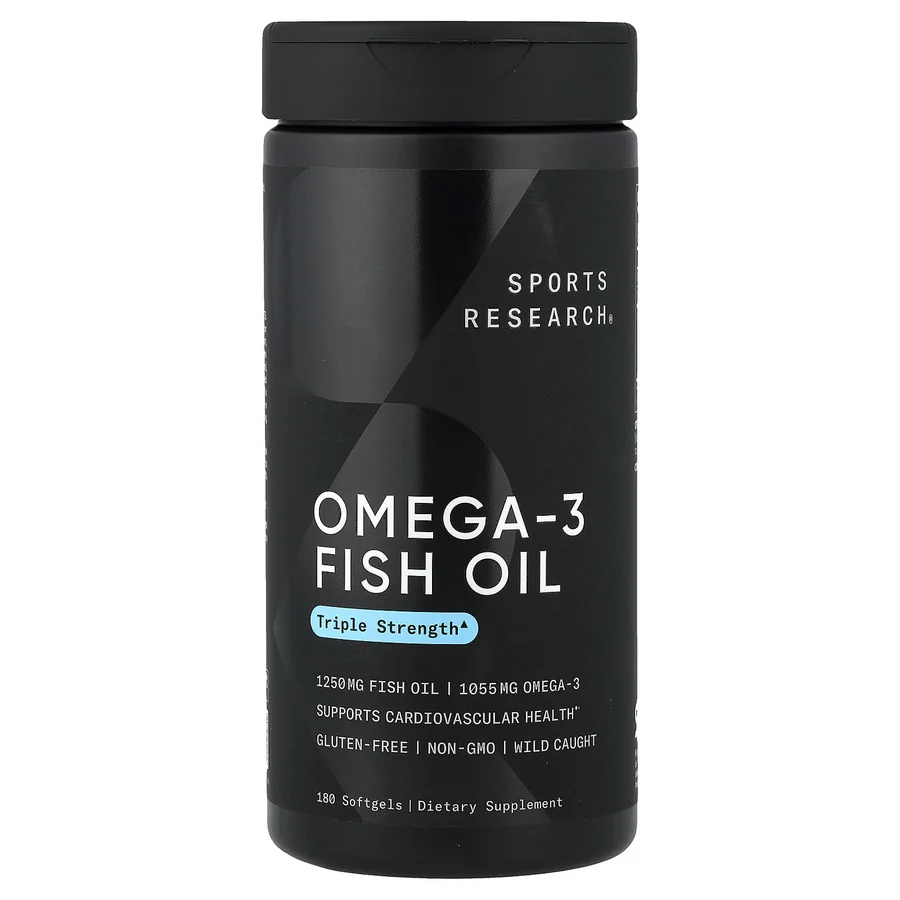
Sports Research Triple Strength is a concentrated, one-softgel fish oil, but not every listing has the same label. The current 90-softgel Alaska pollock bottle shows 690 mg EPA and 260 mg DHA; the 180-softgel iHerb listing shows 690 mg EPA and 310 mg DHA. Match the bottle, Supplement Facts and lot before comparing price or testing.
Fish oil is not suitable for a fish-free diet. If you take blood thinners, have a fish allergy, are pregnant, or have surgery planned, ask your healthcare professional before starting it.
Retailers and the manufacturer show different pack and formulation records. The difference is not just the number of softgels: fish species and DHA amounts can change too. Here are the records checked on October 7, 2026. [1][2][3]
Record
One softgel
Fish source and identity
Manufacturer: 90 softgels
1,250 mg fish oil; 1,040 mg total omega-3; 690 mg EPA + 260 mg DHA = 950 mg combined
1,250 mg fish oil; 1,055 mg total omega-3; 690 mg EPA + 310 mg DHA = 1,000 mg combined
Anchovy, sardine and mackerel; UPC 023249091530; listing says oil from Norway
Costco: 150 softgels
1,250 mg fish oil; 690 mg EPA + 310 mg DHA = 1,000 mg combined
Separate 150-count pack; listing identifies Alaska pollock and oil from Norway
Fish species and processing location answer different questions. A label can name Alaska pollock and also describe oil processed in Norway. Do not turn geography into a fish-species claim, or assume that every bottle with the same brand name contains the same DHA amount.
The current 90-count label names fish gelatin from tilapia, vegetable glycerin, purified water and tocopherols as other ingredients. Read your own bottle for allergens and changes. The front-label 1,250 mg describes fish oil, not EPA+DHA. Our fish oil label-math guide explains the three different totals.
What does it cost per 1,000 mg of EPA+DHA?
The manufacturer lists the 90-softgel, 1,250 mg variant at $30.71 for a one-time purchase. Using its current label, that works out to about $0.34 per softgel and $0.359 per 1,000 mg of EPA+DHA. Price checked October 7, 2026; shipping, tax, subscriptions and coupons are excluded. [1]
This is an equal-amount comparison, not a recommended dose. Using 1,000 mg instead of the actual 950 mg would make this particular bottle appear cheaper than it is.
The calculation does not apply to the 180-count iHerb link above. Check that seller’s current US price and label separately. For a same-date manufacturer-price comparison with Nordic’s standard softgels, see Sports Research vs Nordic Naturals.
Is it IFOS certified, and can you check your lot?
Nutrasource has an IFOS product record for Sports Research Triple Strength Omega-3, with a batch selector. That is a more specific check than a generic quality badge, but it is not a report for every bottle ever sold. [4]
Find the lot or batch number printed on your bottle.
Open the IFOS product record and look for the matching batch.
Compare the report’s product and concentration with your label before relying on its results.
The directory description lists 1,055 mg omega-3 and 690/310 mg EPA/DHA. That is not the same nutrient panel as the current 90-count 1,040 mg/690/260 mg bottle pictured by the manufacturer. We have not matched a purchased 90-count bottle’s lot to a report. A certification logo does not resolve that mismatch by itself.
Testing for purity, oxidation or label accuracy does not establish that the product treats a condition. For the practical checklist, see what to check in a fish oil testing record.
Who might prefer this fish oil?
It is worth comparing if you want a concentrated fish oil in a one-softgel label serving and are willing to check the current formulation. It is less suitable if you need a fish-free product, find softgels difficult to swallow, or specifically want a higher DHA amount per serving.
Useful feature: substantial EPA+DHA in one softgel, with public product-level testing information to investigate.
Practical drawback: similar-looking packs can have different labels, so a brand-only comparison is not enough.
Not established here: better sleep, symptom relief, or a guarantee of no fishy burps.
NCCIH distinguishes dietary fish oil supplements from prescription omega-3 treatments. It also lists unpleasant taste, heartburn, nausea and diarrhea among possible side effects. A “burpless” claim is not a guarantee for an individual reader. [5]
What should you compare before buying?
Nordic Naturals Ultimate Omega is a two-softgel, lemon-flavored option with a different EPA/DHA balance. Use the side-by-side comparison rather than treating the two label servings as equal amounts.
No. On the current 90-count manufacturer label, 1,250 mg is fish oil; total omega-3 is 1,040 mg, including 690 mg EPA and 260 mg DHA.
Why do some listings show 310 mg DHA instead of 260 mg?
The checked 180-count iHerb and 150-count Costco records show 310 mg DHA. The current manufacturer’s 90-count label shows 260 mg. Match the pack and label rather than combining the records.
Is Alaska pollock the same thing as oil from Norway?
No. Alaska pollock identifies the fish species; Norway can identify an oil sourcing or processing location. They are not interchangeable descriptions.
Does an IFOS listing guarantee that I will not get fishy burps?
No. The product record and a matching batch report can help assess testing evidence. They do not guarantee individual tolerance or a clinical benefit.
Updated October 7, 2026: separated the current 90-count label from the 180- and 150-count records and recalculated cost from the correct EPA+DHA amount. Label-based analysis; no hands-on or laboratory test. Editorial policy.
Our editorial assessment
Supplement Explained Score
68/100
Sports Research Triple Strength Omega-3 · Triple Strength Omega-3 · iHerb 180-softgel formula
Five equally weighted criteria, with a product-specific reason for every point. This is a buying-decision assessment, separate from customer stars and personal medical suitability.
Label clarity 4/5
Reviewed Triple Strength Omega-3 · iHerb 180-softgel formula: 1 softgel; 180 label servings. Fish oil 1,250 mg; omega-3 1,055 mg; EPA 690 mg; DHA 310 mg. 180-softgel iHerb panel uses anchovy/sardine/mackerel and DHA 310 mg. Manufacturer 90-softgel Alaska pollock panel has DHA 260 mg.
Evidence transfer 4/5
The reviewed EPA/DHA amounts support an intake comparison; general omega-3 trials do not establish this supplement as lipid therapy.
Safety fit 4/5
Fish source, GI tolerance and medicines require review; higher concentration is not automatically a better personal dose.
Quality proof 2/5
Quality claims cannot be transferred between the 180-softgel and changed 90-softgel formulas without a matching record.
Value fit 3/5
The reviewed 1,055 mg omega-3 formula differs from the current 950 mg manufacturer version; cost is not normalized across them.
Review basis: Published labels, manufacturer/retailer information, clinical sources and exact-product quality records where available. We did not buy, personally use or laboratory-test this product for this assessment.
Product labels and independent directory records identify a formula or testing scope. Clinical references concern ingredients or studied regimens unless the explanation explicitly matches the finished formula.