
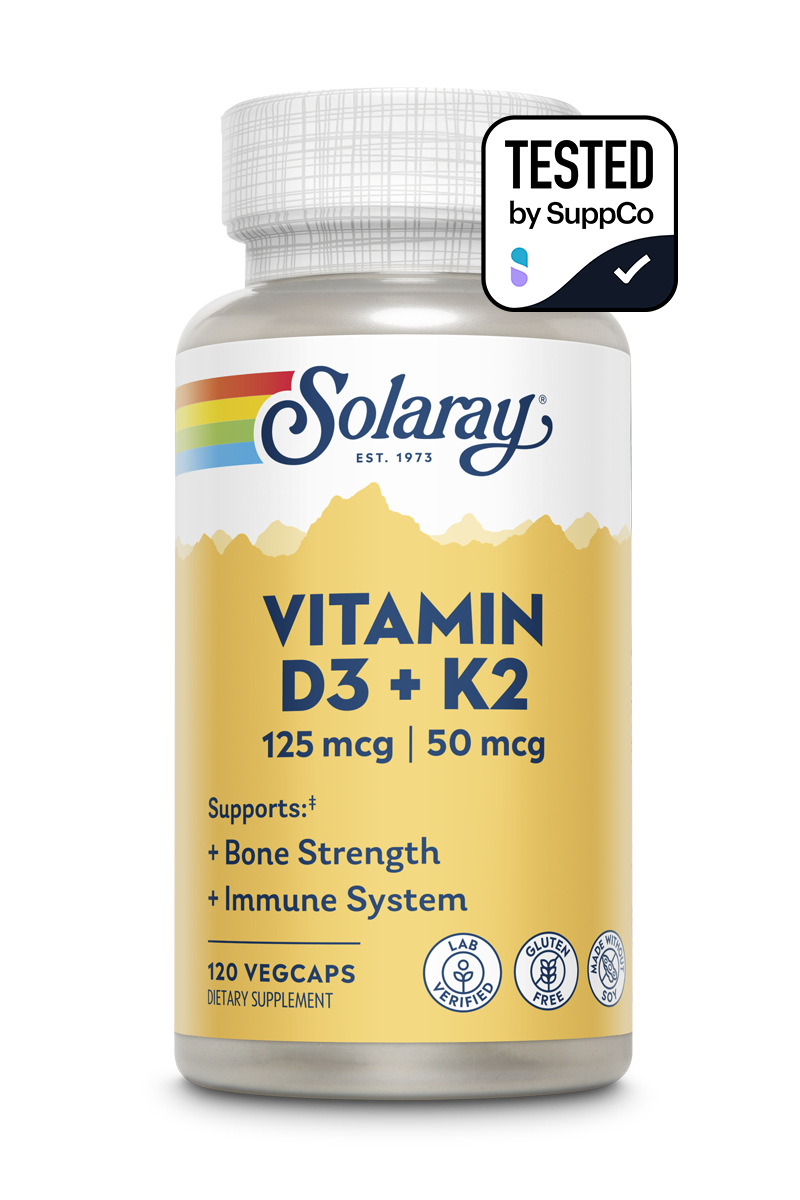
Solaray Vitamin D3 + K2
D3 + K2 · reviewed 120 capsules
D3 125 mcg (5,000 IU); K2 MK-7 50 mcg; calcium 110 mg; phosphorus 85 mg per label serving.
- Amount
- D3 125 mcg (5,000 IU); K2 MK-7 50 mcg; calcium 110 mg; phosphorus 85 mg
- Format
- Capsules
- Review basis
- Label-based analysis
The product, at a glance
Amounts for the reviewed label serving.
- Reviewed variant
- D3 + K2 · reviewed 120 capsules
- Label serving
- 1 capsule
- Servings per reviewed pack
- 120
- Ingredients per label serving
- D3 125 mcg (5,000 IU); K2 MK-7 50 mcg; calcium 110 mg; phosphorus 85 mg
- Ingredient list
- Vitamin D-3 (as Cholecalciferol)(Supplying 5000 IU of Vitamin D), Calcium (from Calcium Phosphate), Phosphorus (from Calcium Phosphate), Vitamin K-2 (as Menaquinone-7 from Chickpea), Vegetable Cellulose Capsule, Magnesium Stearate, Cellulose, Glycerol Monostearate, Rice Bran Extract, Silica and Modified Food Starch.
- Storage
- Store in a cool, dry place
Label sources & rating context
~ means approximate; — means no published value in this record. Customer ratings are the named publisher’s snapshot and may include multiple sizes or earlier formulas. The Supplement Explained Score is our source-reviewed editorial assessment out of 25, separate from customer stars. Compare the five criteria and the same intended use; the total is not a clinical ranking. Prices are dated USD offer snapshots; cost uses the reviewed pack and label serving.
- Label clarity: 5/5
- Evidence transfer: 4/5
- Safety fit: 3/5
- Quality proof: 2/5
- Value fit: 3/5
On this pageTable of Contents
Our editorial assessment
Supplement Explained Score
17/25
Solaray Vitamin D3 + K2 · D3 + K2 · reviewed 120 capsules
Five equally weighted criteria, with a product-specific reason for every point. This is a buying-decision assessment, separate from customer stars and personal medical suitability.
- Label clarity 5/5
- Reviewed D3 + K2 · reviewed 120 capsules: 1 capsule; 120 label servings. D3 125 mcg (5,000 IU); K2 MK-7 50 mcg; calcium 110 mg; phosphorus 85 mg.
- Evidence transfer 4/5
- Vitamin D can address inadequacy, but adding MK-7 does not establish superior clinical outcomes for every adult.
- Safety fit 3/5
- D3 5,000 IU exceeds the US adult routine total-intake UL; K2 affects warfarin planning, and added calcium/phosphorus count too.
- Quality proof 2/5
- The exact panel is identified, but no independent finished-capsule potency/purity record was verified.
- Value fit 3/5
- One capsule is convenient, but the high fixed D amount and added minerals reduce flexibility for routine use.
Review basis: Published labels, manufacturer/retailer information, clinical sources and exact-product quality records where available. We did not buy, personally use or laboratory-test this product for this assessment.
Reviewed · Method v2.0 · How we assign points
Sources behind this score
Product labels and independent directory records identify a formula or testing scope. Clinical references concern ingredients or studied regimens unless the explanation explicitly matches the finished formula.
This review uses the current 120-capsule label image for the 125 mcg D3 product. The manufacturer also presents other bottle sizes, and older page descriptions do not perfectly match the current image’s inactive ingredients. Check the exact bottle rather than assuming every version is identical. [3] [1]
One capsule contains more than D3 and K2
| Nutrient | Reviewed amount per capsule |
|---|---|
| Vitamin D3 | 125 mcg / 5,000 IU |
| Vitamin K2 | 50 mcg MK-7, from chickpea |
| Calcium | 110 mg |
| Phosphorus | 85 mg |
The reviewed image lists a vegetable cellulose capsule, glycerol monostearate, magnesium stearate, silica, modified food starch, and cellulose as other ingredients. This list should not be silently replaced with an older description that mentions different ingredients. [1]
The calcium and phosphorus are part of the supplement total. They should not be omitted from the decision because the front product name emphasizes vitamins.
View the manufacturer’s Supplement Facts label
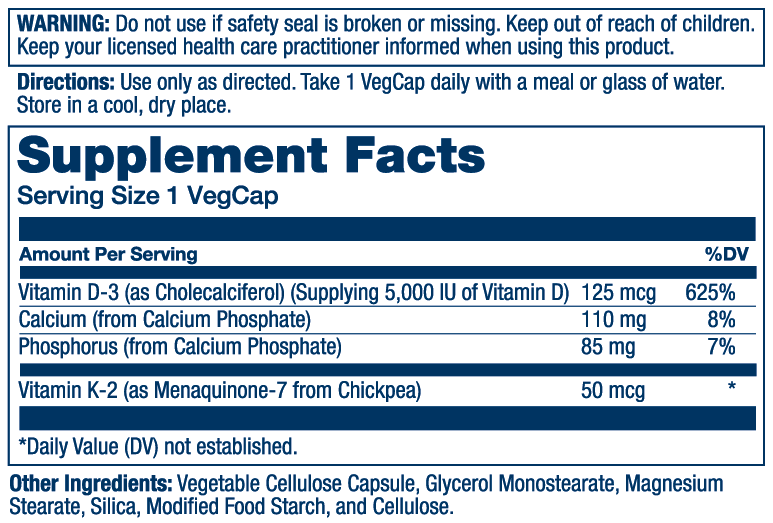
View original manufacturer label
Manufacturer label; check the package you receive for changes.
What 5,000 IU means
Vitamin D is commonly expressed in both micrograms and international units. Here, 125 mcg and 5,000 IU describe the same D3 amount. They are not separate nutrients to add together. [2]
The US adult upper limit is 100 mcg, or 4,000 IU, for routine total daily intake. An upper limit is not a recommended target and is not an automatic toxicity threshold for a single exposure. Clinicians may prescribe different amounts for particular circumstances, but that needs a reason and appropriate management. [2]
For someone already taking a multivitamin or separate vitamin D, this product adds another 5,000 IU. The full supplement list is therefore more relevant than whether the new bottle appears to be “just one capsule.”
K2 does not erase the vitamin D question
The reviewed formula uses MK-7. Its presence establishes the form and amount of added vitamin K2, not a guarantee against excessive vitamin D intake or high calcium levels. Vitamin D toxicity can involve hypercalcemia, and this review did not establish evidence that the K2 amount neutralizes that risk. [1] [2]
Likewise, chickpea-derived MK-7 is a source description. It should not be converted into a broad claim that the entire product is suitable for every dietary restriction without checking the whole formulation and manufacturing statements.
Who should examine another amount first?
A reader looking for an unsupervised, routine addition without a specific reason for a high dose should not use “more IU” as the buying criterion. A lower-amount formula—or no additional vitamin D, depending on the overall plan—may be the appropriate direction to discuss.
As concrete label alternatives, NOW D3 & K2 provides 1,000 IU D3 with 45 mcg MK-4 per capsule, while the reviewed Pure product provides 4,000 IU with 100 mcg MK-7. Pure’s amount still reaches the adult upper limit; it should not be described as a low-dose product merely because it is below Solaray’s 5,000 IU. [4] [5] [2]
These products also differ in K2 form and ingredients, so they are not one-for-one clinical equivalents.
Warfarin and other medicines
Vitamin K is particularly relevant to warfarin and similar vitamin K antagonist treatment. Adding a K2 supplement should be discussed with the prescriber or pharmacist rather than managed by a general internet rule. Maintaining appropriate consistency is different from avoiding all vitamin K or changing a prescribed medicine yourself. [6]
Other medical circumstances can also affect vitamin D and calcium management. A product review cannot determine that a combined high-dose vitamin product is appropriate from symptoms alone.
Bottle size, label version, and price
This review now matches the 120-capsule bottle and its current label. On September 27, 2026, the manufacturer listed 120 capsules at $31.99 (about $0.27 per capsule) and 60 capsules at $18.39. Select the bottle size before checkout; the lower displayed price is not the price of the 120-count bottle. Tax and shipping are excluded. [3]
Even with a verified price, the economically cheapest vitamin D per IU is not automatically the most useful purchase. Buying an amount that does not fit your plan is not a saving.
Before ordering, match the D3 strength, K2 amount and form, capsule count, and full ingredient image. A seller should be able to identify the actual version being shipped. A photograph of only the front label is insufficient when the back-panel details are the reason for choosing it.
Check price at HerbsProHerbsPro: $29.59 for Vitamin D3 Plus K2, 120 Veg Caps, checked October 5, 2026. Price and stock can change; confirm the current bottle label.
We may earn a commission from this link.What evidence would change the decision?
A clear clinician-directed reason for the amount, a matched current bottle label, and a verified supply route would answer different parts of the choice. A general brand-quality statement or a combination-ingredient explanation cannot replace those checks.
We did not establish a direct clinical trial of this finished Solaray product demonstrating superiority over lower-dose D3 products or separate D and K products. That uncertainty should not be filled with general “calcium goes to bones” marketing claims.
The honest verdict is narrow: this is a high-D3, MK-7-containing formula with additional calcium and phosphorus. Assess the amount first, match the bottle version second, and only then compare price. The D3/K2 comparison shows the verified alternatives without treating all doses as equally suitable.
Related reading
For the arithmetic behind capsules, servings, and nutrient quantities, see our serving-size and dose guide.