

Garden of Life Dr. Formulated Probiotics Once Daily Women's
Once Daily Women · 50 billion · shelf-stable · 30 capsules
50 billion CFU; 16 strains per label serving.
- Amount
- 50 billion CFU; 16 strains
- Format
- Capsules
- Review basis
- Label-based analysis
Good fit
Adults who have decided a probiotic fits their needs and prioritize a shelf-stable, one-capsule routine.
Consider another option
You need treatment for vaginal or urinary symptoms, or you have serious illness or a weakened immune system and have not discussed probiotic use with your clinician.
The product, at a glance
Amounts for the reviewed label serving.
- Reviewed variant
- Once Daily Women · 50 billion · shelf-stable · 30 capsules
- Label serving
- 1 capsule
- Servings per reviewed pack
- 30
- Ingredients per label serving
- 50 billion CFU; 16 strains
- Storage
- Cool, dry place; shelf-stable version
Label sources & rating context
~ means approximate; — means no published value in this record. Customer ratings are the named publisher’s snapshot and may include multiple sizes or earlier formulas. The Supplement Explained Score is our source-reviewed editorial assessment out of 25, separate from customer stars. Compare the five criteria and the same intended use; the total is not a clinical ranking. Prices are dated USD offer snapshots; cost uses the reviewed pack and label serving.
- Label clarity: 3/5
- Evidence transfer: 2/5
- Safety fit: 3/5
- Quality proof: 2/5
- Value fit: 3/5
On this pageTable of Contents
- 1Supplement Explained Score
- 2Label facts at a glance
- 3Which Once Daily Women's formula is this?
- 4What benefits are supported by evidence?
- 5How does it compare with Once Daily 30B and Ultimate 100B?
- 6How should you take and store it?
- 7Who should be cautious about using it?
- 8What can the label tell you about quality?
- 9How do you calculate price and value?
- 10FAQ
Our editorial assessment
Supplement Explained Score
13/25
Garden of Life Dr. Formulated Probiotics Once Daily Women's · Once Daily Women · 50 billion · shelf-stable · 30 capsules
Five equally weighted criteria, with a product-specific reason for every point. This is a buying-decision assessment, separate from customer stars and personal medical suitability.
- Label clarity 3/5
- Reviewed Once Daily Women · 50 billion · shelf-stable · 30 capsules: 1 capsule; 30 label servings. 50 billion CFU; 16 strains. The blend total does not disclose every strain contribution; version and storage remain part of identity.
- Evidence transfer 2/5
- The 50-billion/16-strain label is not clinical proof of treatment for vaginal, urinary or digestive problems.
- Safety fit 3/5
- Serious illness/immune compromise needs review; gas and sensitivity to the blend can occur.
- Quality proof 2/5
- The shelf-stable version is identified, but an independent viable-count result for the finished lot was not verified.
- Value fit 3/5
- Thirty daily capsules are practical; version differences and broad strain totals limit like-for-like value comparison.
Review basis: Published labels, manufacturer/retailer information, clinical sources and exact-product quality records where available. We did not buy, personally use or laboratory-test this product for this assessment.
Reviewed · Method v2.0 · How we assign points
Sources behind this score
Product labels and independent directory records identify a formula or testing scope. Clinical references concern ingredients or studied regimens unless the explanation explicitly matches the finished formula.
Which Once Daily Women's formula is this?
This review covers Garden of Life Dr. Formulated Probiotics Once Daily Women with 50 billion CFU, 16 strains and 30 capsules, not the separate 3-in-1 pH product. The manufacturer’s current product page specifies one capsule daily and shelf-stable storage.
At that dose, one bottle supplies 30 daily servings. CFU means colony-forming units, a measure of viable microorganisms—not an ingredient weight or a rating of effectiveness. Our guide to probiotic strains and CFU explains the distinction.
The combined count does not reveal each strain’s share. Exact strain identifiers and individual amounts are not verified here, so do not fill those gaps using another Garden of Life formula. Packaging can change; match the product name, strength and directions on the bottle you buy.
What benefits are supported by evidence?
The label establishes what this product contains, but it does not establish a particular clinical benefit. A clinical trial of this exact 50-billion-CFU, 16-strain blend has not been verified. The women’s positioning is not proof that it treats or prevents yeast infections, bacterial vaginosis or urinary tract infections.
The NIH Office of Dietary Supplements explains that probiotic effects depend on factors including the strain, dose and condition studied. A finding for one strain or blend cannot automatically be applied to another product, even when both contain bacteria from the same broad group.
Sixteen strains therefore do not mean sixteen proven benefits. If you are considering a probiotic for a specific concern, the useful question is whether research supports the identifiable strains and dose for that purpose—not whether the front label sounds comprehensive.
How does it compare with Once Daily 30B and Ultimate 100B?
Once Daily 30B has a lower declared CFU total than Women’s 50B, while Ultimate 100B has a higher total. These are distinct formulas, not a proven good-better-best ladder. Higher CFU counts do not necessarily produce greater health benefits.
Dr. Formulated Once Daily 30B is worth comparing if you prefer a product without women’s-specific positioning. Its lower count is not automatically a disadvantage. It could be the more sensible purchase if its current strain composition fits your purpose and its cost per labeled daily serving is lower.
RAW Probiotics Ultimate Care 100B offers a larger declared count. A reason to prefer it would be its specific formula or guidance from your clinician, rather than the assumption that 100 billion must work twice as well as 50 billion.
The Women’s product has a verified one-capsule schedule and shelf-stable format. Do not assume either alternative shares its 16-strain blend, serving size or storage requirements; compare their current labels before choosing.

Garden of Life Dr. Formulated Probiotics Once Daily
30 billion CFU and 14 strains; check the exact bottle for refrigeration requirements.
Check price at Amazon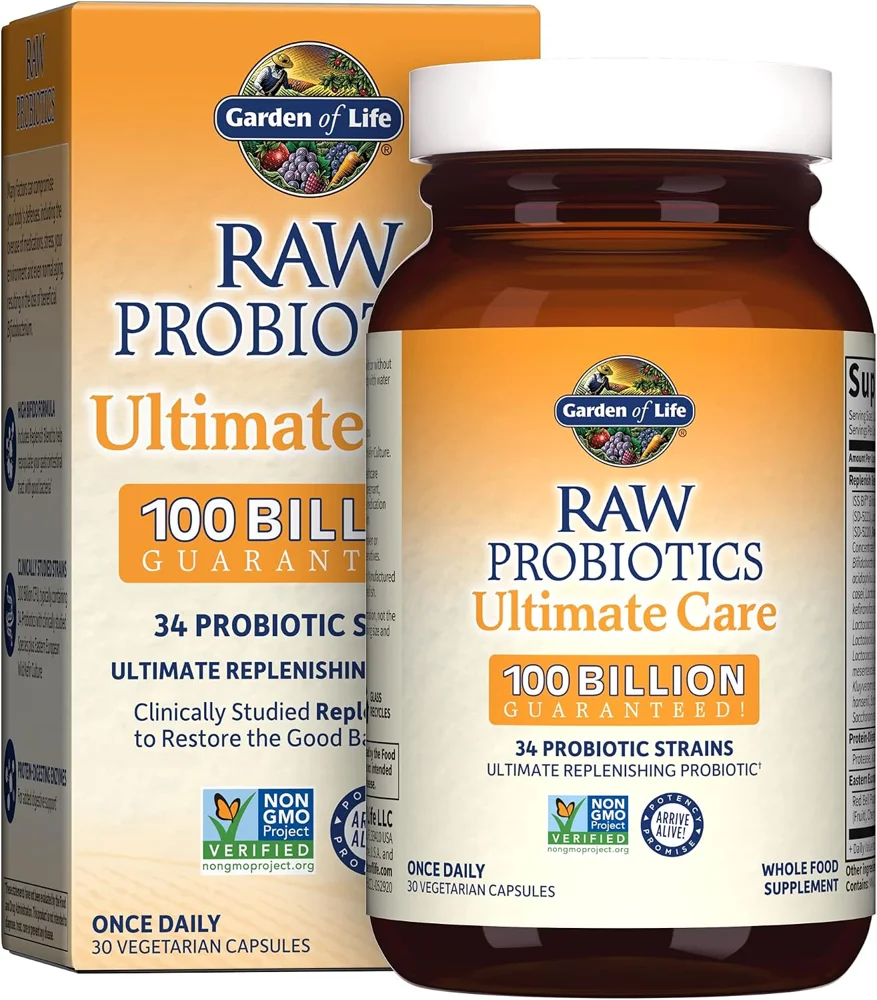
Garden of Life Raw Probiotics Ultimate Care
100 billion CFU and 34 strains; verify the storage variant rather than buying by count alone.
Check price at AmazonAffiliate links: we may earn a commission if you buy. Check the selected size, seller and current label on Amazon.
How should you take and store it?
Follow the current bottle’s directions: the verified schedule is one capsule daily, with cool, dry storage. Check the package for meal instructions rather than assuming all probiotics must be taken on an empty stomach.
Shelf-stable does not mean suitable for every storage condition. Avoid bathroom humidity, a sunny windowsill or a hot parked car. Keep track of the expiration date, and follow your bottle if its instructions differ from an older listing. Our probiotic storage guide explains what to check.
A daily reminder may make the routine easier to follow. Do not increase the dose simply to match another product’s CFU count. The bottle’s 30-day supply describes how long it lasts, not how quickly a benefit should appear.
Who should be cautious about using it?
People with serious illness or weakened immune systems should discuss probiotic use with their clinician before taking this product. For otherwise healthy people, reported side effects are usually minor digestive symptoms, such as gas, but tolerability is not guaranteed.
The NIH safety summary notes rare infections associated with probiotics, particularly in people who are severely ill or immunocompromised. That warrants individualized advice, not an assumption that a supplement is harmless because it contains bacteria commonly used in probiotics.
Check the current ingredient list for anything you need to avoid. Ask your clinician before use during pregnancy or breastfeeding. Stop and seek advice if new symptoms are persistent or worsening. Ongoing digestive, vaginal or urinary symptoms need medical assessment rather than repeated supplement changes; this capsule is not a substitute for diagnosis or prescribed treatment.
What can the label tell you about quality?
The label identifies the intended formula and use, but it cannot independently confirm the viable count or purity of an individual lot. This is a label-based review, not hands-on testing.
No lot-specific certificate of analysis has been verified for this review. That limits what can be said about the contents of a particular bottle; it does not establish that the product failed testing.
When evaluating a testing claim, look for what was measured, who performed the testing and whether the report identifies the relevant lot. Our guide to what third-party testing means explains why a general quality statement is not the same as a product-specific test report.
How do you calculate price and value?
Compare cost per labeled daily serving, not cost per capsule or per billion CFU. For this verified 30-capsule bottle at one capsule daily, divide the amount you actually pay by 30.
For illustration only—not a current price—if the bottle cost $30, the calculation would be $30 ÷ 30 daily servings = $1 per day. A different hypothetical 30-capsule product requiring two capsules daily would provide only 15 days; at the same hypothetical $30 price, it would cost $2 per day.
Include shipping and tax, and count only discounts you will actually use. Recheck the denominator when comparing other bottle sizes or formulas. Capsules left unused before expiration do not add practical value.
A lower daily cost is useful only if the formula suits your needs. Paying more for women’s branding, more strains or a higher CFU total does not by itself buy a better-supported result.
Check current Amazon price and size
Affiliate link: we may earn a commission if you buy.
FAQ
Is this the same as Garden of Life's 3-in-1 pH probiotic?
No. This review concerns Once Daily Women 50 billion CFU, 16 strains and 30 capsules. Do not transfer ingredients, directions or claims from the separate 3-in-1 pH product to this bottle.
Does Once Daily Women need refrigeration?
The verified current version is shelf-stable, with cool, dry storage specified. Follow the instructions on your actual bottle, especially if its packaging differs from the version described here.
Should I take it with food?
Use the meal directions on your current bottle. A preferred meal schedule is not verified in this review, so do not substitute another probiotic's instructions or assume an empty stomach is necessary.
How long should it take to work?
A reliable timeline has not been established here for this exact blend. Thirty capsules means a 30-day supply, not a promised response time. Persistent or worsening symptoms should be assessed rather than managed by extending supplement use.
Is 100 billion CFU better than 50 billion?
Not necessarily. A larger count does not establish greater benefit. Compare the strains, evidence for your intended purpose, labeled daily dose, storage requirements and daily cost before choosing a higher-count formula.
References
- Garden of Life: Dr. Formulated Probiotics Once Daily Women's Shelf-Stable Vegetarian Capsules
- NIH Office of Dietary Supplements: Probiotics—Health Professional Fact Sheet
- Matched product listing and package identity: B00Y8MP4G6
Label and package details checked against the cited sources. Retailer prices and available versions can change; the page update date is shown above.