
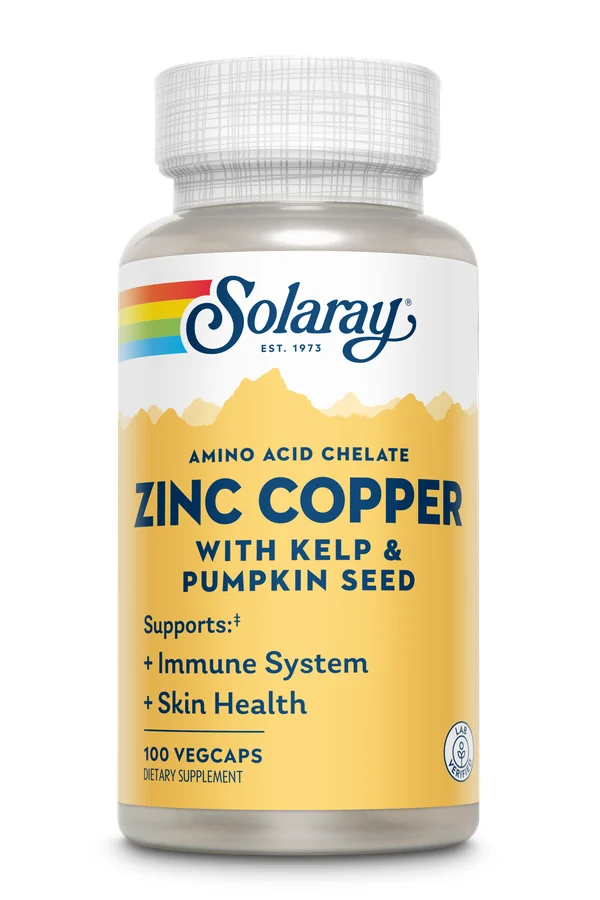
Solaray Zinc Copper with Kelp & Pumpkin Seed
Zinc Copper · 100 capsules
Zinc 50 mg; copper 2 mg; iodine 53 mcg; pumpkin seed 10 mg per label serving.
- Amount
- Zinc 50 mg; copper 2 mg; iodine 53 mcg; pumpkin seed 10 mg
- Format
- Capsules
- Review basis
- Label-based analysis
The product, at a glance
Amounts for the reviewed label serving.
- Reviewed variant
- Zinc Copper · 100 capsules
- Label serving
- 1 capsule
- Servings per reviewed pack
- 100
- Ingredients per label serving
- Zinc 50 mg; copper 2 mg; iodine 53 mcg; pumpkin seed 10 mg
- Ingredient list
- lodine (from Kelp), Zinc (from Zinc Bisglycinate), Copper (from Copper Bisglycinate), Pumpkin (Curcurbita pepo) (hulled seeds), Cellulose, Vegetable Cellulose Capsule, Magnesium Stearate, and Silica.
- Storage
- Store in a cool, dry place
Label sources & rating context
~ means approximate; — means no published value in this record. Customer ratings are the named publisher’s snapshot and may include multiple sizes or earlier formulas. The Supplement Explained Score is our source-reviewed editorial assessment out of 25, separate from customer stars. Compare the five criteria and the same intended use; the total is not a clinical ranking. Prices are dated USD offer snapshots; cost uses the reviewed pack and label serving.
- Label clarity: 5/5
- Evidence transfer: 4/5
- Safety fit: 3/5
- Quality proof: 2/5
- Value fit: 2/5
On this pageTable of Contents
- 1Supplement Explained Score
- 2The whole formula—not just the two headline minerals
- 3Why 25:1 does not answer whether the dose is suitable
- 4The upper limit includes food and other products
- 5Kelp-derived iodine is not an invisible extra
- 6What the bottle costs
- 7Compare lower amounts before comparing brand reputation
- 8What to check before use
- 9The decision in one sentence
Our editorial assessment
Supplement Explained Score
16/25
Solaray Zinc Copper with Kelp & Pumpkin Seed · Zinc Copper · 100 capsules
Five equally weighted criteria, with a product-specific reason for every point. This is a buying-decision assessment, separate from customer stars and personal medical suitability.
- Label clarity 5/5
- Reviewed Zinc Copper · 100 capsules: 1 capsule; 100 label servings. Zinc 50 mg; copper 2 mg; iodine 53 mcg; pumpkin seed 10 mg.
- Evidence transfer 4/5
- Zinc can address a relevant gap; a 25:1 zinc/copper ratio does not prove that this high dose is necessary or beneficial.
- Safety fit 3/5
- Zinc 50 mg exceeds the US adult UL; copper does not cancel that concern, and kelp iodine adds thyroid/stack considerations.
- Quality proof 2/5
- The matched label identifies all four ingredients, but an independent finished-product result was not verified.
- Value fit 2/5
- A low capsule count burden cannot offset excessive zinc for someone who needs only ordinary dietary coverage.
Review basis: Published labels, manufacturer/retailer information, clinical sources and exact-product quality records where available. We did not buy, personally use or laboratory-test this product for this assessment.
Reviewed · Method v2.0 · How we assign points
Sources behind this score
Product labels and independent directory records identify a formula or testing scope. Clinical references concern ingredients or studied regimens unless the explanation explicitly matches the finished formula.
This is therefore not a default daily product for every adult. It is a formula to examine only with a clear reason for the amount and attention to the rest of the diet, supplements, medicines, and intended duration.
The whole formula—not just the two headline minerals
| Ingredient | Per capsule | Why it belongs in the decision |
|---|---|---|
| Zinc, as bisglycinate | 50 mg | High absolute amount |
| Copper, as bisglycinate | 2 mg | Does not remove the need to assess zinc intake |
| Iodine, from kelp | 53 mcg | Additional nutrient to include in the overall plan |
| Pumpkin seed | 10 mg | Other formula component, not evidence of an additional clinical benefit |
The reviewed label also lists cellulose, a vegetable capsule, magnesium stearate, and silica. It is not simply a two-ingredient zinc-and-copper product. [1]
View the manufacturer’s Supplement Facts label
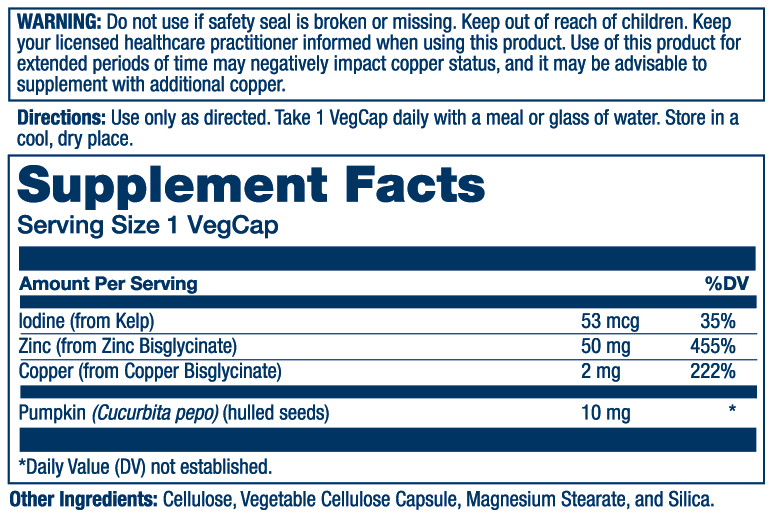
View original manufacturer label
Manufacturer label; check the package you receive for changes.
Why 25:1 does not answer whether the dose is suitable
The ratio is calculated as 50 mg zinc ÷ 2 mg copper = 25:1. That tells you the relationship between the two amounts. It does not establish that either amount is needed or appropriate.
For comparison, Jarrow Zinc Balance lists 15 mg zinc and 1 mg copper per capsule, a 15:1 ratio. Both the ratio and the absolute quantities differ. The more important initial difference is 15 mg versus 50 mg zinc, not which ratio sounds more balanced. [3]
Our zinc-and-copper supplement comparison puts these absolute amounts and iodine differences side by side.
A fixed ratio is not a universal quality score. Adding more copper to a high-zinc product on your own would introduce another dosing decision rather than prove the original product suitable.
The upper limit includes food and other products
NIH’s adult zinc upper limit is 40 mg per day from food, beverages, supplements, and medicines. It differs from the supplemental-only upper limit used for magnesium. The distinction matters: the 50 mg in this capsule is not a remaining allowance after food has been ignored. [2]
Higher amounts can be used for specific medical reasons under a doctor’s care, but that is a separate context. A routine supplement review cannot infer such an indication from fatigue, frequent illness, or a wish to support immunity.
Excess zinc can cause nausea and other symptoms, and long-term excessive intake can impair copper status. The reviewed Solaray label itself includes an extended-use caution related to copper. Its addition of 2 mg copper should therefore not be marketed as eliminating the concern. [2] [1]
Kelp-derived iodine is not an invisible extra
The capsule supplies 53 mcg iodine from kelp. That amount should be included when reviewing other iodine sources, especially when a clinician has advised a particular iodine plan. [1]
The ingredient is not automatically an advantage for someone shopping specifically for zinc and copper. A product without added iodine may be a more direct formulation to examine when that nutrient is not desired in the same bottle.
Avoid treating “with kelp and pumpkin seed” as a proven extra outcome. The label establishes their inclusion; it does not establish an additional clinical benefit for the finished formula.
What the bottle costs
The checked one-time manufacturer price was $11.89 for 100 capsules on September 27, 2026. That is approximately $0.119 per capsule, excluding tax, shipping, subscriptions, and coupons. [4]
The arithmetic does not turn the bottle into a recommended 100-day regimen. A low cost per capsule cannot make an inappropriate zinc amount appropriate. Nor does a large supply establish how long someone should take the product.
Check price at HerbsProHerbsPro: $11.89 for Zinc Copper, 100 Caps, checked October 5, 2026. Price and stock can change; confirm the current bottle label.
We may earn a commission from this link.Compare lower amounts before comparing brand reputation
Jarrow’s verified 15 mg zinc and 1 mg copper formula is a meaningful lower-zinc alternative to examine, not an automatic recommendation that everyone needs that combination. The reviewed facts do not list iodine as an active nutrient. Its current page displayed a two-pack offer, so that price was not treated as a single-bottle price in this review. [3]
The useful comparison is the exact amount, the extra ingredients you actually want, and the reason for use. A standalone zinc product or no additional supplement may also be relevant depending on the overall plan; this review does not determine which is right for an individual.
What to check before use
Include zinc already present in multivitamins, other mineral products, and any relevant medicines. Discuss the full formula with a pharmacist when taking medicines because zinc can interact with certain treatments. A product with copper still deserves that check. [2]
A clinician-directed higher-dose plan should make its purpose and duration clear. “Supports immunity” is not a substitute for that reasoning, and a product’s serving size is not evidence that an indefinite daily routine is appropriate.
The decision in one sentence
Solaray Zinc Copper is a high-zinc combination with copper and added iodine, not a routine low-dose mineral insurance policy. Its label and low per-capsule cost may be easy to understand, but the 50 mg amount is the first fact to resolve before buying—not a detail to discover after starting the bottle.
Related reading
For the arithmetic behind capsules, servings, and nutrient quantities, see our serving-size and dose guide.