
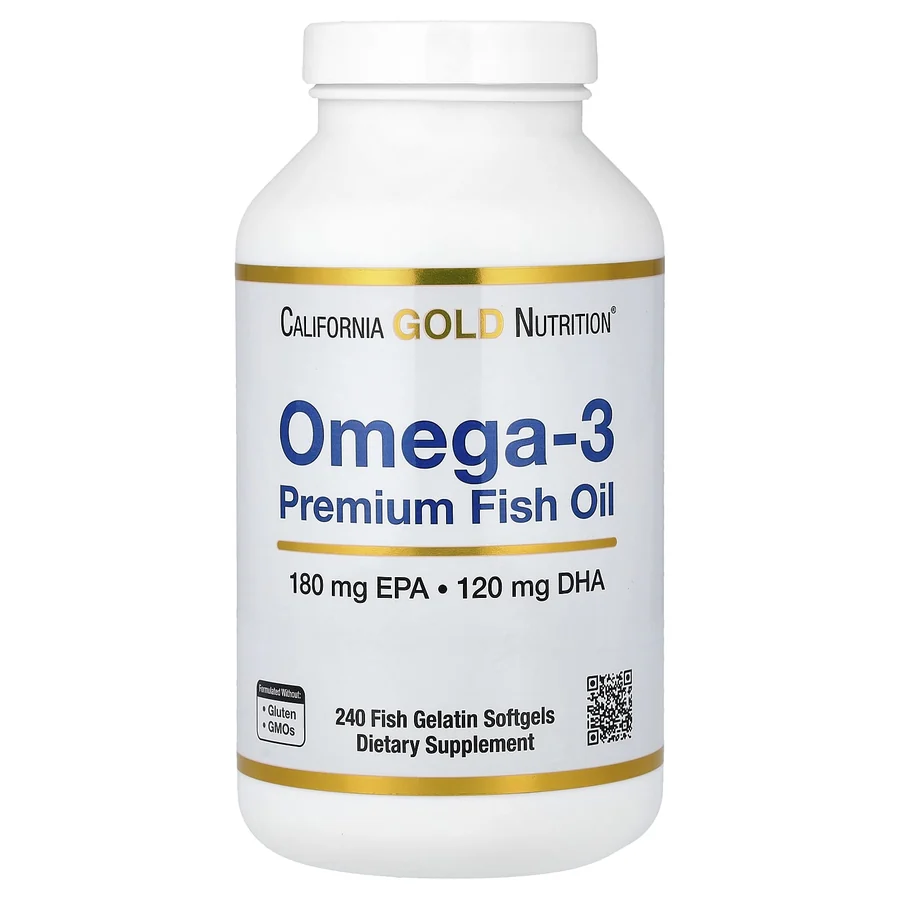
California Gold Nutrition Omega-3 Premium Fish Oil
Omega-3 Premium Fish Oil · 240 fish-gelatin softgels
Omega-3 640 mg; EPA 360 mg; DHA 240 mg per label serving.
- Amount
- Omega-3 640 mg; EPA 360 mg; DHA 240 mg
- Format
- Softgels
- Review basis
- Label-based analysis
Good fit
budget-conscious shoppers who want a simple daily fish oil from a familiar online retailer
Consider another option
you want a higher-potency concentrate, avoid fish gelatin or soy, or prefer a brand with broader independent testing visibility
The product, at a glance
Amounts for the reviewed label serving.
- Reviewed variant
- Omega-3 Premium Fish Oil · 240 fish-gelatin softgels
- Label serving
- 2 softgels
- Servings per reviewed pack
- 120
- Ingredients per label serving
- Omega-3 640 mg; EPA 360 mg; DHA 240 mg
- Other ingredients
- Fish-gelatin softgel; vegetable glycerin; purified water; mixed tocopherols (<0.1%)
Label sources & rating context
~ means approximate; — means no published value in this record. Customer ratings are the named publisher’s snapshot and may include multiple sizes or earlier formulas. The Supplement Explained Score is our source-reviewed editorial assessment out of 25, separate from customer stars. Compare the five criteria and the same intended use; the total is not a clinical ranking. Prices are dated USD offer snapshots; cost uses the reviewed pack and label serving.
- Label clarity: 5/5
- Evidence transfer: 4/5
- Safety fit: 4/5
- Quality proof: 2/5
- Value fit: 3/5
On this pageTable of Contents
- 1Supplement Explained Score
- 2Who California Gold Nutrition Omega-3 Premium Fish Oil may fit
- 3Who should skip California Gold Nutrition Omega-3 Premium Fish Oil
- 4California Gold Nutrition Omega-3 Premium Fish Oil label facts snapshot
- 5What is in the formula?
- 6Price and value analysis
- 7Is there third-party testing or quality proof?
- 8Use-case fit and evidence limits
- 9What do real users often report?
- 10Alternatives to compare
- 11FAQ
Our editorial assessment
Supplement Explained Score
18/25
California Gold Nutrition Omega-3 Premium Fish Oil · Omega-3 Premium Fish Oil · 240 fish-gelatin softgels
Five equally weighted criteria, with a product-specific reason for every point. This is a buying-decision assessment, separate from customer stars and personal medical suitability.
- Label clarity 5/5
- Reviewed Omega-3 Premium Fish Oil · 240 fish-gelatin softgels: 2 softgels; 120 label servings. Omega-3 640 mg; EPA 360 mg; DHA 240 mg.
- Evidence transfer 4/5
- EPA/DHA amounts provide an intake comparison; general fish-oil research does not establish benefit for this bottle's clinical claims.
- Safety fit 4/5
- Fish allergy, GI tolerance and medicine context matter; this is not prescribed triglyceride treatment.
- Quality proof 2/5
- The fish-gelatin formula is identified; no matching independent finished-lot quality record was verified.
- Value fit 3/5
- Two softgels provide 600 mg EPA+DHA, with 120 servings; total oil mass is not used as the value denominator.
Review basis: Published labels, manufacturer/retailer information, clinical sources and exact-product quality records where available. We did not buy, personally use or laboratory-test this product for this assessment.
Reviewed · Method v2.0 · How we assign points
Sources behind this score
Product labels and independent directory records identify a formula or testing scope. Clinical references concern ingredients or studied regimens unless the explanation explicitly matches the finished formula.
Who California Gold Nutrition Omega-3 Premium Fish Oil may fit
- Readers who want a simple daily fish oil without paying premium-brand prices
- iHerb shoppers who prefer a familiar in-house brand and straightforward reordering
- People looking for a moderate EPA+DHA intake rather than a highly concentrated formula
- Shoppers who are comfortable taking 2 softgels with food each day
If your goal is broad omega-3 coverage rather than chasing the highest potency per capsule, this is the lane where the product makes the most sense. For broader background, see our parent guide to omega-3 supplements.
Who should skip California Gold Nutrition Omega-3 Premium Fish Oil
- People who want more EPA+DHA per serving or fewer capsules
- Those avoiding fish, fish gelatin, or soy
- Readers who strongly prefer premium specialist brands with more visible independent testing programs
- Anyone who already knows fish oil tends to trigger reflux or fishy burps for them
If you are fish-free by preference or diet, compare fish oil with algal oil before buying anything in this category: fish oil vs algal oil. If you mainly worry about tolerance, this guide may help: can fish oil cause reflux or fishy burps?
What is in the formula?
According to the public iHerb listing, one serving is 2 softgels. That serving provides 2,200 mg fish oil concentrate and 640 mg total omega-3 fatty acids as triglycerides, including 360 mg EPA, 240 mg DHA, and 40 mg other omega-3 fatty acids.
The other ingredients are limited: fish gelatin softgel, vegetable glycerin, purified water, and vitamin E as mixed tocopherols. The listing also states the product contains fish and soy. Suggested use is 2 softgels daily with food.
If you are comparing labels, the most useful numbers are the EPA and DHA amounts, not just the fish oil total. Our guide on how to read a supplement label can help if fish oil labels tend to blur together.
Studied dose vs label reality
A lot of buyers here are basically asking “is this enough omega-3 or just cheap fish oil?” The honest answer is that it works best as a basic daily product, not a high-potency specialist pick.
Label dose
600 mg EPA + DHAThat is fine for everyday fish-oil shopping, but it is not the kind of label people usually call “triple strength” or “max potency.”
What people compare
250 to 500 mg+ is the common comparison laneFor general intake questions, this lands in a reasonable spot. But once people start wanting fewer softgels or more concentrated formulas, this product stops looking special.
Dose verdict
Roughly aligned Works for basic daily fish oil useThis product is worth comparing on cost per EPA and DHA amount, rather than expecting the most concentrated formula.
Biggest catch
Cheap per serving is not always cheap per useful omega-3Once you compare concentrated fish oils on actual EPA+DHA delivered, the value gap can shrink more than people expect.
What looks strong
- No matched fresh USD serving-cost benchmark was available for the score review. The reviewed Omega-3 Premium Fish Oil · 240 fish-gelatin softgels supplies 120 label servings of Omega-3 640 mg; EPA 360 mg; DHA 240 mg, using 2 softgels per serving. Two softgels provide 600 mg EPA+DHA, with 120 servings; total oil mass is not used as the value denominator.
- Straightforward formula: no long blend list, no inflated marketing story, and EPA/DHA amounts are stated clearly.
- Reasonable everyday dose: 600 mg combined EPA+DHA per serving is not extreme, but it is a practical baseline for many readers comparing standard fish oils.
- Convenient house-brand option: for regular iHerb shoppers, California Gold Nutrition is easy to reorder and often easier to compare against other site listings.
- Basic quality signals on the listing: molecularly distilled, iTested Verified, and produced in a 3rd party audited cGMP registered facility.
In plain terms, this product looks strongest when judged as a budget-friendly daily omega-3, not as a premium high-potency specialist formula.
What looks weak and what the tradeoffs are
The biggest tradeoff is concentration. This product gives 600 mg combined EPA+DHA in a 2-softgel serving, which is workable but not especially concentrated compared with stronger fish oils that deliver more EPA+DHA in the same number of softgels or fewer.
The second tradeoff is ingredient fit. The softgels are made with fish gelatin, and the listing states the product contains soy. That will matter to some readers even if the formula is otherwise simple.
The third tradeoff is trust style rather than a clear red flag. The listing includes positive quality language, but some shoppers are more comfortable with brands that are known mainly for specialty omega-3 products or that offer broader third-party testing visibility. If that matters to you, compare this with our guides on what third-party tested means and the fish oil quality checklist.
Red flags before you hit buy
These are the friction points most likely to make you regret the purchase later, even if the label looked good at first.
- Skip it if you want fewer softgels. This is the wrong lane if capsule count is one of your main buying filters.
- Skip it if soy is a hard no for you. The label is simple, but it is not soy-free.
- Do not buy it just because it is cheap. If you really care about EPA+DHA per serving, compare concentrated products before you decide this is the best value.
Price and value analysis
No matched fresh USD serving-cost benchmark was available for the score review. The reviewed Omega-3 Premium Fish Oil · 240 fish-gelatin softgels supplies 120 label servings of Omega-3 640 mg; EPA 360 mg; DHA 240 mg, using 2 softgels per serving. Two softgels provide 600 mg EPA+DHA, with 120 servings; total oil mass is not used as the value denominator.
That puts this in the value tier, especially for readers who want a basic daily fish oil and are not paying extra for very high EPA/DHA concentration. The catch is that low price per serving does not always mean best value per milligram of EPA+DHA, so concentrated alternatives can still win if capsule count and potency matter more to you.
Cost for the reviewed serving
No matched fresh USD serving-cost benchmark was available for the score review. The reviewed Omega-3 Premium Fish Oil · 240 fish-gelatin softgels supplies 120 label servings of Omega-3 640 mg; EPA 360 mg; DHA 240 mg, using 2 softgels per serving. Two softgels provide 600 mg EPA+DHA, with 120 servings; total oil mass is not used as the value denominator.
Is there third-party testing or quality proof?
The listing states this product is iTested Verified, molecularly distilled, formulated without gluten or GMOs, and produced in a 3rd party audited cGMP registered facility. Those are useful positive signals, but they are still listing-level signals rather than a complete quality dossier.
For readers trying to separate meaningful quality markers from marketing shorthand, it helps to look at the exact testing language, lot-level availability, and how the brand explains purity and oxidation checks. Our explainers on what third-party tested means and the fish oil quality checklist can help you compare products more consistently.
What this product is really implying
The brand implication here is not super flashy. It is more like: simple, clean enough, tested enough, and cheap enough. That pitch is useful, but it still needs a reality check.
Marketing angle
This is a smart, easy, no-drama fish oil buy for everyday use, with enough quality language to feel safe and enough value to feel obvious.
Evidence reality
The support is for EPA and DHA intake overall, not a special advantage for this house-brand product over every other fish oil on the shelf.
Shopping takeaway
If you want a plain, affordable daily fish oil, this works. If you want stronger concentration, fewer capsules, or higher-trust testing visibility, keep comparing.
Use-case fit and evidence limits
| Use Case | Evidence | Typical Time Window |
|---|---|---|
| General EPA+DHA support | Moderate | Usually framed over weeks to months, not overnight. |
| Budget-minded daily fish oil use | Practical fit | Value shows up immediately in bottle size and cost per serving. |
| Cholesterol-support routines | Mixed | Often discussed over weeks to months with diet context. |
| Fishy-burp-sensitive shoppers | Mixed fit | Tolerance differences often show up quickly and vary by person. |
Most evidence in this category is about omega-3 intake overall, especially EPA and DHA, not this exact California Gold Nutrition product. Official U.S. sources such as NIH and NCCIH describe omega-3s as nutrients with established roles in the body, while also making clear that supplement use should be matched to the reason you are taking it and your overall diet.
In practice, this product fits best as a basic fish oil for readers who want everyday intake support, not a targeted high-potency formula. If your main question is around lab follow-up or goal matching, these guides may be more useful than a product page alone: cholesterol labs before fiber or fish oil, cholesterol support, and joint support.
What do real users often report?
Anecdotal only. This block summarizes recurring public discussion themes, not controlled research and not hands-on testing by us.
Consensus scope: 3 public source pages listed below. Themes are anecdotal and are not a representative customer sample.
Recurring positives
- Users discussing fish oil brands often praise affordable products that have simple labels, are easy to reorder, and seem to agree with them when taken with food. Value and convenience come up often in this type of discussion.
Recurring negatives
- The common complaints in fish oil threads are familiar: fishy burps, GI discomfort, uncertainty about how to judge quality, and frustration when a low-cost product turns out to be less concentrated than expected.
Overall read
- The anecdotal read is that products like this appeal most to practical buyers, while detail-focused shoppers usually keep comparing concentration, testing language, and tolerance before they commit.
Public threads reviewed: Public Reddit discussions at r/Supplements discussion 1, r/Supplements discussion 2, and r/Supplements discussion 3.
Note: These are summarized recurring themes from public user discussions. They are anecdotal and do not replace clinical evidence or professional guidance.
Alternatives to compare
If your main complaint here is the modest concentration, compare it with a more concentrated fish oil that delivers higher EPA+DHA per serving or in fewer softgels. That is often the clearest upgrade path.
Our Sports Research vs Nordic Naturals Omega-3 comparison shows how concentrated fish oils differ on serving burden, EPA+DHA, certification visibility, and formula format.
If your concern is ingredient fit rather than potency, a fish-free omega-3 may be the better comparison. Our guide on fish oil vs algal oil is a good next stop.
And if you are still not sure whether this product category fits your diet, goals, or schedule, the broader omega-3 guide may be more useful than any single product page. Timing questions are also common: best time to take omega-3.
| Product | Best For | Main Tradeoff |
|---|---|---|
| NOW Ultra Omega-3 Fish Oil | Higher EPA+DHA per softgel | More coating complexity and smaller everyday value gap than it first appears. |
| Nordic Naturals Ultimate Omega | Premium-brand shoppers | Clearly higher price band. |
| Omega-3 Guide | Source-first decisions | Less product-specific if you are still comparing fish oil with algal oil. |
FAQ
How much EPA and DHA does California Gold Nutrition Omega-3 Premium Fish Oil provide?
Per 2-softgel serving, the listing states 360 mg EPA and 240 mg DHA, for 600 mg combined EPA+DHA.
Is this a high-potency fish oil?
Not really. It is better described as a standard, value-oriented fish oil. More concentrated products can provide more EPA+DHA in the same serving or fewer capsules.
How many softgels do you take?
The listed serving size is 2 softgels daily with food.
Does it contain common allergens or animal ingredients?
Yes. The listing states it contains fish and soy, and the capsules are fish gelatin softgels.
What quality markers are listed?
The public listing says iTested Verified, molecularly distilled, formulated without gluten or GMOs, and produced in a 3rd party audited cGMP registered facility.
Is this the best pick if I want fewer capsules?
Probably not. If capsule count matters a lot to you, compare higher-concentration fish oils first, since they may deliver more EPA+DHA in fewer softgels.
When should I talk to a clinician before using fish oil?
If you are unsure how omega-3 fits with your health history, medications, or lab goals, it is smart to check in first. Our plain-English guide on when to talk to a clinician can help you decide.
References
- iHerb product listing: California Gold Nutrition Omega-3 Premium Fish Oil
- NIH Office of Dietary Supplements: Omega-3 Fatty Acids Consumer Fact Sheet
- NIH Office of Dietary Supplements: Omega-3 Fatty Acids Health Professional Fact Sheet
- NCCIH: Omega-3 Supplements What You Need To Know
- Reddit discussion source 1
- Reddit discussion source 2
- Reddit discussion source 3
Editorial information
Reviewed for Trust
- Publisher: Supplement Explained Editorial Team
- Review model: Editorial evidence review; clinician review is shown only when a named clinician is listed.
- Last reviewed: October 7, 2026
- Last updated: October 7, 2026
- Editorial Policy | How We Review Evidence | Research Process | Disclaimer
- Use: Informational only. Not personal medical advice.
Public review mining
What users tend to say across public reviews
This is a synthesis of recurring public-review themes, not our own clinical test and not a copied review feed. Individual results vary, and retailer reviews can be biased by self-selection.
Common praise
- Retailer reviews repeatedly mention value, easy softgels, secure packaging, and little or no fishy aftertaste.
- The very large review base suggests strong buyer familiarity, which is useful for detecting recurring tolerance and taste themes.
- iTested-style documentation is a useful quality signal, but it should be read as label/purity support rather than health-outcome proof.
Common friction
- The EPA/DHA amount per softgel is modest compared with higher-concentration fish oils, so dose-per-dollar math matters.
- Some users still report fishy burps or reflux with fish oil generally; taking with meals or switching format may matter.
- Brand-level trust debates exist, so product-specific testing and label math are more useful than assuming all house-brand products are equal.
Reader takeaway: Best interpreted as a value-oriented fish oil where the buying decision should center on EPA/DHA per serving, burp tolerance, and available testing documentation.
Review mining date: June 5, 2026. Status: public-review synthesis; not personally tested unless a separate hands-on note appears on this page.
Continue your decision
If this product is not an obvious fit, use one of these routes instead of leaving the decision unfinished.
- Omega-3 guide Review EPA/DHA context, fish oil vs algal oil, reflux issues, and quality checks.
- All product analyses Browse the full product analysis library for alternatives and category comparisons.
- Supplement Explained Score See how label clarity, evidence transfer, safety fit, quality proof, and value fit are scored.
- Interaction checklist Check common combination risks before stacking supplements or medications.