~ = approximate; — = not reported. Customer stars may cover other sizes or older formulas. Our editorial score out of 100 covers the label, evidence and buying tradeoffs, not how well a supplement will work for you. Cost per serving uses the listed pack and its price on the date shown.
Label clarity: 5/5
Research relevance: 5/5
Safety and cautions: 4/5
Testing and quality checks: 3/5
Value for money: 3/5
This unflavored 500 g tub lists 5 g creatine monohydrate per scoop and 100 servings. The reviewed listing claims Informed Sport testing; confirm the exact product and lot in the certifier directory if sport eligibility matters. A different 450 g NSF listing does not verify this tub.
Product labels and independent directory records identify a formula or testing scope. Clinical references concern ingredients or studied regimens unless the explanation explicitly matches the finished formula.
Who might consider this powder?
Someone comparing plain, unflavored 5 g monohydrate servings can use this simple label. Tested athletes should confirm the exact Informed Sport record and lot before relying on the listing claim. The research supports the ingredient and training use, not special results from the Sports Research name.
Who should skip Sports Research Creatine Monohydrate 500 g
People who do not need sport certification and can buy a cheaper generic monohydrate.
Anyone who requires immediate availability when the listing is out of stock.
People expecting a different result simply because the product is certified.
Users with kidney disease or a clinician-directed restriction.
Certification reduces banned-substance risk; it does not replace individual safety context or make loading necessary.
How we reviewed this product
This is a label-based editorial review. We checked the public label, serving size, active amount, current retailer or brand information, named quality signals, ingredient evidence, and recurring public review themes. It is not a hands-on test, lab certificate, or medical recommendation.
Informed Sport is a verifiable named certification and raises confidence. We did not personally open or mix the powder.
What is in the formula?
The formula is 5 g micronized creatine monohydrate per scoop with roughly 100 servings. No additional active ingredients are needed for the core creatine evidence.
The product is listed as vegan, gluten-free, non-GMO, third-party tested, and Informed Sport certified. The certification matters most for athletes subject to testing.
Creatine monohydrate remains the most studied form. Certification improves quality confidence, not the magnitude of the ingredient’s expected effect.
What’s good, what’s not
What looks strong
Strong research relevance: 5 g creatine monohydrate is straightforward.
Named sport certification: Informed Sport is useful for tested athletes.
Single ingredient: no proprietary blend or unnecessary extras.
No matched fresh USD serving-cost benchmark was available for the score review. The reviewed Creatine Monohydrate · Unflavored · 500 g supplies 100 label servings of Micronized creatine monohydrate 5 g, using 1 scoop (5 g) per serving. One hundred plain 5 g servings simplify comparison, but the exact current matched USD price is unavailable.
What may change the decision
Availability: stock status has changed on the retailer listing.
Mixability: clumping or settling appears in some reviews.
Certification premium: unnecessary for buyers focused only on the lowest cost.
Red flags before you buy
Verify the current Informed Sport listing and received label.
Do not confuse certification with a guarantee of better strength gains.
Water-weight and GI effects remain possible.
Kidney disease or medical restrictions require guidance.
Compare the price for 100 servings
Divide the current delivered price for this 500 g tub by 100 for cost per 5 g serving. No fresh matched USD price is quoted here. Compare the same shipping and subscription terms; a price for a 450 g tub is a different calculation.
Is there third-party testing or testing documentation?
Informed Sport certification is a meaningful finished-product signal for banned-substance testing. The listing also states third-party testing, cGMP manufacturing, vegan, gluten-free, and non-GMO positioning.
Certification scope should still be verified against the exact current product and lot, especially when listings or packaging change.
Use-case fit, evidence limits, and safety
NIH ODS identifies creatine monohydrate as the most widely used and studied form and supports performance benefits for repeated short, intense activity.
The product’s label closely matches ingredient research. That does not make every user a responder or turn creatine into an endurance supplement.
Safety limits
Water-weight gain is common.
GI discomfort can occur with large doses or poor mixing.
Kidney disease or medical restrictions need individualized advice.
Tested athletes should maintain documentation for the exact certified product.
If medicines, pregnancy, surgery, kidney or liver disease, abnormal labs, or multiple supplements are part of the picture, use the supplement interaction checklist and involve a qualified clinician or pharmacist.
Alternatives to compare
Compare certification need, raw-material preference, and current price.


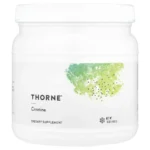 Alternative to compareThorne Creatine, 450 g