
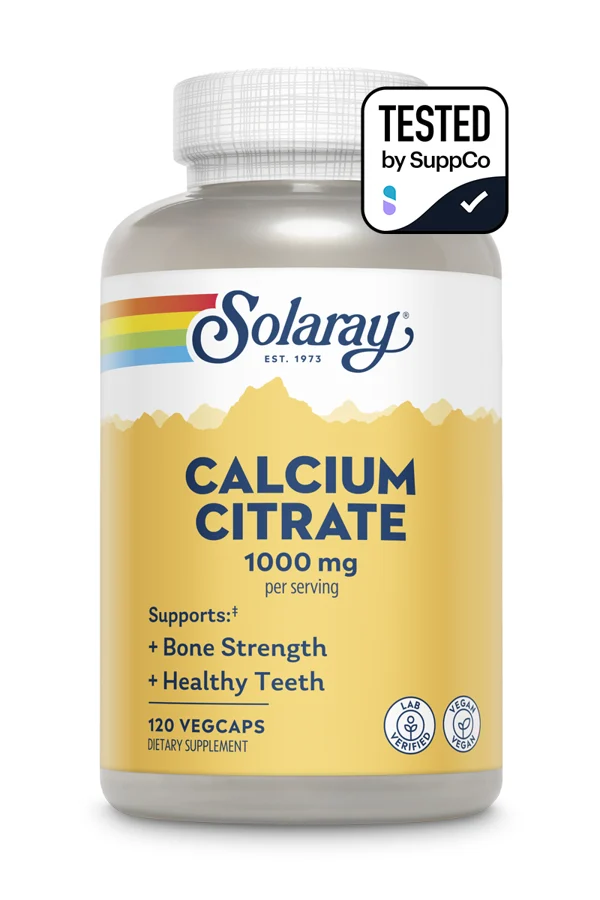
Solaray Calcium Citrate 1000 mg
Calcium Citrate · 120 capsules
Elemental calcium 1,000 mg; citrate (85%) + carbonate per label serving.
- Amount
- Elemental calcium 1,000 mg; citrate (85%) + carbonate
- Format
- Capsules
- Review basis
- Label-based analysis
No matched retailer offer is recorded. Use the review to check the exact label and availability.
The product, at a glance
Amounts for the reviewed label serving.
- Reviewed variant
- Calcium Citrate · 120 capsules
- Label serving
- 4 capsules
- Servings per reviewed pack
- 30
- Ingredients per label serving
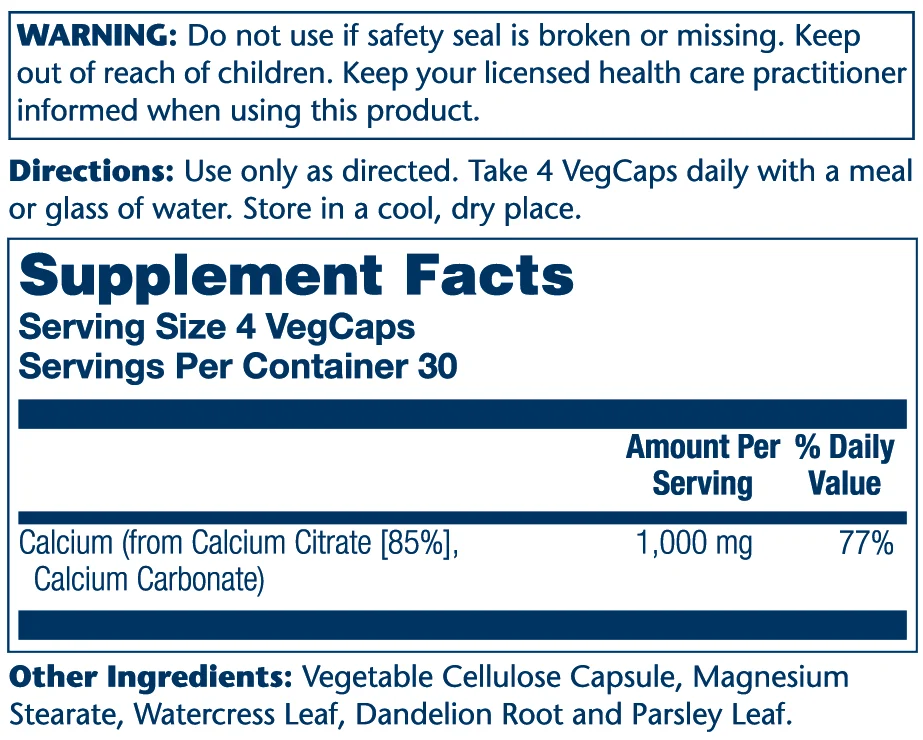
- Elemental calcium 1,000 mg; citrate (85%) + carbonate
- Other ingredients
- Vegetable cellulose capsule, magnesium stearate, watercress leaf, dandelion root, parsley leaf
- Storage
- Store in a cool, dry place
Label sources & rating context
~ means approximate; — means no published value in this record. Customer ratings are the named publisher’s snapshot and may include multiple sizes or earlier formulas. The Supplement Explained Score is our source-reviewed editorial assessment out of 25, separate from customer stars. Compare the five criteria and the same intended use; the total is not a clinical ranking. Prices are dated USD offer snapshots; cost uses the reviewed pack and label serving.
- Label clarity: 4/5
- Evidence transfer: 4/5
- Safety fit: 3/5
- Quality proof: 2/5
- Value fit: 2/5
On this pageTable of Contents
- 1Supplement Explained Score
- 2The reviewed label
- 3Why the carbonate matters
- 4How much is in one capsule?
- 5The direction discrepancy should not be ignored
- 6No added D: a formulation choice, not a nutrition conclusion
- 7Price and the bottle-size problem
- 8When a citrate-only option is a better match
- 9Safety before a large serving
- 10Product examples to compare
Our editorial assessment
Supplement Explained Score
15/25
Solaray Calcium Citrate 1000 mg · Calcium Citrate · 120 capsules
Five equally weighted criteria, with a product-specific reason for every point. This is a buying-decision assessment, separate from customer stars and personal medical suitability.
- Label clarity 4/5
- Reviewed Calcium Citrate · 120 capsules: 4 capsules; 30 label servings. Elemental calcium 1,000 mg; citrate (85%) + carbonate. Companion-blend quantities, current variant or full-panel details remain less complete than the core active amount.
- Evidence transfer 4/5
- Calcium can address an intake gap; the mixed citrate/carbonate form is not proven universal fracture protection.
- Safety fit 3/5
- A 1,000 mg serving requires attention to divided intake, food, other calcium and medicines; kidney history matters.
- Quality proof 2/5
- The reviewed mixed-salt formula lacks a verified exact-product independent quality result.
- Value fit 2/5
- The high multi-capsule serving and pack identity differences limit practical cost comparison.
Review basis: Published labels, manufacturer/retailer information, clinical sources and exact-product quality records where available. We did not buy, personally use or laboratory-test this product for this assessment.
Reviewed · Method v2.0 · How we assign points
Sources behind this score
Product labels and independent directory records identify a formula or testing scope. Clinical references concern ingredients or studied regimens unless the explanation explicitly matches the finished formula.
There is also a buying-relevant inconsistency: the manufacturer’s label image and a website FAQ do not give the same daily capsule instructions. This review explains the label math but does not turn those conflicting directions into a personal regimen. Obtain clarification for your bottle before relying on the website instructions. [2] [1]
The reviewed label
| Detail | 120-capsule US label |
|---|---|
| Full label serving | Four capsules |
| Elemental calcium | 1,000 mg per serving |
| Calcium source | Calcium citrate [85%] and calcium carbonate |
| Full servings per bottle | 30 |
| Arithmetic calcium per capsule | 250 mg |
| Added vitamin D | None listed |
| Other ingredients | Vegetable cellulose capsule, magnesium stearate, watercress leaf, dandelion root, parsley leaf |
The table follows the label image rather than assuming that the product name describes every mineral source. The botanical ingredients are not listed here as evidence of an additional clinical benefit. [1]
View the manufacturer’s Supplement Facts label
View original manufacturer label
Manufacturer label; check the package you receive for changes.
Why the carbonate matters
For someone who accepts a citrate–carbonate blend, the presence of carbonate is a specification to understand. For someone specifically told to choose citrate-only, it can be a reason to select another product.
NIH distinguishes these forms partly by their dependence on stomach acid: citrate is less dependent on acid than carbonate. A product name containing citrate should therefore not be used to erase the distinction between an exclusively citrate product and a mixed-source one. [3]
The bracketed 85% on Solaray’s label describes its calcium-source wording, not an absorption rate. It does not show how much calcium an individual will absorb. [1]
How much is in one capsule?
The arithmetic is 1,000 mg ÷ 4 capsules = 250 mg calcium per capsule. The 120-count bottle contains 120 ÷ 4 = 30 full servings, for a total of 30,000 mg declared calcium. [1]
These quantities help compare bottles. They do not tell a reader how many capsules to take, and they do not imply that capsule contents should be divided. “1,000 mg” on the front is not the amount in each capsule.
The calcium amount in Supplement Facts is already elemental calcium. It would be incorrect to apply another calcium-citrate percentage to that 1,000 mg and report the result as the true nutrient amount. [3]
The direction discrepancy should not be ignored
The inspected label image directs four capsules daily. A manufacturer webpage FAQ instead describes four capsules twice daily while discussing the product’s calcium amount. Those statements are not interchangeable. [2] [1]
We have not received written manufacturer clarification. A useful question is: “For this exact bottle size and lot, what is the current serving size and daily suggested use, and why does the FAQ differ from the label?” Include a photograph of the bottle rather than assuming the FAQ applies to every version.
Until that is resolved, this page should not be used as a dosing instruction. A healthcare professional can also help determine an appropriate total intake independently of the manufacturer’s conflicting wording.
No added D: a formulation choice, not a nutrition conclusion
No vitamin D appears in the reviewed panel. That can be useful when D is already supplied separately and you want to avoid an additional combined dose. It is not a reason to conclude that vitamin D status is irrelevant or that anyone should stop a prescribed vitamin D product. [1] [3]
For a narrower shortlist, see calcium options without added vitamin D, including citrate-only alternatives.
Before combining products, look at the entire supplement list. Calcium may already be present in a multivitamin or other combination formula. The daily calcium target concerns total intake, including food—not just the amount in a new bottle.
Price and the bottle-size problem
The manufacturer lists the 120-capsule version at $14.79 on September 27, 2026. Its 30 four-capsule servings cost about $0.49 each, or $0.25 per standardized 500 mg calcium quantity. These are price comparisons, not dosing instructions; tax and shipping are excluded. [2]
For this 120-count version, a confirmed price can be compared using:
Price per full serving = bottle price ÷ 30.
Price per 500 mg calcium = bottle price ÷ 30,000 × 500.
The 500 mg unit is a cost-normalization example, not an instruction to take that quantity. Use the same purchase conditions across sellers and separate tax and shipping.
When a citrate-only option is a better match
Pure Encapsulations Calcium Citrate provides 300 mg across two capsules, or an arithmetic 150 mg per capsule, with no carbonate or added D listed on the reviewed label. NOW Calcium Citrate Pure Powder provides 600 mg calcium in its approximately 3 g serving, with no other ingredients listed. [4] [5]
These are meaningful alternatives for a citrate-only requirement or a different format. They are not automatically superior for every person, and their full servings are not the same calcium amount as Solaray’s four capsules.
Safety before a large serving
NIH notes that the fraction of supplemental calcium absorbed is highest at amounts of 500 mg or less at one time. That does not mean calcium above 500 mg is never absorbed; it does mean that a 1,000 mg label serving should not automatically be marketed as the best single-dose choice. [3]
Kidney conditions, a stone history, other supplements, and medicines can affect the appropriate plan. A review cannot establish your dietary shortfall or resolve a medication schedule.
The product’s honest position is a mixed-source calcium option without added D, with clear four-capsule quantity math and an unresolved instruction discrepancy—not a pure-citrate winner or a universal 1,000 mg daily recommendation.
Related reading
For the difference between citrate-only calcium and blends, see our calcium citrate supplement comparison.
For the arithmetic behind capsules, servings, and nutrient quantities, see our serving-size and dose guide.
Product examples to compare
- Solaray Calcium, Magnesium, Zinc: Four capsules: 1,000 mg calcium, 500 mg magnesium and 25 mg zinc; check overlap and tolerance first.