
Calcium Citrate Supplements Compared: Source, Serving and Added Vitamin D
A calcium supplement with “citrate” in its name may be citrate-only or a blend containing another calcium source. The useful comparison starts with that distinction, followed by elemental calcium per unit, the number of units per serving, and whether vitamin D is added. A larger front-label amount is not automatically the best fit. [1] [2] [3]
On this pageTable of Contents
- 1Three meaningfully different options
- 2First decide whether citrate-only is a requirement
- 3Pure Encapsulations: citrate-only capsules with a 150 mg unit
- 4NOW: citrate-only powder without a capsule
- 5Solaray: a blend that needs a direction check
- 6Why calcium per unit can matter more than calcium per bottle
- 7Do you need vitamin D in the same product?
- 8Test evidence and product comfort need their own proof
- 9When to pause the shopping comparison
The verified products below cover citrate-only capsules, citrate-only powder, and a citrate–carbonate capsule blend. They do not represent every calcium citrate product sold in the United States, and we have not tested their swallowing, taste, or clinical effects.
Three meaningfully different options
Compare the reviewed products
| Criterion | Solaray Calcium Citrate 1000 mg | Citracal Maximum Plus D3 |
|---|---|---|
| Format | Capsules | Caplets |
| Reviewed variant | Calcium Citrate · 120 capsules | Maximum Plus D3 · 120 caplets · retailer formula |
| Label serving | 4 capsules | 2 caplets |
| Servings per reviewed pack | 30 | 60 |
| Ingredients per label serving | Elemental calcium 1,000 mg; citrate (85%) + carbonate | Retailer panel: calcium 630 mg; D3 12.5 mcg (500 IU) |
| Other ingredients | Vegetable cellulose capsule, magnesium stearate, watercress leaf, dandelion root, parsley leaf | Polyethylene glycol; croscarmellose sodium; partially hydrolyzed polyvinyl alcohol; titanium dioxide; magnesium silicate; magnesium stearate (630 mg retailer formula) |
| Storage | Store in a cool, dry place | — |
| Formula / pack difference | — | Current manufacturer formula is 650 mg calcium + D3 25 mcg per 2 caplets; linked retailer describes older 630 mg / 12.5 mcg formula. |
| Supplement Explained Score | ||
| Customer ratings | 4.8/5 · 58 ratingsSolaray · 2026-10-07 | — |
| Sources | ||
| Review & retailer offer |
~ means approximate; — means no published value in this record. Customer ratings are the named publisher’s snapshot and may include multiple sizes or earlier formulas. The Supplement Explained Score is our source-reviewed editorial assessment out of 25, separate from customer stars. Compare the five criteria and the same intended use; the total is not a clinical ranking. Prices are dated USD offer snapshots; cost uses the reviewed pack and label serving.
The absence of added vitamin D is a label fact, not a recommendation to avoid vitamin D or a statement that your vitamin D status is adequate. All calcium amounts in this table are elemental calcium as declared in Supplement Facts. [2] [3] [1]
If you specifically want separate nutrient amounts, compare calcium supplements without added vitamin D.
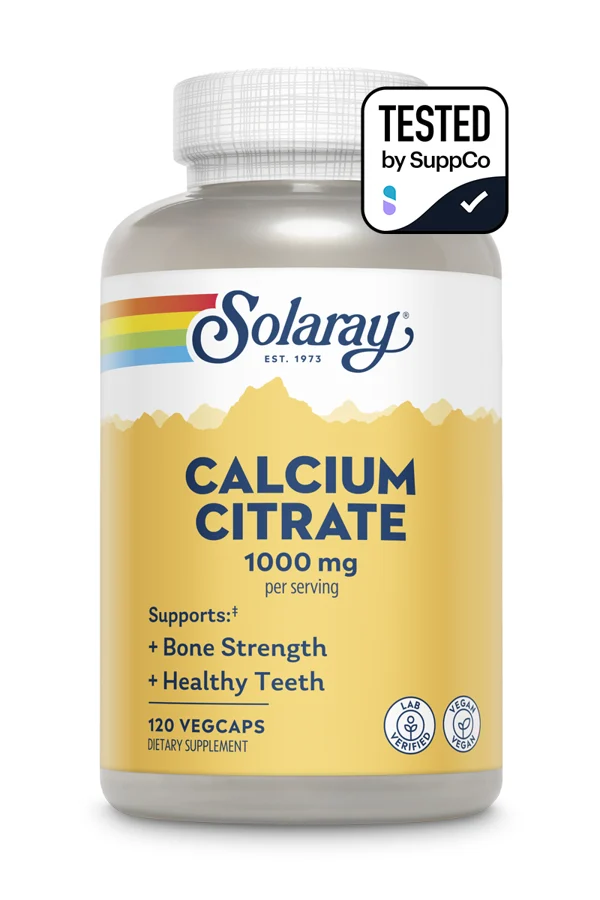
Solaray Calcium Citrate 1000 mg
1,000 mg calcium per four capsules. 120 capsules. Manufacturer directions conflict; confirm the current bottle instructions before use.
First decide whether citrate-only is a requirement
The Solaray label explicitly includes citrate and carbonate. It should not receive a citrate-only designation simply because citrate is in the product name. Pure’s reviewed capsule label and NOW’s pure powder record identify calcium citrate without listing carbonate as another calcium source. [1] [2] [3]
NIH explains that calcium citrate is less dependent on stomach acid than calcium carbonate, which can make form relevant. It also notes that calcium absorption generally benefits from taking supplements with food. Those are useful distinctions, not a reason to diagnose your needs from a product comparison. [4]
A clinician’s recommendation to use citrate-only should be checked against the actual panel. Someone who does not require an exclusive citrate source may have a different set of priorities, including unit amount or format.
Pure Encapsulations: citrate-only capsules with a 150 mg unit
The reviewed Pure label lists 300 mg calcium in two capsules, making the arithmetic amount per capsule 150 mg. The other ingredients are the cellulose-and-water capsule and ascorbyl palmitate. It has no added vitamin D listed. [2]
This is a concrete option to examine when a smaller counted unit and citrate-only formulation are the priorities. It does not mean the capsule is physically small: dimensions and a swallowing test were not verified here. Do not confuse lower nutrient content per capsule with proven easier swallowing.
The selected 60-capsule bottle was $14 at the manufacturer during the September 27, 2026 check. It has 30 labeled two-capsule servings, giving a cost of about $0.47 per 300 mg serving or $0.78 per standardized 500 mg quantity. The latter is arithmetic, not a serving instruction. Tax and shipping are excluded. [5]
NOW: citrate-only powder without a capsule
NOW’s product record lists about 3 g of powder, described as 1.5 level teaspoons, supplying 600 mg calcium. The record lists about 76 servings and no other ingredients. This is a different format for someone who wishes to avoid swallowing capsules. [3]
The 3,000 mg of calcium citrate compound and the 600 mg of elemental calcium are different numbers. Do not interpret the compound mass as the nutrient dose, and do not multiply the already stated 600 mg by another citrate percentage.
The trade-off is measuring and mixing. An approximate household measurement is not a personalized dose calculator. We have not tasted the powder, measured its suspension in drinks, or established a reliable lower-dose fraction of its serving. The approximate serving count should remain approximate in any cost calculation.
Solaray: a blend that needs a direction check
The reviewed 120-capsule Solaray label lists 1,000 mg calcium across four capsules, from citrate and carbonate. The source wording includes “citrate [85%]”; that should not be converted into an independently verified absorption percentage or an exact amount absorbed from each source. [1]
There is an important inconsistency in the manufacturer materials: the image says four capsules daily, while a website FAQ describes four capsules twice daily. This comparison does not resolve that conflict into a regimen. Check the instructions on the bottle and obtain manufacturer or pharmacist confirmation before relying on the contradictory web text. [6] [1]
The blend may still be relevant to a shopper who accepts both mineral sources and wants no added D. It is not a substitute for an exclusively citrate formulation when that distinction matters.
Why calcium per unit can matter more than calcium per bottle
A capsule providing 150 mg and one corresponding to 250 mg are not the same unit. Likewise, a 600 mg powder serving and a 1,000 mg four-capsule serving should not be compared as though their larger number automatically meant a better routine. [2] [3] [1]
NIH reports that the fraction of supplemental calcium absorbed is highest at amounts of 500 mg or less at one time. This is not a claim that anything above 500 mg is wasted or that every reader should take exactly 500 mg. It is a reason not to treat the largest single serving as an automatic advantage. [4]
The appropriate supplement amount also depends on calcium already supplied by food. A supplement is not inherently supposed to provide the entire daily requirement on top of an adequate diet.
Do you need vitamin D in the same product?
None of these three reviewed panels lists added D. That may be convenient for someone already taking vitamin D separately or following a plan that keeps the two nutrients independently adjustable. It does not establish that vitamin D is unnecessary for calcium nutrition. [2] [3] [1] [4]
Products containing D can be valid alternatives, but their D amount should be included in total intake rather than ignored as a bonus ingredient. This specific verified table should not be mistaken for a survey of all calcium-plus-D products.
Test evidence and product comfort need their own proof
A brand’s manufacturing-quality statement does not verify the size of its pills, the experience of swallowing them, or a finished-product clinical benefit. We have not awarded independent certification badges to these calcium products without an exact program record.
For a strong allergy requirement, a medication-related restriction, or a need for a certain calcium source, verify the current full panel and ask about the exact bottle. Changing brand, country, or size can require checking the formula again.
When to pause the shopping comparison
Kidney disease, a history of kidney stones, calcium-related medical issues, or medicine interactions can make individualized advice important. Calcium can affect the absorption of certain medicines, so a pharmacist should check the actual drug rather than apply a universal spacing rule. [4]
Start with the amount and source that fit your plan. Then choose between citrate-only capsules, citrate-only powder, and an acceptable blend. “Best” should describe that match—not merely the product with the highest milligram number.
Related reading
For the four-capsule calcium panel and unresolved directions, see our Solaray calcium citrate label review.
For the arithmetic behind capsules, servings, and nutrient quantities, see our serving-size and dose guide.
Compare specific product labels:
- Citracal Maximum Plus D3: A calcium-citrate caplet with a meaningful old/new vitamin D label difference; confirm the bottle before comparing doses.