

Calcium Supplements Without Vitamin D: Citrate-Only and Blend Options
Calcium supplements without added vitamin D do exist. Pure Encapsulations Calcium Citrate and NOW Calcium Citrate Pure Powder are citrate-only options in the panels described below; Solaray Calcium Citrate is a citrate-carbonate blend. NOW’s manufacturer text retrieved October 10, 2026 and the Pure and Solaray panels archived in the September 27 report list no added vitamin D. That is a product filter, not a reason to avoid vitamin D or assume your vitamin D status is adequate. [1] [2] [3]
Do not stop prescribed vitamin D or increase calcium because a D-free product is available. Discuss calcium with your clinician if you have kidney disease, a stone history or high blood calcium, and check medicine compatibility with a pharmacist. Calcium supplementation is not a stand-alone osteoporosis treatment. [4]
For a broader calcium-form decision, see the calcium citrate comparison.
Compare calcium source, amount and format
| Your requirement | Citrate-only, counted capsules | Citrate-only, no capsule to swallow | No added D, blend acceptable |
|---|---|---|---|
| Panel and source scope | Pure Calcium Citrate, 60 capsules; September 27 archived panel | NOW Calcium Citrate Pure Powder; manufacturer text retrieved October 10 | Solaray Calcium Citrate, 120 capsules; September 27 archived panel |
| Calcium amount | 300 mg per two capsules; 150 mg each by arithmetic | 600 mg per approximately 3 g serving, described as 1.5 level teaspoons | 1,000 mg per four capsules; 250 mg each by arithmetic |
| Main caveat | Nutrient amount does not establish capsule size or ease of swallowing. | Requires measuring and mixing; partial teaspoons are not verified precise amounts. | Contains carbonate; check actual bottle directions rather than an inconsistent archived FAQ. |
Use the complete current panel to establish no declared added D. The front name alone does not reliably answer whether a nutrient appears elsewhere in the formulation. [1] [2] [3]
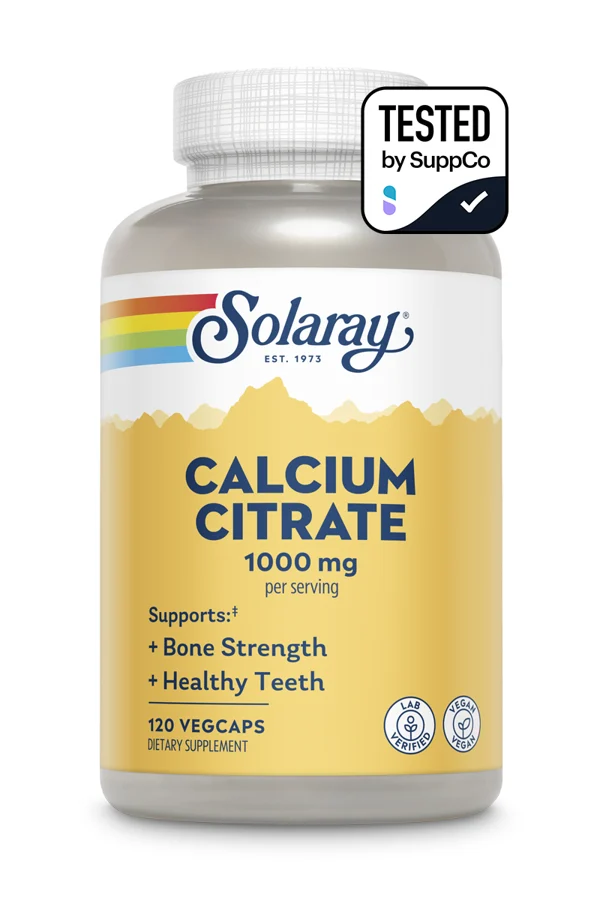
Solaray Calcium Citrate 1000 mg
The archived 120-capsule panel lists 1,000 mg calcium per four capsules from citrate and carbonate. Confirm the actual bottle instructions; an archived website FAQ conflicted with daily directions.
Why someone might want calcium and D separately
A person may already use a vitamin D product, may have a clinician-directed amount that should not be changed, or may want the two supplement amounts independently adjustable. These are practical reasons to seek a calcium formula without D.
Our calcium after menopause guide works through total food intake and the trade-offs of a combination calcium product.
They do not establish that calcium nutrition is independent of vitamin D. NIH describes vitamin D as important to calcium absorption and explains that overall calcium intake includes food as well as supplements. Choosing separate bottles does not replace attention to either nutrient. [4]
Pure: distinguish calcium amount from capsule size
The archived Pure 60-capsule label uses a two-capsule serving providing 300 mg calcium as citrate. The arithmetic amount per capsule is 150 mg. The capsule shell contains cellulose and water, and ascorbyl palmitate is listed as another ingredient; vitamin D is not listed. The current manufacturer gallery links this same panel, but an archived image does not verify the contents of every current bottle. [1] [5]
This is a smaller counted calcium unit than the 250 mg arithmetic Solaray capsule amount. It does not establish that the Pure capsule is physically smaller or easier to swallow. Compare the actual package and serving, not an inferred capsule dimension.
NOW: powder with no other ingredients listed
NOW’s manufacturer text retrieved October 10 lists 600 mg elemental calcium in approximately 3 g powder, described as 1.5 level teaspoons. The 8 oz product, SKU 1240, lists about 76 servings and no other ingredients. This avoids a capsule shell but introduces measurement requirements. [2]
The 3,000 mg calcium citrate compound amount is not 3,000 mg calcium. The declared nutrient amount is 600 mg per serving. Do not multiply that elemental amount by a citrate percentage again or assume a guessed fraction of a teaspoon gives a precise smaller amount.
Solaray: no added D does not mean citrate-only
Solaray’s archived panel has no vitamin D, but it identifies both citrate and carbonate as calcium sources. That allows it into the no-added-D set, not a citrate-only category. [3]
The archived 120-capsule panel supplies 1,000 mg calcium across four capsules, giving 30 full servings. The manufacturer page archived in the September 27 report included daily directions and a conflicting FAQ phrase saying four capsules twice daily.
The directions returned from the manufacturer page on October 10 say four VegCaps daily with a meal and water. That retrieval does not establish that the earlier FAQ conflict was formally resolved. Follow the actual bottle’s instructions and ask the manufacturer if wording conflicts; do not double a serving because of the archived FAQ. These are manufacturer directions, not a personal intake recommendation. [6]
A blend can be relevant when both sources are acceptable. It is not interchangeable with a clinician’s citrate-only instruction.
How to check that there is no added vitamin D
Here, it means no added vitamin D is declared on the described full product panel. It is not a laboratory finding of absolute zero vitamin D molecules and does not verify every future batch or reformulation.
Before ordering, confirm that the current panel has no added D, the calcium source meets your requirement and the unit amount and format fit your plan. Recheck when a seller uses an old photo, combines strengths or lists another country’s formulation.
Read for other ingredients too. Avoiding vitamin D does not necessarily mean a single-ingredient supplement; Solaray’s botanicals and capsule excipients show why the full list matters. [3] [1]
Compare a current offer using elemental calcium
Match the delivered price to the exact bottle count and current serving label. For a 60-capsule Pure bottle matching the archived panel, total declared calcium is 30 servings × 300 mg = 9,000 mg. Divide the matching delivered price by 9,000 to compare cost per milligram. [1]
For a standardized 500 mg comparison quantity, multiply that per-milligram cost by 500. This is a comparison unit, not advice to divide capsules or take 500 mg.
The archived 120-capsule Solaray panel gives 30 × 1,000 mg = 30,000 mg declared calcium. NOW’s approximately 76 servings × 600 mg gives about 45,600 mg, so its denominator remains approximate. Recheck each purchased label and compare the same shipping, discount and subscription terms rather than assigning a cheapest-product ranking.
Does calcium need D in the same capsule?
The two nutrients do not need to be printed on the same supplement label for the body to use calcium. The important distinction is between no added D in this product and inadequate vitamin D overall. NIH’s guidance addresses the broader nutritional relationship, not a requirement that every calcium capsule contain D. [4]
Citrate is less dependent on stomach acid; carbonate absorbs best with food. That distinction does not remove total-intake, kidney, stone-history or medicine considerations. For a fuller form comparison, see calcium carbonate versus citrate. Gas, bloating or constipation questions belong in the calcium side-effects guide.
Related reading
For the four-capsule calcium panel and direction discrepancy, see our Solaray calcium citrate label review.
For the arithmetic behind capsules, servings and nutrient quantities, see our serving-size and dose guide.
References
- Pure Calcium Citrate: 60-capsule panel archived in the September 27, 2026 report.
- NOW Calcium Citrate Pure Powder.
- Solaray Calcium Citrate: 120-capsule panel archived in the September 27, 2026 report.
- NIH ODS: Calcium, Health Professional Fact Sheet.
- Pure Encapsulations Calcium Citrate.
- Solaray Calcium Citrate.