
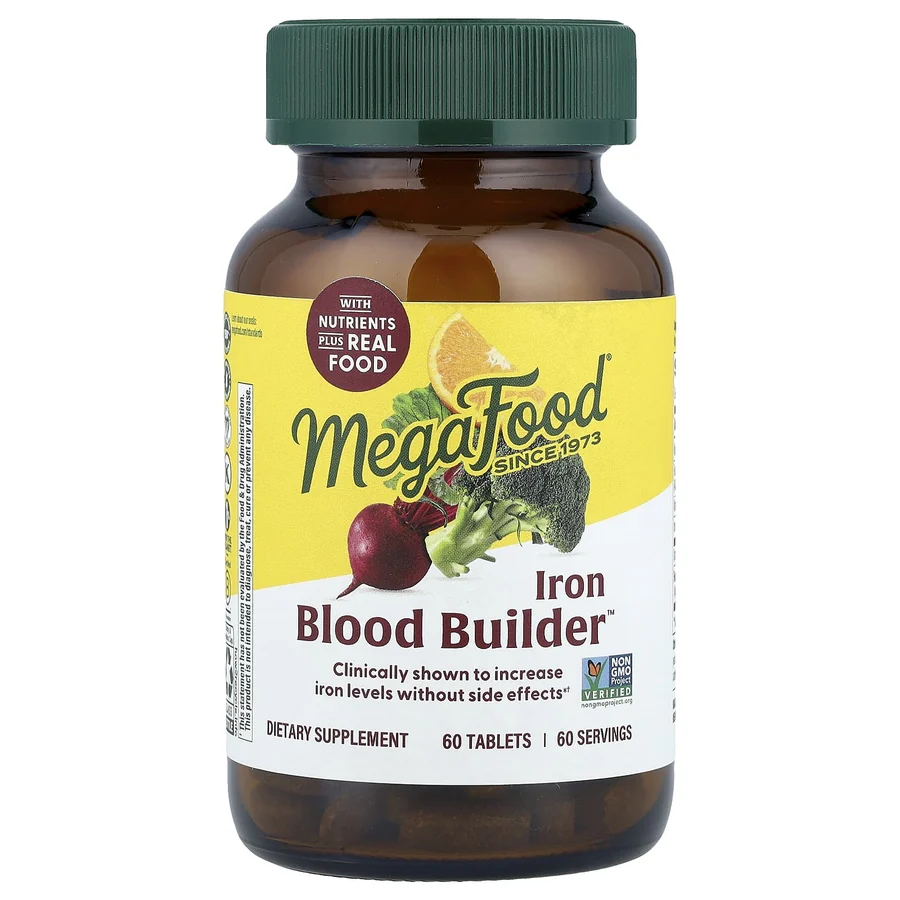
MegaFood Blood Builder Iron 60 Tablets
Blood Builder · 60 tablets
Iron bisglycinate 26 mg; C 15 mg; folate 680 mcg DFE; B12 30 mcg per label serving.
- Amount
- Iron bisglycinate 26 mg; C 15 mg; folate 680 mcg DFE; B12 30 mcg
- Format
- Tablets
- Review basis
- Label-based analysis
Good fit
people with a confirmed need who want one tablet and an iron bisglycinate form
Consider another option
you have not established iron need, already take iron, or have unexplained symptoms
The product, at a glance
Amounts for the reviewed label serving.
- Reviewed variant
- Blood Builder · 60 tablets
- Label serving
- 1 tablet
- Servings per reviewed pack
- 60
- Ingredients per label serving
- Iron bisglycinate 26 mg; C 15 mg; folate 680 mcg DFE; B12 30 mcg
- Other ingredients
- Fermentation media (rice protein, autolyzed yeast extract, organic brown rice, inactive yeast); stearic acid; rice protein; silica; autolyzed yeast extract; hypromellose
Label sources & rating context
~ means approximate; — means no published value in this record. Customer ratings are the named publisher’s snapshot and may include multiple sizes or earlier formulas. The Supplement Explained Score is our source-reviewed editorial assessment out of 25, separate from customer stars. Compare the five criteria and the same intended use; the total is not a clinical ranking. Prices are dated USD offer snapshots; cost uses the reviewed pack and label serving.
- Label clarity: 5/5
- Evidence transfer: 4/5
- Safety fit: 3/5
- Quality proof: 2/5
- Value fit: 4/5
On this pageTable of Contents
- 1Supplement Explained Score
- 2Who MegaFood Blood Builder Iron 60 Tablets may fit
- 3Who should skip MegaFood Blood Builder Iron 60 Tablets
- 4MegaFood Blood Builder Iron 60 Tablets label facts snapshot
- 5What is in the formula?
- 6Strengths, tradeoffs, and red flags
- 7Price and value analysis
- 8Is there third-party testing or quality proof?
- 9Use-case fit, evidence limits, and safety
- 10Alternatives to compare
- 11FAQ
- 12References and product sources
Our editorial assessment
Supplement Explained Score
18/25
MegaFood Blood Builder Iron 60 Tablets · Blood Builder · 60 tablets
Five equally weighted criteria, with a product-specific reason for every point. This is a buying-decision assessment, separate from customer stars and personal medical suitability.
- Label clarity 5/5
- Reviewed Blood Builder · 60 tablets: 1 tablet; 60 label servings. Iron bisglycinate 26 mg; C 15 mg; folate 680 mcg DFE; B12 30 mcg.
- Evidence transfer 4/5
- Twenty-six milligrams of iron supports an assessed iron need; it is not treatment for unexplained fatigue without checking the cause.
- Safety fit 3/5
- Avoid unnecessary iron, count prenatal/multivitamin overlap, separate interacting medicines and protect children from poisoning.
- Quality proof 2/5
- The matched tablet label is identified; no independent finished-lot purity or superiority result was verified.
- Value fit 4/5
- The dated $0.40 tablet serving and 60-serving pack make the assessed-iron routine easy to compare.
Review basis: Published labels, manufacturer/retailer information, clinical sources and exact-product quality records where available. We did not buy, personally use or laboratory-test this product for this assessment.
Reviewed · Method v2.0 · How we assign points
Sources behind this score
Product labels and independent directory records identify a formula or testing scope. Clinical references concern ingredients or studied regimens unless the explanation explicitly matches the finished formula.
Who MegaFood Blood Builder Iron 60 Tablets may fit
- People whose clinician or lab work indicates an iron supplement is appropriate.
- Shoppers who prefer iron bisglycinate over a ferrous sulfate product.
- People who want a once-daily tablet instead of several capsules.
- Readers who understand that symptom improvement and lab correction are separate questions.
Use the iron guide and iron lab checklist before treating fatigue alone as a reason to buy.
Who should skip MegaFood Blood Builder Iron 60 Tablets
- Anyone without a clear reason to supplement iron.
- People with high iron markers, iron-loading conditions, or an existing iron-containing stack.
- Anyone relying on the product to diagnose or treat anemia without medical follow-up.
- Households that cannot store iron safely away from children.
Iron overdose is a serious poisoning risk for children. Unexplained anemia, heavy bleeding, GI symptoms, pregnancy, chronic disease, or a poor response to iron require cause-focused care, not a stronger shopping claim.
Proof status for this review
This is a label-based editorial review. We checked the public label, serving size, active amount, current retailer or brand information, named quality signals, ingredient evidence, and recurring public review themes. It is not a hands-on test, lab certificate, or medical recommendation.
The page does not claim personal use or independent testing. The review relies on the public Supplement Facts panel, retailer data, official iron guidance, and clearly labeled anecdotal review themes.
What is in the formula?
Each tablet lists 15 mg vitamin C, 680 mcg DFE folate, 30 mcg vitamin B12, 26 mg iron as ferrous bisglycinate, and 125 mg beetroot. Suggested use is one tablet daily; the listing says it may be taken on an empty stomach.
The formula combines a named iron form with nutrients involved in red blood cell biology. That does not mean every person with fatigue needs iron, folate, or B12, and it does not identify the cause of abnormal blood counts.
The product’s central value proposition is tolerability and one-tablet convenience. Those are product-fit claims, not evidence that it treats anemia without diagnosis, monitoring, or attention to the cause.
Iron form
What the label uses
Ferrous bisglycinateA named chelated form that is easier to compare than a proprietary iron blend.
Daily amount
Iron dose
26 mgMore than a casual nutritional top-up for many adults.
Convenience
Pill burden
One tabletThe clearest practical advantage.
Decision boundary
What the label cannot show
Whether you need ironFerritin, CBC, transferrin saturation, history, and symptoms supply that context.
Strengths, tradeoffs, and red flags
What looks strong
- One-tablet routine: the full label serving is easy to follow.
- Named iron form: ferrous bisglycinate is clearly identified.
- Transparent supporting nutrients: vitamin C, folate, B12, and beetroot amounts are listed.
- Serving cost: about $0.40 per label serving; a low price is not a reason to take iron without an appropriate need.
What may change the decision
- High-stakes fit: iron is not a supplement to start from fatigue alone.
- Multi-nutrient overlap: folate and B12 can duplicate a multivitamin or prenatal.
- GI response varies: bisglycinate does not eliminate constipation, nausea, or stomach discomfort for everyone.
Red flags before you buy
- Keep iron products out of reach of children; accidental overdose can be fatal.
- Do not continue indefinitely without checking whether labs and the underlying cause are improving.
- Black stools can occur with iron, but severe pain, vomiting, bleeding concerns, or worsening symptoms need medical assessment.
Price and value analysis
HerbsPro listed the 60-tablet bottle at $23.99 on October 2, 2026, or about $0.40 per label serving. It is reasonable value only when the formula matches an established need; unnecessary iron or overlap with another supplement is not a bargain. Price excludes coupons, tax, and shipping and may change.
Per day
Label-use cost
About $0.40One tablet provides the full listed formula.
Per 10 mg iron
Dose-normalized cost
About $0.15Useful only after dose appropriateness is established.
Value gate
What decides value
Confirmed need + follow-upCheap iron is not good value when it is unnecessary or poorly monitored.
Use the price per effective dose calculator when package size, serving burden, or active amount makes two products look more similar than they are.
Is there third-party testing or quality proof?
The strongest visible quality signal is label clarity: the iron form, supporting nutrients, tablet count, and serving are explicit. We did not review a public batch COA or a product-specific independent certification.
For iron, quality also includes appropriate use. A clean label cannot compensate for missing diagnosis, unsafe storage, unrecognized blood loss, or no follow-up.
Use-case fit, evidence limits, and safety
NIH explains that iron is essential for hemoglobin and many other functions, but both deficiency and excess can cause harm. Supplement recommendations depend on age, sex, pregnancy status, diet, labs, and medical context.
The evidence for oral iron does not prove that this exact multi-nutrient tablet is the right dose or duration for every low ferritin result. Response, tolerance, adherence, and the reason iron became low all matter.
Safety boundary
- Iron commonly causes nausea, constipation, abdominal pain, vomiting, or diarrhea.
- Iron can interact with levothyroxine and some medicines; spacing instructions matter.
- Iron-loading conditions and high iron markers are reasons not to self-supplement.
- Persistent low ferritin or anemia needs investigation for bleeding, absorption problems, diet, menstruation, pregnancy, or chronic disease.
If medicines, pregnancy, surgery, kidney or liver disease, abnormal labs, or multiple supplements are part of the picture, use the supplement interaction checklist and involve a qualified clinician or pharmacist.
Alternatives to compare
Compare iron form, elemental dose, other nutrients, and lab plan rather than choosing by the phrase ‘blood builder.’
FAQ
How much iron is in MegaFood Blood Builder?
One tablet provides 26 mg of iron as ferrous bisglycinate.
Can Blood Builder cause constipation?
Yes. Bisglycinate may be better tolerated by some people, but constipation and other GI effects still appear in public reports.
Can I take it without iron blood tests?
Iron is not a low-risk general energy supplement. A defined reason, relevant labs, and follow-up make the decision safer and more useful.
Does it replace treatment for anemia?
No. Anemia has multiple causes, and this product does not diagnose the cause or replace medical care and monitoring.
References and product sources
- iHerb product listing – label, price, ingredients, warnings, and public reviews
- NIH ODS Iron Fact Sheet for Consumers – iron need, sources, safety, and interactions
- NIH ODS Iron Health Professional Fact Sheet – clinical and upper-intake context
- Public Reddit Blood Builder discussion – anecdotal side-effect themes
- Public Reddit user-experience discussion – anecdotal tolerance and response themes
Update note: Label, price, availability, and quality claims were checked on July 28, 2026. Retailer listings and formulas can change; use the live label before purchase.
Editorial information
Continue your decision
If this product is not an obvious fit, use one of these routes instead of leaving the decision unfinished.
- All product analyses Browse the full product analysis library for alternatives and category comparisons.
- Supplement Explained Score See how label clarity, evidence transfer, safety fit, quality proof, and value fit are scored.
- Interaction checklist Check common combination risks before stacking supplements or medications.
- How we review evidence Understand how editorial evidence claims, uncertainty, and safety language are handled.