
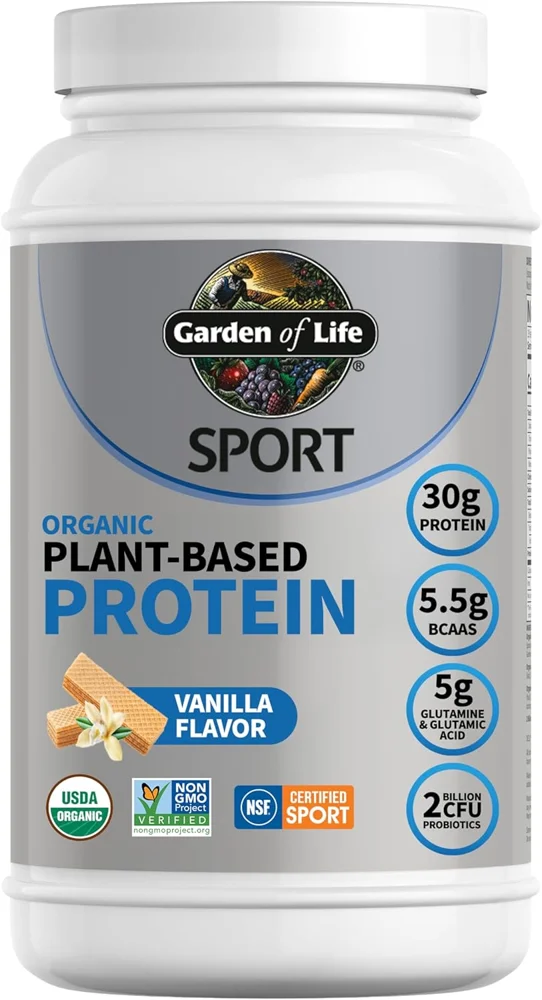
Garden of Life SPORT Plant-Based Protein
SPORT Vanilla · 806 g / 19-serving format
Protein 30 g; BCAAs 5.5 g; glutamine + glutamic acid 5 g per label serving.
- Amount
- Protein 30 g; BCAAs 5.5 g; glutamine + glutamic acid 5 g
- Format
- Powder
- Review basis
- Label-based analysis
Good fit
Plant-based eaters who need a convenient 30 g protein serving.
Consider another option
Meals already comfortably cover your protein needs.
The product, at a glance
Amounts for the reviewed label serving.
- Reviewed variant
- SPORT Vanilla · 806 g / 19-serving format
- Label serving
- 2 scoops (42 g)
- Servings per reviewed pack
- 19
- Ingredients per label serving
- Protein 30 g; BCAAs 5.5 g; glutamine + glutamic acid 5 g
- Ingredients & allergens
- NSF listing: vegan; dairy-, soy- and gluten-free claims
- Nutrition per label serving
- 160 calories; 7 g carbohydrate; 3 g fat per 42 g serving
- Sugar per label serving
- <1 g total sugar per 42 g serving
- Quality & testing
- NSF Certified for Sport · US Vanilla / 806 g · specified lots Source ↗
Label sources & rating context
Manufacturer ↗ · Label source ↗
~ means approximate; — means no published value in this record. Customer ratings are the named publisher’s snapshot and may include multiple sizes or earlier formulas. The Supplement Explained Score is our source-reviewed editorial assessment out of 25, separate from customer stars. Compare the five criteria and the same intended use; the total is not a clinical ranking. Prices are dated USD offer snapshots; cost uses the reviewed pack and label serving.
- Label clarity: 5/5
- Evidence transfer: 4/5
- Safety fit: 4/5
- Quality proof: 4/5
- Value fit: 3/5
On this pageTable of Contents
- 1Supplement Explained Score
- 2Label facts at a glance
- 3What is in the SPORT Vanilla formula?
- 4What can the protein evidence support?
- 5How does SPORT compare with Raw and other options?
- 6How should you use it?
- 7Who should be cautious?
- 8What do the certifications actually tell you?
- 9How do you calculate price and value?
- 10Product examples to compare
- 11FAQ
Our editorial assessment
Supplement Explained Score
20/25
Garden of Life SPORT Plant-Based Protein · SPORT Vanilla · 806 g / 19-serving format
Five equally weighted criteria, with a product-specific reason for every point. This is a buying-decision assessment, separate from customer stars and personal medical suitability.
- Label clarity 5/5
- Reviewed SPORT Vanilla · 806 g / 19-serving format: 2 scoops (42 g); 19 label servings. Protein 30 g; BCAAs 5.5 g; glutamine + glutamic acid 5 g.
- Evidence transfer 4/5
- Thirty grams of plant protein can help meet protein needs; the labeled BCAAs are already within that protein, not an added 5.5 g bonus.
- Safety fit 4/5
- Consider plant allergies, kidney-related dietary restrictions and GI tolerance; additional probiotics are not needed by every protein user.
- Quality proof 4/5
- An exact US Vanilla/806 g NSF Certified for Sport record is published with specified lots.
- Value fit 3/5
- Nineteen two-scoop servings make the tub easy to normalize; certification is concrete, but a matched fresh USD cost is unavailable.
Review basis: Published labels, manufacturer/retailer information, clinical sources and exact-product quality records where available. We did not buy, personally use or laboratory-test this product for this assessment.
Reviewed · Method v2.0 · How we assign points
Sources behind this score
Product labels and independent directory records identify a formula or testing scope. Clinical references concern ingredients or studied regimens unless the explanation explicitly matches the finished formula.
What is in the SPORT Vanilla formula?
SPORT Vanilla is a multi-source plant-protein powder with an added probiotic and a fruit blend. The manufacturer’s listing identifies 30 g of complete protein, 5.5 g of BCAAs, 5 g of glutamine/glutamic acid and 2 billion CFU of Bacillus subtilis DE111 per serving.
Protein sources include organic pea, garbanzo bean, navy bean, lentil and cranberry seed. For protein comparisons, count 30 g; do not add the listed amino acid figures to that total. The fruit blend adds ingredients, but its inclusion alone does not establish a recovery advantage.
This review covers the Vanilla version cataloged at 19 servings. Check your current package, because serving counts and consumer packaging may change.
What can the protein evidence support?
Protein can help meet the nutritional needs of training, but this ingredient list does not demonstrate that SPORT produces better results than another adequate protein source.
The NIH Office of Dietary Supplements summarizes sports-nutrition recommendations of about 1.2–2.0 g of protein per kilogram of body weight daily for athletes. For a 70 kg adult, about 154 pounds, that is 84–140 g from all food and supplements—not powders alone. This is athlete guidance, not an automatic target for everyone.
The same resource finds limited support for extra BCAAs when adequate high-quality protein is consumed and does not establish glutamine as a reliable performance enhancer. SPORT’s 5 g figure combines glutamine with glutamic acid; it is not a verified 5 g glutamine dose.
Likewise, the DE111 count does not establish a digestive benefit for you. Organic status does not prove superior muscle gain.
How does SPORT compare with Raw and other options?
SPORT offers 8 g more protein per labeled serving than Garden of Life Raw Organic Protein: 30 g versus 22 g. That difference helps if you need a larger protein addition; it does not establish better results or better value.
Choose SPORT for its higher labeled protein serving and, after verification, its sport-focused certification. Raw may fit if 22 g covers your shortfall. Compare current serving weights, ingredients and certifications rather than treating the tubs as interchangeable. The Raw versus SPORT comparison examines that choice in more detail.
A simpler plant-protein powder is worth considering if you do not want the probiotic or fruit blend. A dairy-based complete protein powder can also be an option if dairy fits your diet. Compare specific labels rather than assuming either category is cheaper. Meals remain a reasonable alternative when they comfortably cover your protein needs.
How should you use it?
Use SPORT to fill a protein gap, following the current package’s serving directions—not an assumed scoop size. Thirty grams of protein is not the same as 30 g of powder.
Check grams of powder per serving and how many scoops make that serving. A partial serving will not provide the full listed 30 g of protein. The serving-size guide explains why scoop counts alone can mislead.
A shake around training can be convenient, but do not treat a narrow timing window as more important than adequate daily intake. Follow the package’s mixing and storage directions, and plan how the powder fits alongside meals rather than adding it automatically.
Who should be cautious?
Skip the powder if it contains an ingredient you must avoid, and get individualized advice if you have a prescribed protein restriction. Plant-based does not mean allergy-free.
Pea and several other legumes are part of this formula. Read the full ingredient and allergen statements for your flavor, including any cross-contact information; do not infer allergy safety from an organic seal.
If you have kidney disease, ask your clinician whether this serving fits your nutrition plan. If you are seriously ill or immunocompromised, ask before using a product with live probiotics. This powder should not be used to manage a serious illness.
Also check calories, sweeteners and any nutrients you already get from other supplements on the current label. Those details can matter even when the protein amount fits your needs.
What do the certifications actually tell you?
The manufacturer identifies SPORT as USDA organic, non-GMO and NSF Certified for Sport. These designations address different concerns; none proves that the powder improves training results or contains zero contaminants.
Organic concerns production standards. Non-GMO concerns genetically modified inputs, not protein quality. NSF Certified for Sport addresses supplement-quality and banned-substance risks, which is especially relevant to tested athletes. Confirm the exact product and flavor in the certifier’s current directory before relying on it.
Certification is not a zero-risk or zero-heavy-metal guarantee. The third-party testing guide explains why the scope of testing matters. This is a label-based review, not hands-on testing, and it does not establish lot-specific contaminant levels.
Published comments on the manufacturer’s product page give mixed impressions. Some describe liking an earlier flavor, while others report froth or a change in taste. These are individual reports, not our tasting results or a representative satisfaction survey; older comments may concern an earlier formula.
How do you calculate price and value?
Compare cost per labeled serving and cost per gram of protein—not cost per scoop or per gram of powder. Powder weight includes ingredients that are not protein.
Purely hypothetical example, not a current price: a 19-serving container priced at $38 would cost $2 per serving. At 30 g of protein per serving, it would contain 570 g of labeled protein; $38 ÷ 570 ≈ $0.067 per gram. A hypothetical 22 g serving costing $1.50 would work out to about $0.068 per gram: a lower serving price, but almost the same protein value.
Use the protein cost-per-gram calculator with your actual purchase price and current label. Include discounts, shipping and taxes consistently. Then ask whether organic ingredients, the extra blend or verified sport certification justify any difference for your needs. A longer ingredient list is not, by itself, a reason to pay more.
Check current Amazon price and size
Affiliate link: we may earn a commission if you buy.
Product examples to compare
- Garden of Life Raw Organic Meal: Chocolate: 20 g protein, 6 g fiber and 150 calories per scoop; about 14 servings.
- Garden of Life Raw Organic Protein & Greens: Chocolate plant protein with added greens; compare protein and actual fiber rather than the greens claim.
FAQ
Does one scoop provide 30 g of protein?
The verified figure is per serving, not per scoop. Check the current package for the serving’s powder weight and scoop count before calculating your intake.
Can I use SPORT on rest days?
Yes, if it fills a protein gap that day. Training-day timing alone is not a reason to add it; count protein from meals and supplements together.
Does SPORT replace a separate probiotic?
Not automatically. It includes 2 billion CFU of DE111 per serving, but that count alone cannot show whether it suits your purpose or matches another probiotic’s formulation.
Is SPORT Vanilla a meal replacement?
The verified information establishes a protein supplement, not a nutritionally complete meal. Do not assume it replaces balanced meals; check the current calories and full nutrition panel.
Can tested athletes rely on the certification logo alone?
No. Confirm the exact flavor and product in NSF’s current directory and follow your sport organization’s supplement rules. Certification reduces risk; it does not eliminate it.
References
- Garden of Life: SPORT Organic Plant-Based Protein, Vanilla
- NIH Office of Dietary Supplements: Dietary Supplements for Exercise and Athletic Performance—Health Professional Fact Sheet
- Matched product listing and package identity: B01N7DTD98
Label and package details checked against the cited sources. Retailer prices and available versions can change; the page update date is shown above.