
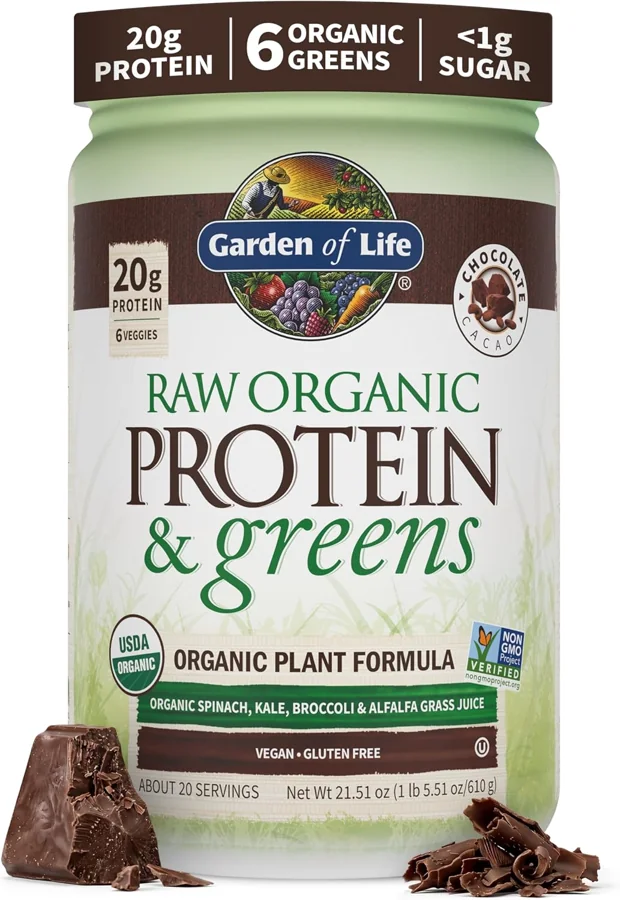
Garden of Life Raw Organic Protein & Greens
Raw Organic Protein & Greens · Chocolate Cacao · 610 g
Protein 20 g; fiber 3 g; B. subtilis DE111 250 million CFU (pictured panel) per label serving.
- Amount
- Protein 20 g; fiber 3 g; B. subtilis DE111 250 million CFU (pictured panel)
- Format
- Powder
- Review basis
- Label-based analysis
Good fit
People seeking plant protein with some fiber who also want added greens.
Consider another option
You need a complete meal replacement, a vegetable substitute, or demonstrated digestive benefits.
The product, at a glance
Amounts for the reviewed label serving.
- Reviewed variant
- Raw Organic Protein & Greens · Chocolate Cacao · 610 g
- Label serving
- 1 scoop (~30.5 g)
- Servings per reviewed pack
- ~20
- Ingredients per label serving
- Protein 20 g; fiber 3 g; B. subtilis DE111 250 million CFU (pictured panel)
- Nutrition per label serving
- 120 calories; less than 1 g total sugar; 0 g added sugar; 250 mg sodium
- Formula / pack difference
- Chocolate label lists DE111 250 million CFU; manufacturer description says 1.5 billion. Table follows pictured label.
Label sources & rating context
~ means approximate; — means no published value in this record. Customer ratings are the named publisher’s snapshot and may include multiple sizes or earlier formulas. The Supplement Explained Score is our source-reviewed editorial assessment out of 25, separate from customer stars. Compare the five criteria and the same intended use; the total is not a clinical ranking. Prices are dated USD offer snapshots; cost uses the reviewed pack and label serving.
- Label clarity: 4/5
- Evidence transfer: 4/5
- Safety fit: 3/5
- Quality proof: 2/5
- Value fit: 3/5
On this pageTable of Contents
- 1Supplement Explained Score
- 2Label facts at a glance
- 3What does the Chocolate Cacao formula actually offer?
- 4Do the protein, probiotics, and enzymes justify the claims?
- 5Where does Protein & Greens fit into an ordinary day?
- 6Who should check before using this plant protein?
- 7What should you verify on the Chocolate Cacao tub?
- 8How can you compare its cost fairly?
- 9When might another Garden of Life formula fit better?
- 10FAQ
Our editorial assessment
Supplement Explained Score
16/25
Garden of Life Raw Organic Protein & Greens · Raw Organic Protein & Greens · Chocolate Cacao · 610 g
Five equally weighted criteria, with a product-specific reason for every point. This is a buying-decision assessment, separate from customer stars and personal medical suitability.
- Label clarity 4/5
- Reviewed Raw Organic Protein & Greens · Chocolate Cacao · 610 g: 1 scoop (~30.5 g); ~20 label servings. Protein 20 g; fiber 3 g; B. subtilis DE111 250 million CFU (pictured panel). Chocolate label lists DE111 250 million CFU; manufacturer description says 1.5 billion. Table follows pictured label.
- Evidence transfer 4/5
- The 20 g plant protein has nutritional relevance; greens and low-count DE111 are not proven extra recovery or digestive benefits.
- Safety fit 3/5
- Review the full plant blend for allergies and GI tolerance; avoid assuming protein powder is a complete meal.
- Quality proof 2/5
- Raw Protein & Greens does not inherit the separate SPORT product's NSF certification.
- Value fit 3/5
- About 20 servings are identifiable, but the pictured 250 million CFU conflicts with a 1.5 billion description; added features complicate value.
Review basis: Published labels, manufacturer/retailer information, clinical sources and exact-product quality records where available. We did not buy, personally use or laboratory-test this product for this assessment.
Reviewed · Method v2.0 · How we assign points
Sources behind this score
Product labels and independent directory records identify a formula or testing scope. Clinical references concern ingredients or studied regimens unless the explanation explicitly matches the finished formula.
What does the Chocolate Cacao formula actually offer?
The core is a plant protein blend with six added greens. The manufacturer’s Chocolate Cacao panel lists one level scoop of about 30.5 g, with 20 g protein, 3 g fiber and 120 calories. It has less than 1 g total sugar, no added sugar and stevia in the ingredients. Low sugar does not mean unsweetened.
The greens count describes variety, not vegetable quantity. Spinach, alfalfa grass juice, broccoli, carrot, beet and kale are included in the blend, but their individual amounts are not listed. A scoop is not a replacement for a serving of vegetables.
The panel names Bacillus subtilis DE111 at 250 million CFU, while the product-page description says 1.5 billion CFU. Check the container you receive rather than assuming the higher number. Neither amount alone establishes a digestive benefit.
Raw Organic Protein and SPORT are separate formulas. Their serving information and certifications should not be transferred to Protein & Greens. Compare the protein and fiber you would actually consume.
Do the protein, probiotics, and enzymes justify the claims?
The NIH exercise evidence review describes protein’s role in muscle repair and adaptation to exercise. That supports assessing your overall protein intake; it does not establish an advantage for this particular blend over another powder. A supplement is most useful when it addresses a dietary gap.
For probiotics, the relevant questions concern the organisms, amount, and intended outcome. NIH’s probiotic evidence summary explains why findings for particular strains and conditions cannot automatically be applied to other products. A CFU number alone does not demonstrate a digestive benefit.
Similarly, an enzyme count does not establish reduced bloating or improved protein absorption. These are ingredient-level considerations, not results from a trial of this Chocolate Cacao product. Treat the additions as features, not reasons to expect a noticeable digestive improvement.
Where does Protein & Greens fit into an ordinary day?
Start with the meal or snack where protein is genuinely missing. A shake may be convenient there, but adding one automatically on top of an already adequate diet is a different decision from filling a gap.
Check when protein shakes displace fiber-rich food; a greens claim does not make a powder a constipation treatment.
The manufacturer panel directs one level scoop in 8 fl oz of water. Milk or a plant-based beverage changes the protein and calories of the finished drink; include those additions when comparing it with another snack.
A 120-calorie water-mixed shake is not automatically a complete lunch. Protein and fiber figures do not establish nutritional completeness. If it is part of breakfast or lunch, consider the rest of the meal too.
Who should check before using this plant protein?
Plant-based does not mean allergen-free. Review the actual ingredients and allergen statement, especially if you have a food allergy or need to avoid cross-contact.
Probiotics can cause gas or other digestive symptoms in some people. People who are seriously ill or immunocompromised should discuss probiotic-containing supplements with a clinician before use, as noted in the NIH guidance.
If you have kidney disease or have been instructed to limit protein, ask how a serving fits your existing plan. Persistent discomfort is a reason to stop and reassess, not evidence that the powder is working.
What should you verify on the Chocolate Cacao tub?
The matched retail listing, B01A7N9KPK, is Chocolate Cacao, 22 oz (610 g). The manufacturer panel reviewed here lists about 20 servings. Check that the purchased container agrees, especially because the producer’s panel and description differ on probiotic quantity.
If organic certification or sports testing matters to you, verify it for this exact formula. Certification for another Garden of Life product, including SPORT, does not cover Protein & Greens.
An ingredient list is also not a contaminant test report. If independent testing is a buying priority, look for documentation tied to the actual product rather than relying on brand familiarity.
How can you compare its cost fairly?
Use delivered price divided by actual days of use, including shipping and any applicable tax. At one manufacturer serving daily, a container that confirms 20 servings lasts 20 days. Your portion size and frequency may change that.
For protein value, divide delivered price by total protein in the tub. If the purchased package confirms both 20 servings and 20 g protein per serving, it contains 400 g protein.
One hypothetical example: a $40 delivered tub meeting those conditions would cost $2 per day and $0.10 per gram of protein. Those are illustrations, not a current price quote.
The protein powder cost-per-gram calculator can help compare equivalent quantities. Decide separately whether the fiber and added ingredients are worth any price difference.
Affiliate link: we may earn a commission if you buy. Confirm the selected size, label and seller.
When might another Garden of Life formula fit better?
If greens are not a priority, compare Garden of Life Raw Organic Protein on its current protein, fiber, ingredients, and delivered cost. There is little reason to choose greens branding if the additions do not matter to your use.
SPORT Organic Plant-Based Protein is a separate option to investigate when sports-testing requirements matter; verify the exact certification rather than assuming it from the name. A simpler plant protein from another brand may also be reasonable. Compare equivalent protein quantities and tolerable ingredients, not reputation alone.
FAQ
Should I count protein from milk added to the shake?
Yes. The powder’s protein figure does not include your mixing liquid. Add the protein from the amount of milk or plant-based beverage you actually use, based on that beverage’s label.
Does Chocolate Cacao tell me whether it is low in sugar?
The reviewed manufacturer panel lists less than 1 g total sugar and 0 g added sugar per scoop. It also lists stevia, so low sugar does not mean an unsweetened powder. Confirm the panel on your container.
What does CFU mean on a probiotic label?
CFU means colony-forming units, a measure of viable microorganisms. The producer's Chocolate Cacao panel lists 250 million CFU of B. subtilis DE111, but its page description says 1.5 billion. Use the purchased container's information; a larger count is not automatically more effective.
Do the digestive enzymes make a milk-based shake lactose-free?
No lactose-free claim can be inferred from an enzyme count. Choose the liquid based on its own label if lactose matters; do not rely on this powder’s enzymes to make dairy suitable for you.
How should I store the powder?
Follow the purchased container’s storage and after-opening instructions, and check any expiration date. The manufacturer’s probiotic number should not be treated as a guarantee of viability under every storage condition.
References
- Garden of Life Chocolate Cacao Nutrition Facts panel
- Garden of Life Raw Organic Protein & Greens product information
- Reviewed package and label: B01A7N9KPK
- NIH Office of Dietary Supplements: Exercise and Athletic Performance
- NIH Office of Dietary Supplements: Probiotics
Label details checked October 2, 2026. This is a document-based review, not a hands-on product test. Retailer prices and product versions can change.
Editorial information
Continue your decision
If this product is not an obvious fit, use one of these routes instead of leaving the decision unfinished.
- Probiotics guide Compare CFU, strain labeling, capsule vs food tradeoffs, and use-case fit.
- All product analyses Browse the full product analysis library for alternatives and category comparisons.
- Supplement Explained Score See how label clarity, evidence transfer, safety fit, quality proof, and value fit are scored.
- Interaction checklist Check common combination risks before stacking supplements or medications.