
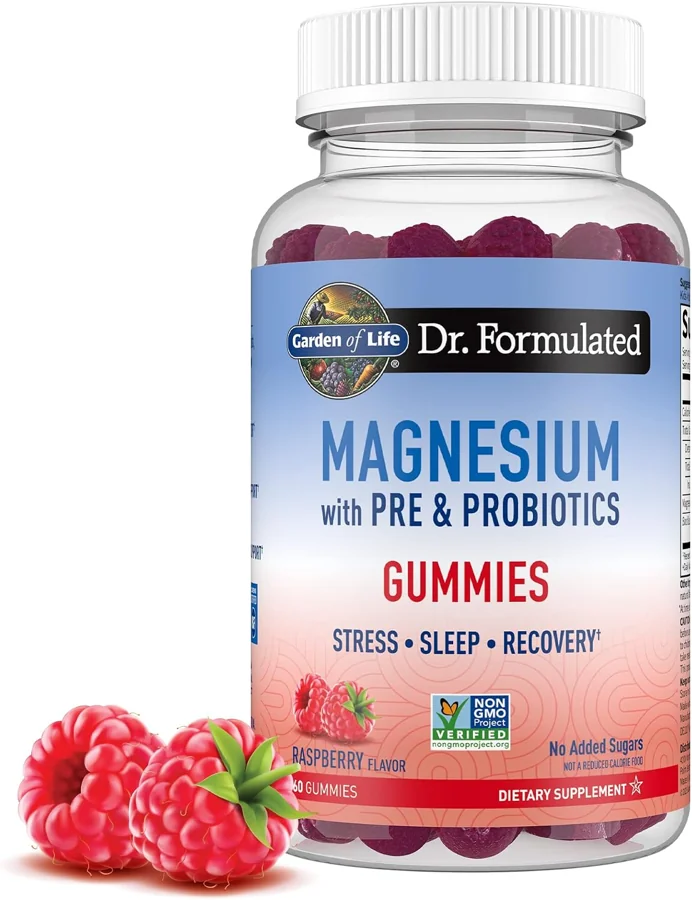
Garden of Life Dr. Formulated Magnesium Gummies
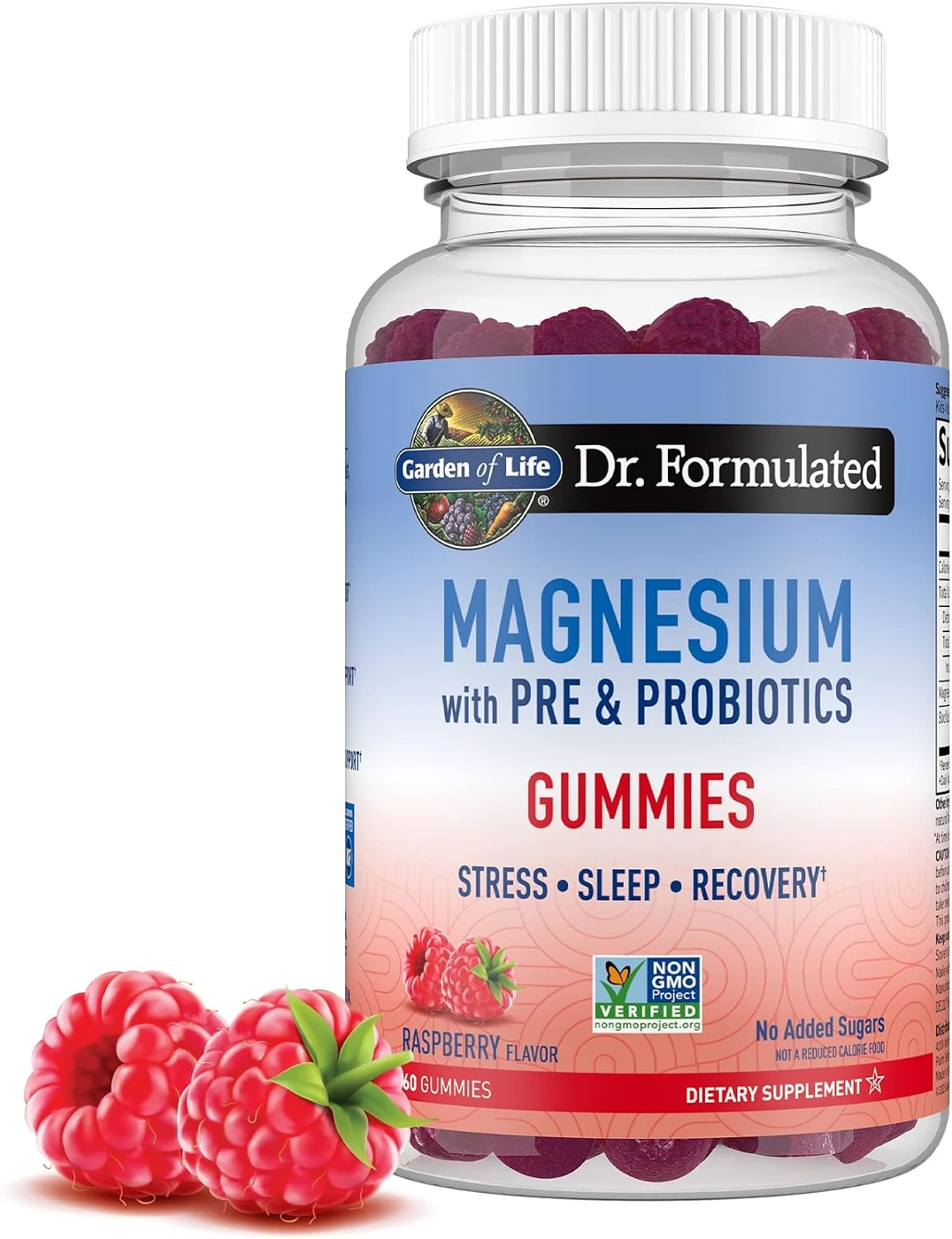
Magnesium Gummies · Raspberry · 60 gummies
Magnesium (citrate) 100 mg; B. subtilis DE111 250 million CFU per label serving.
- Amount
- Magnesium (citrate) 100 mg; B. subtilis DE111 250 million CFU
- Format
- Gummies
- Review basis
- Label-based analysis
Check medicines and kidney-health concerns before use. Review the safety context.
Good fit
Adults who prefer chewing to pills and want magnesium citrate in 100 mg increments.
Consider another option
You specifically want glycinate or a proven sleep treatment.
The product, at a glance
Amounts for the reviewed label serving.
- Reviewed variant
- Magnesium Gummies · Raspberry · 60 gummies
- Label serving
- 1 gummy
- Servings per reviewed pack
- 60
- Ingredients per label serving
- Magnesium (citrate) 100 mg; B. subtilis DE111 250 million CFU
- Nutrition per label serving
- 10 calories, 1 g fiber and 0 g total sugar per gummy
- Sugar per label serving
- 0 g per 1 gummy; <1 g per 4 gummies
Label sources & rating context
~ means approximate; — means no published value in this record. Customer ratings are the named publisher’s snapshot and may include multiple sizes or earlier formulas. The Supplement Explained Score is our source-reviewed editorial assessment out of 25, separate from customer stars. Compare the five criteria and the same intended use; the total is not a clinical ranking. Prices are dated USD offer snapshots; cost uses the reviewed pack and label serving.
- Label clarity: 4/5
- Evidence transfer: 3/5
- Safety fit: 3/5
- Quality proof: 2/5
- Value fit: 3/5
On this pageTable of Contents
- 1Supplement Explained Score
- 2Label facts at a glance
- 3What is in the raspberry gummies?
- 4Do these gummies have evidence for sleep or digestion?
- 5How should you interpret the one-to-four-gummy directions?
- 6When do these magnesium gummies need extra caution?
- 7What do the label and NSF designation establish?
- 8How much does the bottle cost per actual day of use?
- 9When would citrate capsules or glycinate make more sense?
- 10FAQ
Our editorial assessment
Supplement Explained Score
15/25
Garden of Life Dr. Formulated Magnesium Gummies · Magnesium Gummies · Raspberry · 60 gummies
Five equally weighted criteria, with a product-specific reason for every point. This is a buying-decision assessment, separate from customer stars and personal medical suitability.
- Label clarity 4/5
- Reviewed Magnesium Gummies · Raspberry · 60 gummies: 1 gummy; 60 label servings. Magnesium (citrate) 100 mg; B. subtilis DE111 250 million CFU. Companion-blend quantities, current variant or full-panel details remain less complete than the core active amount.
- Evidence transfer 3/5
- Magnesium intake is distinct from claims about the DE111 probiotic; neither establishes a special gummy sleep benefit.
- Safety fit 3/5
- Multiple gummies raise the magnesium amount; kidney impairment, GI tolerance and stacked magnesium need attention.
- Quality proof 2/5
- Gluten-free certification is a narrower scope than sport, potency or comprehensive contaminant testing.
- Value fit 3/5
- Flexible 100 mg gummies aid portioning; four gummies use the 60-count bottle much faster than one daily.
Review basis: Published labels, manufacturer/retailer information, clinical sources and exact-product quality records where available. We did not buy, personally use or laboratory-test this product for this assessment.
Reviewed · Method v2.0 · How we assign points
Sources behind this score
Product labels and independent directory records identify a formula or testing scope. Clinical references concern ingredients or studied regimens unless the explanation explicitly matches the finished formula.
What is in the raspberry gummies?
These gummies contain magnesium citrate, not glycinate. Each provides 100 mg of elemental magnesium—the amount of the mineral itself, not the weight of the citrate compound. That distinction matters when comparing different magnesium forms.
The formula also includes Bacillus subtilis DE111, labeled at 250 million CFU per gummy at expiration. Consider it an added ingredient, not a reason to increase your magnesium dose. The matched label is for the raspberry, 60-gummy bottle.
If you are choosing between citrate and glycinate, the magnesium form selector can help separate mineral form from delivery format.
Do these gummies have evidence for sleep or digestion?
Magnesium supports normal muscle and nerve function. NIH lists citrate among forms that generally absorb better than oxide; that does not establish an advantage for this gummy over every alternative (NIH magnesium fact sheet).
Supplying magnesium is not the same as proving a sleep benefit. No trial of this exact gummy for sleep was verified for this review. The Dr. Formulated name should not be read as evidence that it treats insomnia, anxiety, or cramps.
Probiotic effects are strain- and outcome-specific. A CFU count alone cannot establish improved digestion, and findings about other probiotics cannot automatically be transferred to DE111 in this formula (NIH probiotic fact sheet).
How should you interpret the one-to-four-gummy directions?
The label allows one to four gummies daily for adults and teens and advises starting gradually. This is a range, not a target everyone should reach.
The US adult upper limit is 350 mg daily from supplements and medications, excluding magnesium in food (NIH). Four gummies supply 400 mg before counting other supplemental sources. This limit is not the RDA or a recommended daily dose.
Choose the amount around an actual intake gap and other products you use, not the largest number on the bottle. Include magnesium-containing multivitamins, antacids, or laxatives in that check. A diagnosed deficiency or use by a teen warrants individualized advice rather than an automatic four-gummy routine.
When do these magnesium gummies need extra caution?
Magnesium can cause diarrhea, nausea, and abdominal cramping. Citrate in a gummy is still magnesium; chewability does not remove those risks. Loose stools are a reason to reassess the amount, not keep increasing it.
Kidney disease needs individual guidance because impaired kidney function can allow magnesium to accumulate. Do not use the label’s maximum as a default in that situation.
Magnesium can reduce absorption of tetracycline or quinolone antibiotics and oral bisphosphonates (NIH). Ask a pharmacist about your particular medicine’s separation interval rather than using one timing rule for every drug. The magnesium interactions guide is a starting point for checking a medication list.
What do the label and NSF designation establish?
The label identifies the magnesium form, probiotic strain, and CFU amount at expiration. Those details make the formula easier to assess, but label specificity is not independent verification of every bottle.
The NSF gluten-free designation concerns gluten; it is not NSF Certified for Sport or evidence of sport-specific banned-substance screening. See the product listing and package information for the matched version.
Lot-specific independent test results were not established by the reviewed documentation. If that matters to you, request current documentation. Match the bottle you buy to the raspberry, 60-gummy version rather than assuming another listing is identical.
How much does the bottle cost per actual day of use?
A 60-count bottle lasts 60 days at one gummy daily, but only 15 days at four. The label-serving count is therefore not automatically your practical supply.
Divide the delivered price—including shipping and applicable tax—by the days the bottle will actually last. For a magnesium-only comparison, the bottle contains 6,000 mg of labeled elemental magnesium; dividing the delivered price by 6 gives the cost per 1,000 mg.
Hypothetical cost comparison
If a bottle cost $24 delivered, it would be $0.40 per day at one gummy or $1.60 at four, and $4 per 1,000 mg. This is an illustration, not a verified current price.
A chewable format may justify extra cost for you. Do not assign the probiotic a premium solely because it appears on the label.
Affiliate link: we may earn a commission if you buy. Confirm the selected size, label and seller.
When would citrate capsules or glycinate make more sense?
If swallowing pills is comfortable, compare capsule or tablet options on elemental dose and delivered cost. There is no need to pay for a gummy format you do not prefer.
- Solaray Magnesium Citrate 400 mg is a same-form comparison. Check its serving size and total supplemental intake rather than treating 400 mg as a better goal.
- Solaray Magnesium Glycinate is a different-form option if you specifically want glycinate. Changing forms does not, by itself, establish better sleep results.
Choose based on form, usable dose, tolerance, and cost—not the presence of a probiotic alone.
FAQ
Why does one gummy list 0 g sugar while four list less than 1 g?
These statements are compatible with nutrition-label rounding. A 0 g declaration per gummy does not necessarily mean no sugar is present. Use the label's amount for the portion you take.
Do these gummies contain sugar alcohols?
No sugar alcohol is listed on the reviewed panel. Gummy format alone does not tell you which sweeteners are used, so there is no basis to assume sugar alcohols are present.
Should I take them at bedtime?
No exact-product evidence was verified showing that bedtime dosing works better. Medication timing and tolerability matter more than assuming a nighttime routine is necessary.
Can I substitute these for prescribed magnesium?
Check with the prescribing clinician before switching. Gummy count is not a substitute for matching the intended elemental dose and magnesium form, and this product also adds a probiotic.
What does CFU at expiration actually tell me?
CFU means colony-forming units, a measure of viable microorganisms. At expiration describes the label's stated time point; it does not establish that 250 million CFU is effective for your particular digestive concern.
References
- Reviewed package and label: B09KCMXXXF
- NIH Office of Dietary Supplements: Magnesium—Health Professional Fact Sheet
- NIH Office of Dietary Supplements: Probiotics—Health Professional Fact Sheet
Label details checked October 2, 2026. This is a document-based review, not a hands-on product test. Retailer prices and product versions can change.