
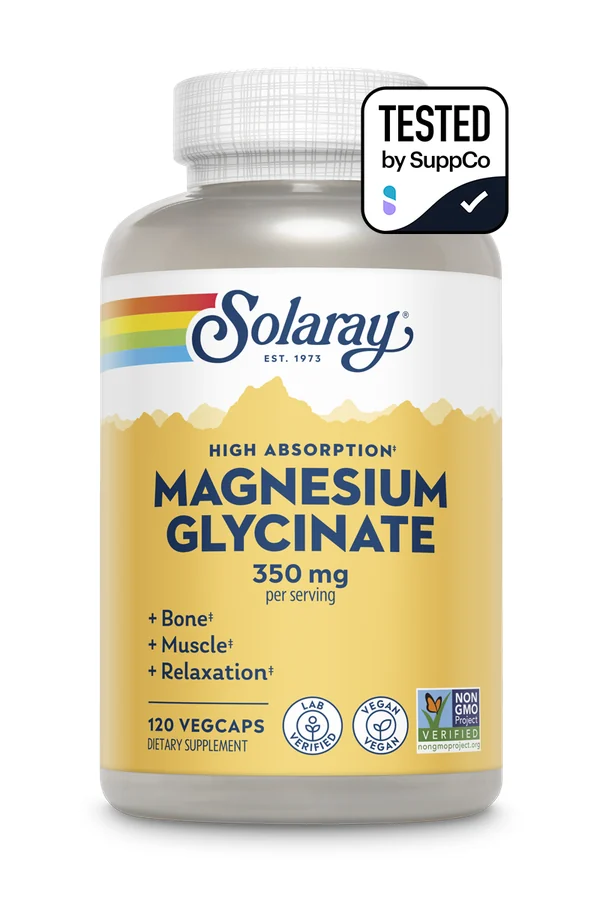
Solaray High Absorption Magnesium Glycinate 120 VegCaps
Magnesium Glycinate 350 mg · 120 VegCaps
Elemental magnesium 350 mg; BioPerine black-pepper extract 5 mg per label serving.
- Amount
- Elemental magnesium 350 mg; BioPerine black-pepper extract 5 mg
- Format
- Capsules
- Review basis
- Label-based analysis
Check medicines and kidney-health concerns before use. Review the safety context.
The product, at a glance
Amounts for the reviewed label serving.
- Reviewed variant
- Magnesium Glycinate 350 mg · 120 VegCaps
- Label serving
- 4 capsules
- Servings per reviewed pack
- 30
- Ingredients per label serving
- Elemental magnesium 350 mg; BioPerine black-pepper extract 5 mg
- Other ingredients
- Vegetable cellulose capsule, magnesium stearate, cellulose, silica
- Storage
- Store in a cool, dry place
Label sources & rating context
~ means approximate; — means no published value in this record. Customer ratings are the named publisher’s snapshot and may include multiple sizes or earlier formulas. The Supplement Explained Score is our source-reviewed editorial assessment out of 25, separate from customer stars. Compare the five criteria and the same intended use; the total is not a clinical ranking. Prices are dated USD offer snapshots; cost uses the reviewed pack and label serving.
- Label clarity: 5/5
- Evidence transfer: 4/5
- Safety fit: 3/5
- Quality proof: 2/5
- Value fit: 3/5
On this pageTable of Contents
- 1Supplement Explained Score
- 2The label at a glance
- 3Who may prefer this format—and who may not
- 4What 120 capsules actually buys
- 5Does BioPerine make it better absorbed?
- 6Price: compare a confirmed bottle, not the lowest page number
- 7Safety matters before the serving count
- 8Alternatives that solve different problems
- 9Two common buying questions
Our editorial assessment
Supplement Explained Score
17/25
Solaray High Absorption Magnesium Glycinate 120 VegCaps · Magnesium Glycinate 350 mg · 120 VegCaps
Five equally weighted criteria, with a product-specific reason for every point. This is a buying-decision assessment, separate from customer stars and personal medical suitability.
- Label clarity 5/5
- Reviewed Magnesium Glycinate 350 mg · 120 VegCaps: 4 capsules; 30 label servings. Elemental magnesium 350 mg; BioPerine black-pepper extract 5 mg.
- Evidence transfer 4/5
- The 350 mg elemental amount is informative; glycinate and BioPerine do not establish a finished-formula sleep advantage.
- Safety fit 3/5
- The full serving reaches the supplemental magnesium UL, and BioPerine adds medication-interaction screening.
- Quality proof 2/5
- Ingredient/manufacturing claims do not establish an independently verified result for this finished 120-capsule pack.
- Value fit 3/5
- Four capsules make 30 servings; the added absorption ingredient and capsule burden may not match a simple magnesium need.
Review basis: Published labels, manufacturer/retailer information, clinical sources and exact-product quality records where available. We did not buy, personally use or laboratory-test this product for this assessment.
Reviewed · Method v2.0 · How we assign points
Sources behind this score
Product labels and independent directory records identify a formula or testing scope. Clinical references concern ingredients or studied regimens unless the explanation explicitly matches the finished formula.
This review covers that exact formula, not an Extra Strength 500 mg product, a powder, or a differently sized bottle. It is a label-and-evidence review; we have not conducted a taste test, laboratory analysis, or controlled comparison of its effects.
The label at a glance
| Item | Reviewed 120-capsule label |
|---|---|
| Serving size | Four VegCaps |
| Servings per bottle | 30 |
| Magnesium | 350 mg, from magnesium bisglycinate |
| Magnesium Daily Value | 83% |
| BioPerine | 5 mg black-pepper fruit extract |
| Other ingredients | Vegetable cellulose capsule, magnesium stearate, cellulose, silica |
The official Supplement Facts image is the source for these quantities. Magnesium stearate appears as an excipient; it should not be treated as an additional declared dose of elemental magnesium. [1]
View the manufacturer’s Supplement Facts label
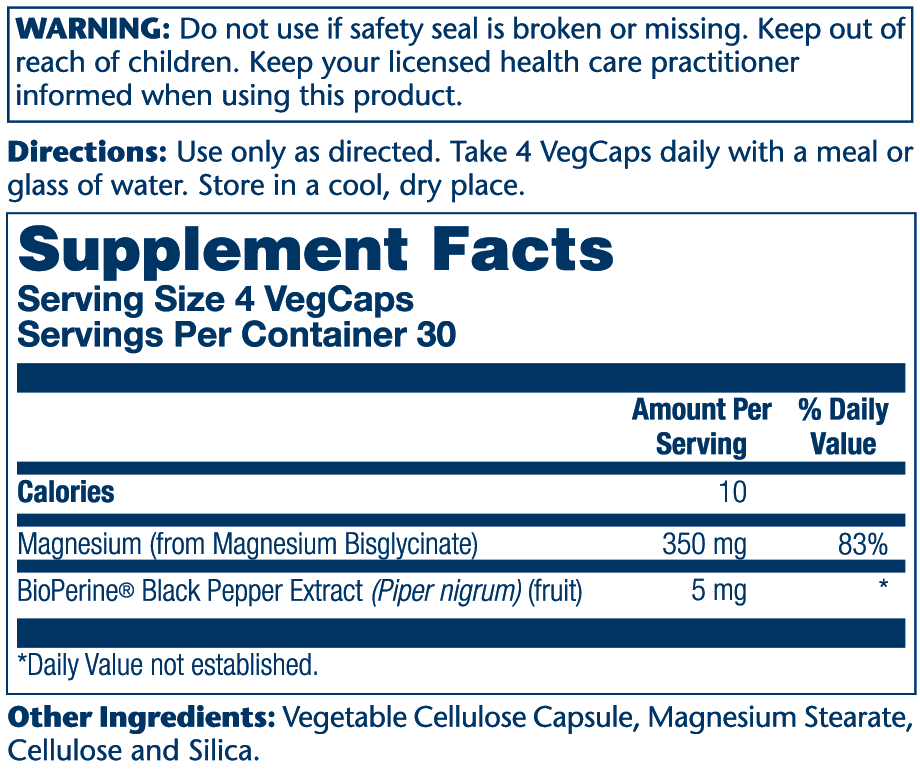
View original manufacturer label
Manufacturer label; check the package you receive for changes.
Who may prefer this format—and who may not
The capsule format may suit someone who dislikes preparing a drink and wants individually counted units. The bottle is also easy to compare with other capsules once the four-unit serving is understood.
Before altering a capsule, read which capsule-opening instructions have actually been confirmed.
It is a less obvious fit for someone who wants one capsule to provide the full labeled amount, has difficulty swallowing capsules, or specifically avoids black-pepper extract. For that last preference, Solaray’s powder is a materially different formulation: its label lists magnesium and citric acid, without BioPerine. The powder introduces its own measurement and mixing requirements. [2]
Neither label establishes that one format will work better for your symptoms. The format question and the clinical need for supplementation are separate decisions.
What 120 capsules actually buys
The calculation is:
120 capsules ÷ 4 capsules per serving = 30 label servings.
For quantity comparison, 350 mg ÷ 4 = 87.5 mg magnesium per capsule. That is useful arithmetic, not a prescription to take a particular number of capsules or to divide capsule contents. The listed magnesium amount is already the elemental nutrient amount; do not apply another “percentage of magnesium” calculation to it. [1] [3]
A 120-count bottle therefore should not be compared with a competing 120-count bottle as though the serving count were automatically identical. Pure Encapsulations’ reviewed label, for example, lists 120 mg in one capsule; NOW’s tablets list 200 mg in two tablets. The relevant denominators differ. [4] [5]
Compare the exact labels in Solaray versus NOW magnesium glycinate, including four capsules versus two tablets.
Does BioPerine make it better absorbed?
The label establishes that the ingredient is present, not how much additional magnesium this finished product delivers into the body. A black-pepper extract claim, an ingredient mechanism, and a study of the complete capsule are different types of evidence.
We did not establish a direct human trial showing a specific absorption advantage for this exact Solaray capsule over the other products compared here. It would therefore be misleading to attach a percentage improvement to the 5 mg BioPerine amount or to turn its presence into a guaranteed benefit. People taking medicines should include the full formula—not just the magnesium amount—when discussing suitability with a pharmacist. [1]
Price: compare a confirmed bottle, not the lowest page number
The exact 120-capsule variant is listed at $18.39 by Solaray on September 27, 2026: about $0.61 per full serving and $0.175 per 100 mg magnesium. Tax and shipping are excluded. [6]
Once the correct price is available, the calculations are simple:
Cost per label serving = bottle price ÷ 30.
Cost per 100 mg magnesium = bottle price ÷ 10,500 × 100.
The 10,500 mg denominator is 30 servings multiplied by 350 mg. The second calculation standardizes cost, not clinical effectiveness. Use the same purchase conditions when comparing: one-time purchase with one-time purchase, with tax, shipping, and any discount identified separately.
Check price at HerbsProHerbsPro: $18.39 for High Absorption Magnesium Glycinate, 350 Mg, 120 Veg Caps, checked October 5, 2026. Price and stock can change; confirm the current bottle label.
We may earn a commission from this link.Safety matters before the serving count
The US adult upper limit for magnesium from supplements and medications is 350 mg daily. It does not include magnesium naturally present in food. A full serving of this product reaches that supplemental limit before other magnesium supplements or magnesium-containing medicines are considered. This is a safety benchmark, not a statement that everyone needs 350 mg or that a lower intake cannot cause diarrhea. [3]
Magnesium supplements can cause gastrointestinal effects and require particular caution with impaired kidney function. They can also interfere with absorption of some medicines, including certain antibiotics and oral bisphosphonates. Ask a pharmacist about the specific medicine and timing rather than adopting one spacing rule for everything. [3]
Alternatives that solve different problems
| Alternative | Concrete reason to compare it | Its own limitation |
|---|---|---|
| Solaray Magnesium Glycinate Powder | No added sweetener or BioPerine on the reviewed label | Rounded scoop and drink preparation |
| Pure Encapsulations Magnesium Glycinate | 120 mg in a single capsule | Still has a capsule shell and an additional excipient |
| NOW Magnesium Glycinate Tablets | 200 mg in two tablets | Tablets, not capsules; different inactive ingredients |
| Thorne Magnesium Bisglycinate Powder | Exact NSF Certified for Sport powder listing | Sweetened with monk fruit and requires mixing |
These differences are supported by the respective labels and certification record, not a claim that the products are interchangeable at their full serving sizes. [2] [4] [5] [7] [8]
Two common buying questions
Can I open these capsules?
We did not find explicit manufacturer permission for opening this exact Solaray product. Permission for another brand’s two-piece capsule does not answer that question. Ask Solaray or a pharmacist with the bottle in hand; a purpose-made powder avoids having to assume a capsule-opening method is appropriate.
Is it guaranteed to be gentle on the stomach?
No. “Glycinate” is not a guarantee of zero gastrointestinal effects. Total supplemental intake and individual response still matter. For the practical checks to make when loose stools occur, see whether magnesium can cause diarrhea. [3]
The names overlap: our glycinate versus bisglycinate guide explains which label differences actually matter.
The reason to choose this bottle is the exact capsule formula—not a misunderstood 350 mg-per-capsule claim, an assumed 120-day supply, or an unverified absorption promise.
Related reading
For the practical trade-offs of scooping and swallowing, see our magnesium powder-versus-capsule comparison.
For the arithmetic behind capsules, servings, and nutrient quantities, see our serving-size and dose guide.
References
- Solaray Magnesium Glycinate: 120-capsule Supplement Facts.
- Solaray Magnesium Glycinate Powder: Supplement Facts.
- NIH ODS: Magnesium, Health Professional Fact Sheet.
- Pure Magnesium Glycinate: 30-capsule label.
- NOW Magnesium Glycinate Tablets.
- Solaray Magnesium Glycinate product page.
- Thorne Magnesium Bisglycinate POWDER.
- NSF Certified for Sport: Thorne Magnesium Bisglycinate.