
Best Supplements for Stress Support
If you are looking at supplements because you feel wound up, overstimulated, or not sleeping well, the first useful step is to define the real problem. “Stress support” can mean everyday stress, poor sleep, caffeine-like overactivation, or ongoing anxiety symptoms that are affecting daily life. Those are not the same decision.
This page is designed to help you sort realistic options from marketing. It is not a list of miracle fixes, and it should not replace care if your symptoms are persistent, severe, or hard to control.
On this pageTable of Contents
- 1Reviewed for Trust
- 2Quick answer
- 3Key Takeaways
- 4Short Summary VIDEO
- 5INFOGRAPHIC
- 6Start with the real stress question
- 7Where ashwagandha may fit
- 8Other common routes readers compare
- 9What people often get wrong
- 10When supplements are not the first move
- 11Safety notes
- 12FAQ
- 13References
- 14Update Note
- 15Next Questions to Read
Reviewed for Trust
- Author: Supplement Explained
- Role: Editorial Publisher
- Last reviewed: March 27, 2026
- Last updated: March 27, 2026
- Editorial Policy | How We Review Evidence | Research Process | Disclaimer
- Use: Informational only. Not personal medical advice.
Quick answer
There is no single best supplement for stress support. The most realistic answer depends on what you mean by stress.
- If you mean everyday stress: ashwagandha is one of the more commonly discussed options, and some studies suggest certain extracts may help over 6 to 8 weeks. The evidence is promising but not definitive, and products vary.
- If you mean feeling overstimulated: readers often compare L-theanine, usually because it is seen as a calmer, lower-stakes option. Goal-specific evidence is still limited, so the details matter.
- If you mean tension, low intake, or sleep disruption: magnesium is another common route, but it is often oversold as a universal fix.
- If you mean poor sleep: your better starting point may be a sleep-focused plan rather than a generic stress supplement list. See sleep support.
- If you mean persistent anxiety, panic, or distress that is affecting work, relationships, or daily functioning: buying a supplement is not the main decision. NCCIH notes that effective conventional treatments for anxiety disorders are available, including psychotherapy and medication, and complementary approaches have not been proven effective for anxiety disorders.
Short version: for mild everyday stress, some supplements may be reasonable to explore carefully. For ongoing anxiety-like symptoms, supplements should not distract from getting proper evaluation and support.
Key Takeaways
- If you mean everyday stress: ashwagandha is one of the more commonly discussed options, and some studies suggest certain extracts may help over 6 to 8 weeks. The evidence is promising but not definitive, and products vary.
- If you mean feeling overstimulated: readers often compare L-theanine, usually because it is seen as a calmer, lower-stakes option. Goal-specific evidence is still limited, so the details matter.
- If you mean tension, low intake, or sleep disruption: magnesium is another common route, but it is often oversold as a universal fix.
- If you mean poor sleep: your better starting point may be a sleep-focused plan rather than a generic stress supplement list. See sleep support.
Short Summary VIDEO
INFOGRAPHIC
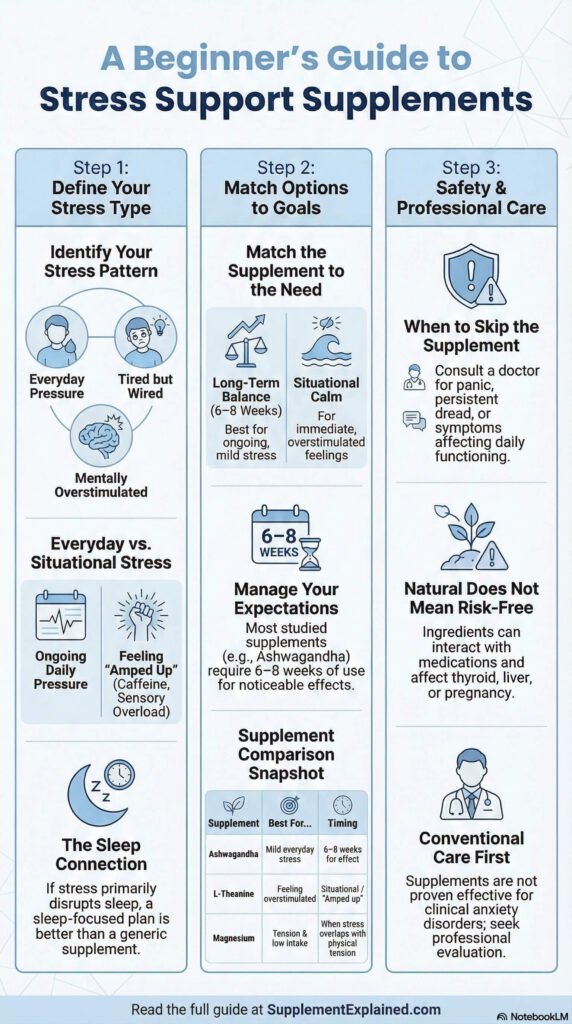
Start with the real stress question
Many “best stress supplements” articles blur together very different experiences. That is where readers get stuck.
- Everyday stress: You feel under pressure, mentally tired, and more reactive than usual.
- Sleep-related stress: You are tired but wired, or stress is mainly showing up as trouble falling or staying asleep.
- Feeling overstimulated: You feel keyed up, especially with caffeine, busy schedules, or sensory overload.
- Persistent anxiety symptoms: You are worrying most days, feeling on edge, having panic symptoms, or avoiding normal activities because of distress.
Those categories overlap, but they do not point to the same next step. If the real issue is sleep, a broad “stress support” supplement may miss the mark. If the real issue is persistent anxiety or panic, a supplement may become a delay tactic rather than a solution.
NCCIH is clear on two important points: effective conventional treatments for anxiety disorders are available, and complementary approaches have not been proven effective for anxiety disorders. If you think that may describe you, start with a health professional conversation rather than more supplement shopping. You can also read when to talk to a clinician.
Where ashwagandha may fit
Ashwagandha is one of the few supplements that comes up repeatedly in stress-support discussions because some studies suggest certain extracts may help reduce stress and anxiety over about 6 to 8 weeks. The NIH Office of Dietary Supplements also notes that some studies have found lower stress hormone levels with use.
That sounds strong, but the practical reality is narrower than the marketing.
- The evidence is modest, not settled: studies are generally small, and products, extracts, and doses vary.
- It is not a universal answer: benefits seen in one extract at one dose do not automatically apply to every bottle on a store shelf.
- Sleep effects may be modest: some small studies suggest sleep benefits, but the evidence is not broad enough to treat as a guaranteed sleep solution.
For readers with mild everyday stress who want a supplement with at least some supportive human research, ashwagandha may be one of the more reasonable places to read further. Start with the evidence-aware overview at ashwagandha, and do not skip the safety page on ashwagandha side effects.
The strength of evidence here is best described as promising but limited. That is very different from “best supplement for stress” headlines.
Other common routes readers compare
Most readers do not compare only one supplement. They usually weigh a few options based on how their stress shows up.
- L-theanine: Often explored by people who feel mentally “amped up” or want something that feels more situational than all-day. It is commonly discussed for calm focus, but this page should not overstate its stress-specific evidence. If that route fits your situation, read the full guide at L-theanine.
- Magnesium: Frequently considered when stress overlaps with low dietary intake, muscle tension, or sleep problems. It is also one of the most overgeneralized supplements online. It can be useful in the right context, but it is not a catch-all answer for every stress complaint. For a practical comparison of forms and expectations, see magnesium.
- Sleep-first approaches: If your “stress” is mostly bedtime rumination, short sleep, or waking unrested, your decision may belong on a sleep page instead. See sleep support.
In other words, the best route usually depends less on hype and more on whether the main problem is daytime pressure, feeling overstimulated, or disrupted sleep.
What people often get wrong
- They shop the symptom label, not the pattern. “Stress” is too broad to guide a smart choice on its own.
- They treat “natural” as a safety guarantee. NCCIH notes that dietary supplements can have side effects and undesirable interactions with medicines.
- They assume more is better. Higher doses do not reliably mean better results and may raise the chance of side effects.
- They expect immediate relief from products studied over weeks. Ashwagandha research often looks at several weeks of use, not one dose.
- They ignore product differences. Extracts, standardization, and dosing can vary widely between brands.
- They use supplements to avoid a bigger decision. If you are dealing with panic, frequent dread, avoidance, or distress that is affecting your life, the key question is not which capsule to buy.
When supplements are not the first move
Supplements make the most sense when the problem is relatively mild, you have a clear goal, and you can use them cautiously. They are not the first move when:
- you think you may have an anxiety disorder
- you are having panic symptoms
- your worry or distress is affecting work, school, sleep, or relationships
- you are using alcohol or other substances to cope
- symptoms are new, escalating, or hard to explain
NCCIH advises that if someone thinks they may have an anxiety disorder, they should talk with a health care provider. That matters because effective conventional treatments are available, including psychotherapy and medication.
If that sounds relevant, see when to talk to a clinician. A supplement can sometimes be a side consideration, but it should not replace proper evaluation.
Safety notes
Even relatively common supplements deserve a safety check before you try them.
- Ashwagandha: The NIH Office of Dietary Supplements notes common side effects such as stomach upset, loose stools, nausea, and drowsiness. Thyroid, liver, pregnancy, and medication context matter. Read more at ashwagandha side effects.
- L-theanine and magnesium: These may seem gentler, but they can still be a poor fit depending on medications, medical conditions, kidney function, or your goal.
- Medicine interactions matter: NCCIH notes that dietary supplements may have side effects and undesirable interactions with medicines.
- Pregnancy and breastfeeding deserve extra caution: this is not the place for casual experimentation.
A practical rule: if you take prescription medicines, have an ongoing medical condition, or your symptoms are more than mild, pause before starting something new.
FAQ
Short answers to the questions readers most often ask before taking the next step.
What is the best supplement for stress support overall?
There is no single best option for everyone. For mild everyday stress, ashwagandha is one of the more researched choices, but the evidence is still limited and product quality varies. If the real issue is poor sleep, overstimulation, or persistent anxiety symptoms, your best next step may be different.
Does ashwagandha help with stress right away?
Usually not in the way marketing implies. Studies often look at several weeks of use, commonly around 6 to 8 weeks. If you are expecting a same-day effect, that does not match the main research pattern.
Is magnesium better than ashwagandha for stress?
Not necessarily. Magnesium is often considered when stress overlaps with low intake, tension, or sleep problems, while ashwagandha is more commonly discussed for everyday stress support. They are different routes, and neither is a guaranteed answer.
Is L-theanine a good option if I feel mentally overamped?
It is a common option readers compare for that reason, especially when they want a calmer, more situational-feeling supplement. But the goal-specific evidence is not strong enough to call it a universal best choice. The detailed context is on our L-theanine page.
When should I stop shopping for supplements and talk to a clinician?
If your symptoms are persistent, intense, causing panic, disrupting daily life, or making you avoid normal activities, stop treating it like a routine supplement choice. NCCIH says people who think they may have an anxiety disorder should talk with a health care provider. You can start here: when to talk to a clinician.
Are stress supplements safe because they are natural?
No. Natural does not mean risk-free. Supplements can cause side effects and can interact with medicines. Ashwagandha in particular has important cautions involving thyroid, liver, pregnancy, and medication context.
Update Note
Last reviewed and updated on March 27, 2026. We revisit priority pages when important evidence, safety, labeling, or regulatory context changes.