
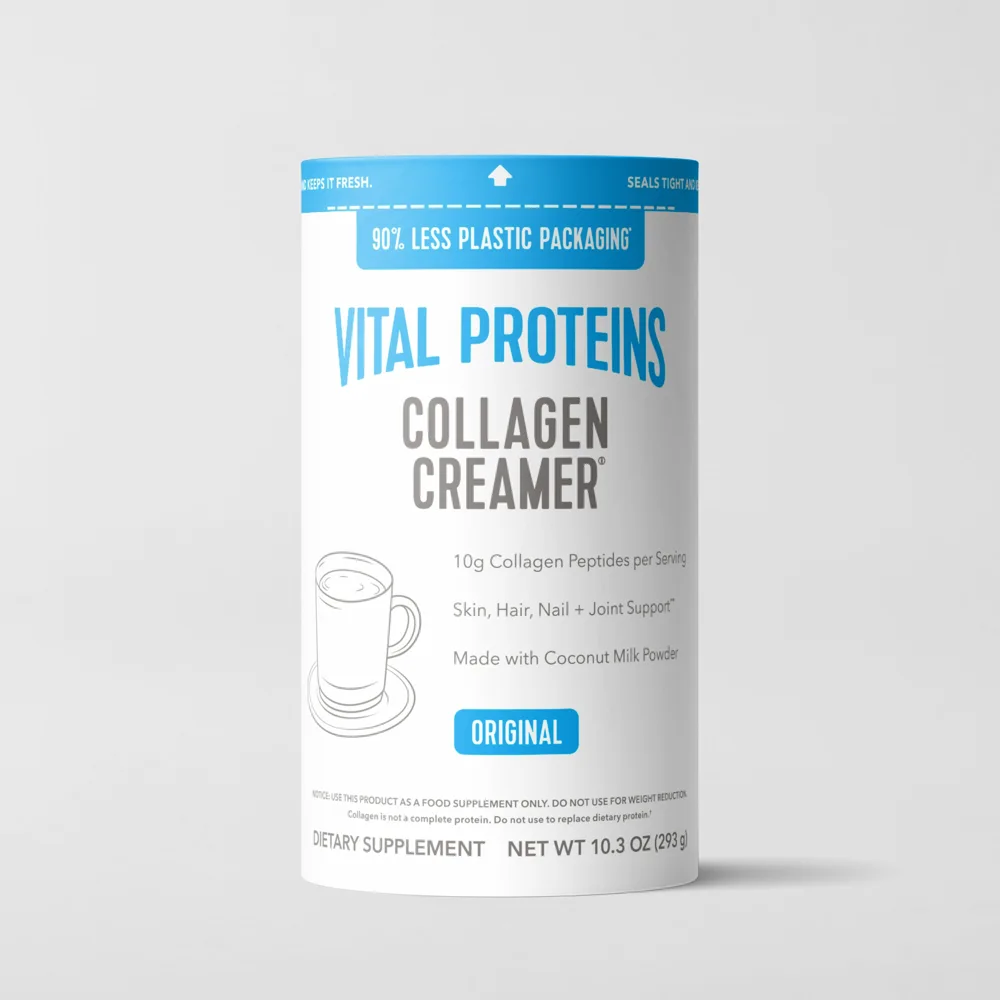
Vital Proteins Original Collagen Creamer
Collagen Creamer · Original · 10.3 oz
Collagen 10 g; declared protein 9 g per label serving.
- Amount
- Collagen 10 g; declared protein 9 g
- Format
- Powder
- Review basis
- Label-based analysis
Good fit
People who specifically want bovine collagen combined with a coconut-milk-based coffee additive.
Consider another option
You need a vegan product or must avoid bovine or coconut ingredients.
The product, at a glance
Amounts for the reviewed label serving.
- Reviewed variant
- Collagen Creamer · Original · 10.3 oz
- Label serving
- 1/4 cup (~24 g)
- Servings per reviewed pack
- ~12
- Ingredients per label serving
- Collagen 10 g; declared protein 9 g
- Other ingredients
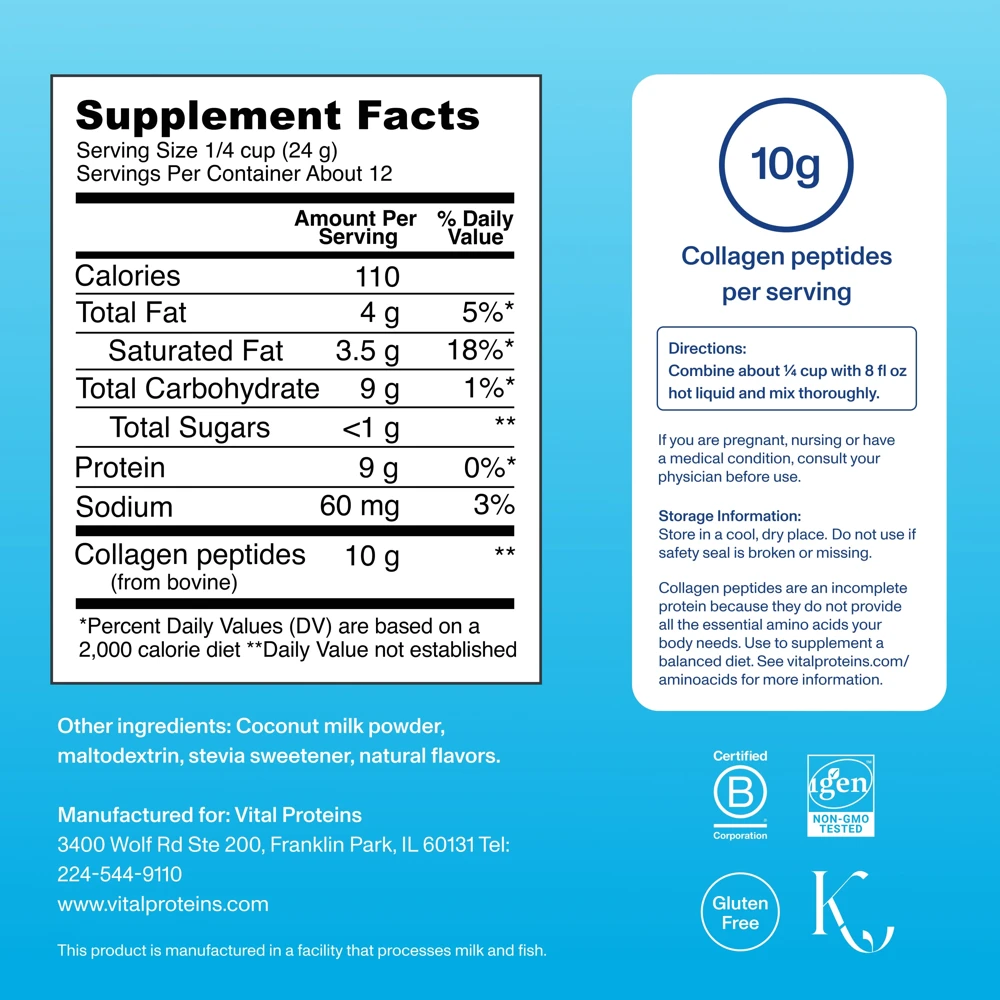
- Coconut milk powder, maltodextrin, stevia, natural flavors
- Nutrition per label serving
- 110 calories; 3.5 g saturated fat; under 1 g sugar
Label sources & rating context
~ means approximate; — means no published value in this record. Customer ratings are the named publisher’s snapshot and may include multiple sizes or earlier formulas. The Supplement Explained Score is our source-reviewed editorial assessment out of 25, separate from customer stars. Compare the five criteria and the same intended use; the total is not a clinical ranking. Prices are dated USD offer snapshots; cost uses the reviewed pack and label serving.
- Label clarity: 5/5
- Evidence transfer: 3/5
- Safety fit: 3/5
- Quality proof: 2/5
- Value fit: 2/5
On this pageTable of Contents
- 1Supplement Explained Score
- 2Label facts at a glance
- 3What is in the current Original Collagen Creamer?
- 4What can the evidence actually tell you?
- 5How do you use it without misreading the serving?
- 6Who should be cautious about this creamer?
- 7How much quality information is available?
- 8How do you calculate its real cost?
- 9How does it compare with plain collagen and regular creamer?
- 10Product examples to compare
- 11FAQ
Our editorial assessment
Supplement Explained Score
15/25
Vital Proteins Original Collagen Creamer · Collagen Creamer · Original · 10.3 oz
Five equally weighted criteria, with a product-specific reason for every point. This is a buying-decision assessment, separate from customer stars and personal medical suitability.
- Label clarity 5/5
- Reviewed Collagen Creamer · Original · 10.3 oz: 1/4 cup (~24 g); ~12 label servings. Collagen 10 g; declared protein 9 g.
- Evidence transfer 3/5
- Collagen skin findings are mixed; incorporating 10 g into creamer does not establish a finished-blend clinical advantage.
- Safety fit 3/5
- Bovine sourcing, creamer ingredients and dietary tolerance matter; collagen is not a complete-protein replacement.
- Quality proof 2/5
- The Original creamer label is identified; an independent report for the finished creamer was not verified.
- Value fit 2/5
- A quarter-cup serving yields only about 12 servings, with a substantial creamer routine compared with plain powder.
Review basis: Published labels, manufacturer/retailer information, clinical sources and exact-product quality records where available. We did not buy, personally use or laboratory-test this product for this assessment.
Reviewed · Method v2.0 · How we assign points
Sources behind this score
- Manufacturer
- 2025 collagen skin-aging review: study quality and funding
- 2025 collagen hydration/elasticity meta-analysis
Product labels and independent directory records identify a formula or testing scope. Clinical references concern ingredients or studied regimens unless the explanation explicitly matches the finished formula.
What is in the current Original Collagen Creamer?
The current Original 10.3 oz tub combines bovine collagen peptides with coconut milk powder, maltodextrin, stevia sweetener and natural flavors. According to the manufacturer’s label, one serving is 1/4 cup, or about 24 g, supplying 10 g collagen peptides and 9 g declared protein. The tub contains about 12 servings.
That serving also supplies 110 calories, 4 g fat, 3.5 g saturated fat, 9 g carbohydrate and under 1 g total sugar. The collagen amount and declared protein amount are separate label figures; use the appropriate one when comparing products.
This is not the same formula as the older vanilla or mocha creamers. It is also not plain collagen powder with a small splash of creamer added: the full serving is a substantial amount of powder. Check the Original label rather than borrowing nutrition numbers or flavor expectations from older listings.
What can the evidence actually tell you?
The strongest conclusion is about what a serving contains, not what it will do for your skin, hair, nails or joints. The cited sources do not establish clinical results for this exact Original formula, and the manufacturer’s benefit claims are not independent proof.
The NIH Office of Dietary Supplements’ exercise and performance fact sheet discusses protein needs, sources and use in exercise. That general guidance is not a clinical trial of this creamer. Its 9 g protein declaration should not be converted into a promise of muscle growth, wrinkle reduction or pain relief.
The verified label information also gives no separate MCT amount. Coconut milk powder therefore does not provide a quantified MCT dose for comparison with another supplement. Likewise, directions for adding the product to morning coffee do not demonstrate better collagen absorption at breakfast.
A 2025 review found no significant skin benefits in higher-quality trials. It did not test this exact product.
How do you use it without misreading the serving?
Measure the labeled 1/4-cup portion and follow the manufacturer’s instruction to mix it with 8 fl oz of hot liquid. Do not assume that a casual spoonful, or a scoop from another product, equals the stated serving.
You can use less powder, but that also lowers the collagen amount. A smaller coffee-sized portion should not still be counted as delivering the full 10 g. The distinction between a serving size and the amount you actually take matters more than whether you call the portion a scoop.
At one full serving daily, a tub lasts roughly 12 days. If this replaces another creamer, compare both labels. If you add it alongside your usual milk or creamer, include both in your nutrition totals. The mixing directions do not guarantee creaminess or clump-free results.
Who should be cautious about this creamer?
People avoiding animal products or coconut should skip this formula. Those monitoring saturated fat or carbohydrates should check whether a full serving fits their diet: it contributes 3.5 g saturated fat and 9 g carbohydrate.
Under 1 g total sugar does not mean carbohydrate-free. Use the full carbohydrate figure rather than the sugar number alone when tracking intake. If a medical condition affects your allowed protein or fat intake, discuss the product with your care team rather than changing prescribed restrictions.
For a food allergy, read the current package’s allergen statement and confirm suitability with the manufacturer; the ingredient list alone cannot settle cross-contact questions. This coffee additive should not replace assessment of persistent joint pain or unexplained hair loss.
How much quality information is available?
The label identifies the formula and serving amounts, but it does not by itself establish finished-product purity or clinical effectiveness. This is a label-based review, not hands-on testing.
A batch-specific contaminant report or third-party certification for this exact variant has not been verified for this review. That is missing information, not evidence that the product is contaminated. If testing matters to your purchase, ask for documentation matching the product and lot you will receive.
The guide to collagen and heavy-metal testing explains what to check. Testing for identity or contaminants would not itself prove skin or joint benefits. Consumer packaging may change, so recheck the serving size, ingredients and allergen information on arrival.
How do you calculate its real cost?
Calculate cost using about 12 labeled servings per tub, not the tub’s weight alone. Divide the amount you actually pay—including applicable shipping and tax, after discounts—by 12 for the cost of one full serving.
For a collagen comparison, the tub contains approximately 120 g collagen: 12 servings multiplied by 10 g. For a declared-protein comparison, use approximately 108 g: 12 multiplied by 9 g. The 24 g serving weight includes the other ingredients and is not a valid collagen or protein denominator.
For a clearly hypothetical example, suppose the total paid were $24. That would equal about $2 per full serving, $0.20 per gram of collagen, or $0.22 per gram of declared protein. These are illustrative calculations, not a current price.
The protein-powder cost-per-gram calculator can help with the arithmetic. Choose the denominator that matches your goal, and compare any subscription discount alongside its recurring purchase terms.
Check current Amazon price and size
Affiliate link: we may earn a commission if you buy.
How does it compare with plain collagen and regular creamer?
Plain bovine collagen powder is the closest alternative if you want collagen but prefer to control your coffee’s other ingredients separately. The manufacturer describes its plain Collagen Peptides as a single-ingredient bovine product, unlike this creamer’s combination of collagen, coconut milk powder, maltodextrin, stevia and flavors.
Choose this creamer for the convenience of that combined formula. Consider Vital Proteins Unflavored Collagen Peptides when you want collagen without those creamer ingredients. Check that powder’s own serving size and nutrition label; do not transfer this tub’s numbers to it.
If you only want creamier coffee, an ordinary creamer avoids buying collagen you did not intend to use. If your main goal is more dietary protein, compare foods or another protein supplement by its own protein amount and type. None is automatically cheaper or better: compare the actual formula, serving and total cost for how you plan to use it.
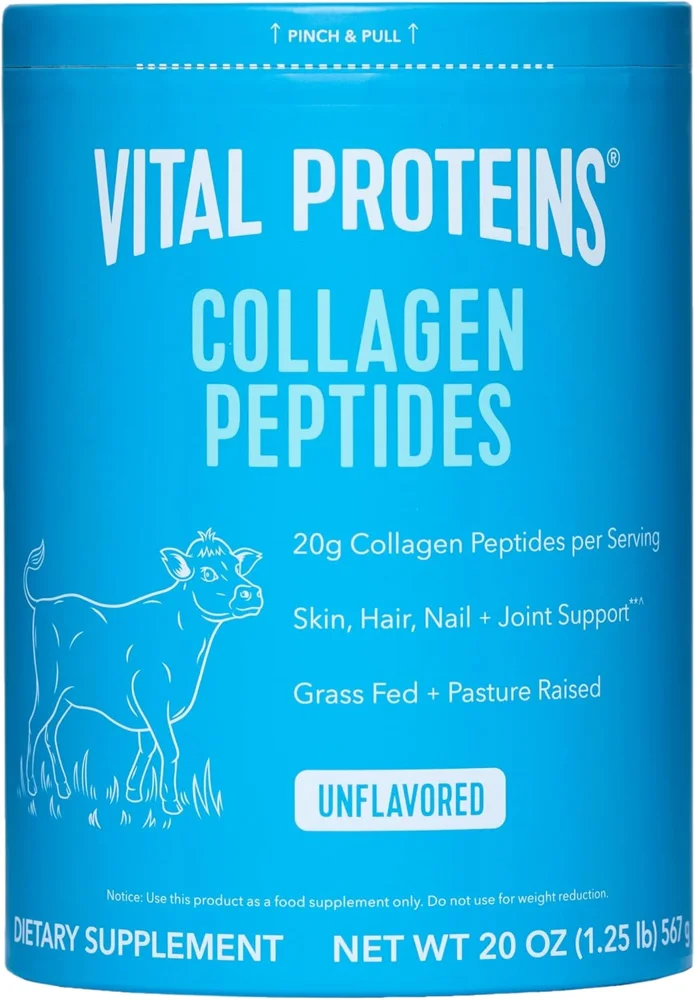
Vital Proteins Collagen Peptides Unflavored 20 oz
Single-ingredient bovine powder with 20 g collagen per labeled serving.
Check price at Amazon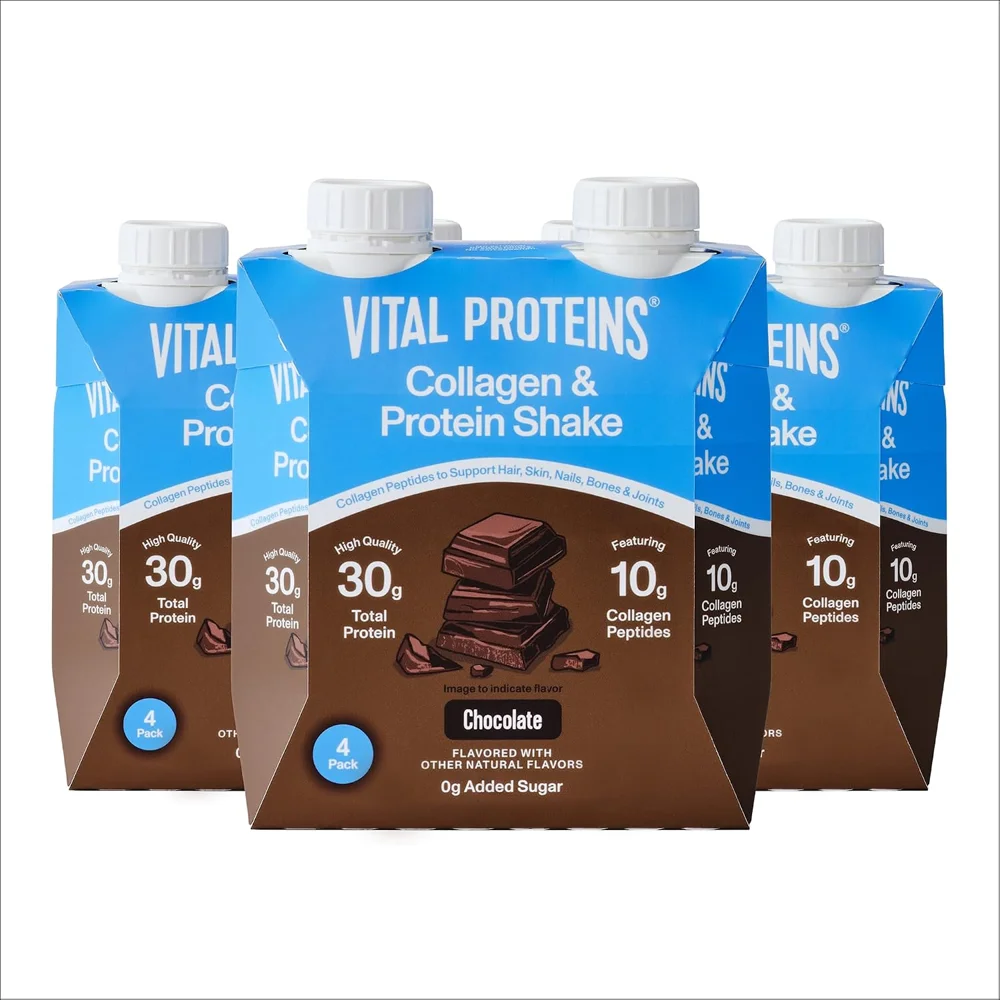
Vital Proteins Collagen & Protein Shake
A ready-to-drink chocolate carton: 30 g total protein includes 10 g collagen.
Check price at AmazonAffiliate links: we may earn a commission if you buy. Check the selected size, seller and current label on Amazon.
Product examples to compare
- Vital Proteins Matcha Collagen: 10 g bovine collagen and 50 mg caffeine in a matcha drink; about 21 servings.
FAQ
How much collagen is in one serving?
The current Original label lists 10 g bovine collagen peptides per 1/4-cup serving, weighing about 24 g. It separately declares 9 g protein. Those figures should not be treated as interchangeable.
Can I use less than 1/4 cup?
Yes, but a smaller portion supplies less collagen. Do not count a light spoonful as the full labeled 10 g dose. Measure what you use if you want a meaningful serving-cost comparison.
Does it need to be taken in the morning?
The directions describe mixing with hot liquid, not a requirement to take it at breakfast. No special morning absorption advantage is established by the sources reviewed. Morning coffee is a convenience, not a proven timing benefit.
Is it sugar-free or carbohydrate-free?
It is not carbohydrate-free: one serving contains 9 g carbohydrate and under 1 g total sugar. Under 1 g does not establish zero sugar, and the ingredient list includes maltodextrin.
Will it make coffee creamy without clumps?
That cannot be guaranteed from the label. The manufacturer suggests mixing a serving with 8 fl oz of hot liquid, but creaminess, sweetness and clumping have not been independently assessed in this review.
References
- Vital Proteins Original Collagen Creamer — product information and label
- NIH Office of Dietary Supplements: Dietary Supplements for Exercise and Athletic Performance — Health Professional Fact Sheet
- Effects of Collagen Supplements on Skin Aging: systematic review and meta-analysis (2025)
- Matched product listing and package identity: B0CZPLBNCW
Label and package details checked against the cited sources. Retailer prices and available versions can change; the page update date is shown above.