
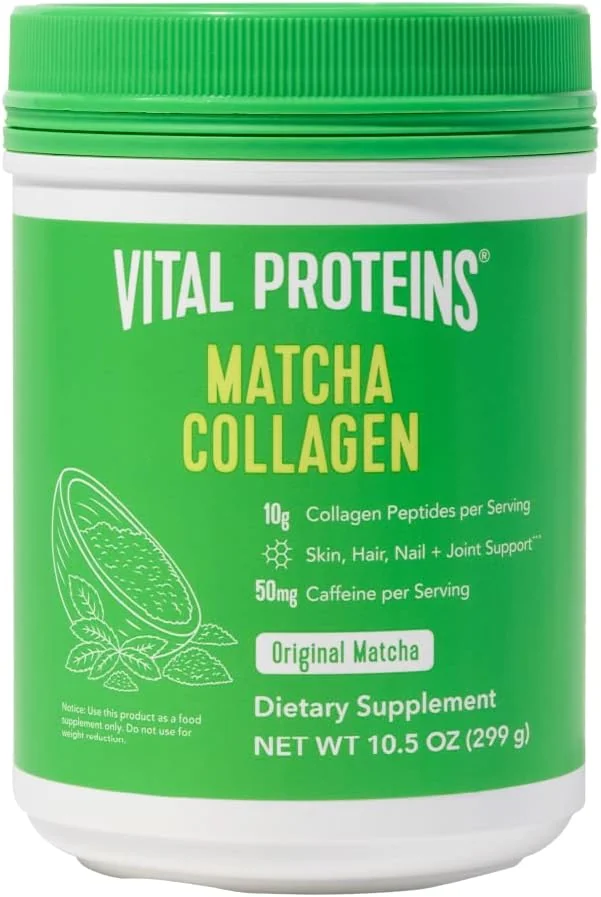
Vital Proteins Matcha Collagen
Matcha Collagen · Original · 299 g
Collagen 10 g; declared protein 9 g; caffeine 50 mg; L-theanine 16 mg per label serving.
- Amount
- Collagen 10 g; declared protein 9 g; caffeine 50 mg; L-theanine 16 mg
- Format
- Powder
- Review basis
- Label-based analysis
Good fit
Matcha drinkers who want bovine collagen in one caffeinated mix.
Consider another option
You avoid caffeine or bovine ingredients, or want separate control of each amount.
The product, at a glance
Amounts for the reviewed label serving.
- Reviewed variant
- Matcha Collagen · Original · 299 g
- Label serving
- 2 tablespoons (14 g)
- Servings per reviewed pack
- ~21
- Ingredients per label serving
- Collagen 10 g; declared protein 9 g; caffeine 50 mg; L-theanine 16 mg
- Ingredients & allergens
- Bovine collagen plus matcha; not vegan or caffeine-free
- Nutrition per label serving
- 50 calories; 3 g carbohydrate; 2 g total sugar; 50 mg sodium
Label sources & rating context
~ means approximate; — means no published value in this record. Customer ratings are the named publisher’s snapshot and may include multiple sizes or earlier formulas. The Supplement Explained Score is our source-reviewed editorial assessment out of 25, separate from customer stars. Compare the five criteria and the same intended use; the total is not a clinical ranking. Prices are dated USD offer snapshots; cost uses the reviewed pack and label serving.
- Label clarity: 5/5
- Evidence transfer: 3/5
- Safety fit: 3/5
- Quality proof: 2/5
- Value fit: 2/5
On this pageTable of Contents
- 1Supplement Explained Score
- 2Label facts at a glance
- 3What does the 10.5 oz Matcha Collagen actually combine?
- 4Does this blend have evidence for skin or calm focus?
- 5How does Matcha Collagen fit into a daily drink?
- 6Who should be cautious about this caffeinated blend?
- 7How can you identify the right Matcha Collagen version?
- 8What are you paying for across about 21 servings?
- 9When does plain collagen plus tea make more sense?
- 10FAQ
Our editorial assessment
Supplement Explained Score
15/25
Vital Proteins Matcha Collagen · Matcha Collagen · Original · 299 g
Five equally weighted criteria, with a product-specific reason for every point. This is a buying-decision assessment, separate from customer stars and personal medical suitability.
- Label clarity 5/5
- Reviewed Matcha Collagen · Original · 299 g: 2 tablespoons (14 g); ~21 label servings. Collagen 10 g; declared protein 9 g; caffeine 50 mg; L-theanine 16 mg.
- Evidence transfer 3/5
- Collagen skin findings are mixed; 16 mg theanine is not matched to the 200 mg trial, and no exact matcha-blend benefit was verified.
- Safety fit 3/5
- The 50 mg caffeine serving affects sleep, stimulant stacking and pregnancy intake; collagen source restrictions also matter.
- Quality proof 2/5
- The matcha-collagen label is identified, but no independent finished-powder record was verified.
- Value fit 2/5
- Caffeine, matcha and collagen bind separate choices into one roughly 21-serving drink.
Review basis: Published labels, manufacturer/retailer information, clinical sources and exact-product quality records where available. We did not buy, personally use or laboratory-test this product for this assessment.
Reviewed · Method v2.0 · How we assign points
Sources behind this score
- Manufacturer
- 2025 collagen skin-aging review: study quality and funding
- 2025 collagen hydration/elasticity meta-analysis
- 2019 randomized crossover trial: L-theanine 200 mg/day
Product labels and independent directory records identify a formula or testing scope. Clinical references concern ingredients or studied regimens unless the explanation explicitly matches the finished formula.
What does the 10.5 oz Matcha Collagen actually combine?
This is a two-in-one powder: matcha plus bovine collagen. A full 14 g serving supplies 10 g of collagen and 9 g of declared protein. Those are different label measures, not two protein portions to add together. The rest of the powder is not additional collagen, and the blend is neither vegan nor caffeine-free.
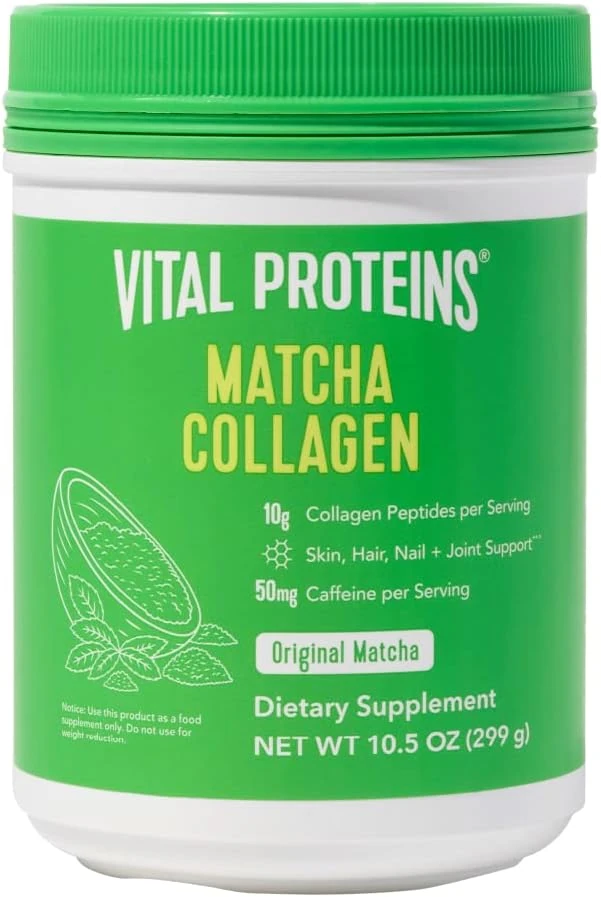
Each serving also supplies 50 mg of caffeine and, on the matched 10.5 oz panel, 16 mg of L-theanine. The practical question is whether you want those ingredients tied to the same serving. You cannot increase collagen from this blend without also increasing caffeine. This review uses the pictured 10.5 oz version, not the newer 10 oz packaging. [1] [2]
Does this blend have evidence for skin or calm focus?
There is no verified clinical trial for this exact blend in the cited sources. Ingredient research therefore cannot establish that this product improves skin or produces calm focus.
A 2025 review of collagen and skin-aging trials cautions against treating skin benefits as settled, particularly when higher-quality trials are considered. That makes a promise of visible skin improvement a weak reason to pay extra for this blend. The review also does not test this formula. [3] Our collagen peptides overview discusses the broader ingredient evidence.
The separately studied L-theanine intervention used 200 mg per day, not this serving’s 16 mg. Its findings cannot be directly applied to this amount or this combination. L-theanine also should not be treated as something that cancels caffeine. [4]
How does Matcha Collagen fit into a daily drink?
Think of it as a caffeinated drink with added collagen, not a caffeine-free protein powder. Choose a time that already suits your caffeine habits, and count coffee, tea, energy drinks, and other caffeinated supplements alongside its 50 mg.
Morning may be more practical if later caffeine disrupts your sleep. There is no reason in the reviewed evidence to force an evening serving for a presumed collagen timing advantage; your caffeine sensitivity is the clearer scheduling consideration. The collagen timing guide addresses that question separately.
Follow the preparation instructions on your container. A kitchen scale can help you match the 14 g serving rather than relying on an unmeasured spoonful.
Who should be cautious about this caffeinated blend?
FDA guidance notes that 400 mg of caffeine per day is not generally associated with negative effects for most adults. That is broad context, not a recommended target or a personalized safe limit. This serving’s 50 mg still matters when combined with other sources. [5]
For drink-related heartburn, compare protein shakes and reflux triggers, including caffeine, timing and what else goes into the drink.
- If caffeine triggers insomnia, jitteriness, or palpitations, do not expect L-theanine to prevent those effects.
- Avoid this blend if you must avoid bovine-derived ingredients.
- For pregnancy or breastfeeding, get individual advice rather than applying the general adult caffeine figure.
How can you identify the right Matcha Collagen version?
Retail bullet text lists 20 mg of L-theanine, while the pictured 10.5 oz panel lists 16 mg. The manufacturer also has newer 10 oz packaging with a different panel. For the version reviewed here, use 16 mg and about 21 servings; do not combine numbers from different listings. [1] [2]
Before buying, match the container size and nutrition panel rather than relying only on the product name. If a different version arrives, recalculate its serving cost and caffeine contribution from that container.
Brand recognition alone does not establish independent testing. If certification or contaminant testing matters to you, look for verifiable documentation covering this product, ideally the batch you are buying.
What are you paying for across about 21 servings?
At one full serving daily, the matched tub lasts about 21 days—not a full month. Those servings contain about 210 g of collagen, despite the 299 g total powder weight. Divide the delivered price, including shipping and applicable tax after discounts, by the actual days you expect it to last.
In a clearly hypothetical example—not a current price—a $42 delivered tub would cost about $2 per full daily serving, or $0.20 per gram of collagen. That calculation values collagen content, not the powder’s total weight.
Compare that with the combined cost of enough plain collagen to supply 10 g and your preferred tea. Any premium here is mainly paying for one-container convenience. If you already keep both ingredients at home, the blend may save preparation steps without saving money.
Affiliate link: we may earn a commission if you buy. Confirm the selected size, label and seller.
When does plain collagen plus tea make more sense?
Plain collagen plus separately prepared tea lets you keep the collagen amount steady while choosing your tea strength, switching drinks, or leaving caffeine out. Compare labels rather than assuming another tub has the same serving. The Vital Proteins unflavored collagen review covers a separate-powder option.
This blend is reasonable when you already want a caffeinated matcha drink and prefer one preparation step. Separate products make more sense when caffeine needs vary by day or when you want collagen in foods and drinks without adding matcha flavor. Neither arrangement establishes better skin results.
FAQ
Can I use half a serving?
Half the labeled amount is 7 g of powder. Assuming an evenly mixed powder, that would provide approximately 5 g of collagen and 25 mg of caffeine. It reduces both together; it does not selectively reduce caffeine.
Can I add it to a smoothie instead of making tea?
A smoothie is an option if matcha fits the recipe. Keep track of the powder amount: changing the drink does not change its caffeine contribution. A full serving still adds 50 mg of caffeine.
Does 2 g of total sugar mean 2 g of added sugar?
Not necessarily. Total sugar and added sugar are different label entries. The matched panel's 2 g total-sugar figure alone does not establish the added-sugar amount; check your container's added-sugars line and ingredient list.
Can this replace breakfast or a protein shake?
At 50 calories and 9 g of declared protein per serving, it is better viewed as a drink addition than a full meal. If protein is your main purchase goal, compare declared protein per serving and per dollar.
Is the FDA's 400 mg caffeine figure appropriate during pregnancy?
The general adult figure is not pregnancy guidance. Discuss this product and all other caffeine sources with your prenatal clinician; do not treat its L-theanine content as a reason to disregard caffeine.
References
- Reviewed package and label: B0BLF3X7ZT
- Vital Proteins Matcha Collagen product information
- 2025 review of collagen supplementation and skin-aging outcomes
- L-theanine supplementation intervention study
- FDA: Spilling the Beans—How Much Caffeine Is Too Much?
Label details checked October 2, 2026. This is a document-based review, not a hands-on product test. Retailer prices and product versions can change.