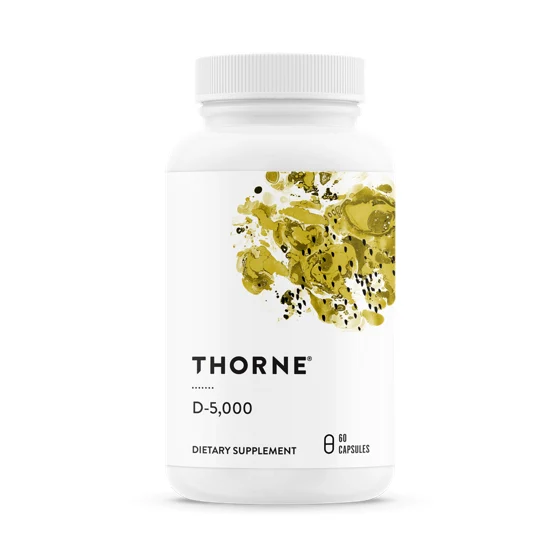
Count vitamin D from food and every supplement, including multivitamins and D+K products. Excess vitamin D can cause hypercalcemia (too much calcium in the blood) and other harm. Review this strength and your medicines with a clinician, particularly if you take a thiazide diuretic. Medically supervised treatment can differ from the general upper limit; the manufacturer's one-capsule-daily direction is label information, not an individualized dosing recommendation.
The manufacturer's ingredient list names vitamin D3 as the active ingredient, with leucine, microcrystalline cellulose, silicon dioxide, a hypromellose cellulose capsule and vitamin E (d-alpha-tocopherol) as other ingredients. Vitamin K is not listed, so this is not a D3 + K2 combination.
Check the strength when comparing similar product names. A 1,000 IU capsule contains one-fifth as much vitamin D as this 5,000 IU capsule; a 10,000 IU capsule contains twice as much. Those are dose comparisons, not evidence that the stronger product delivers greater benefit.
What the NSF record establishes
The NSF Certified for Sport directory entry identifies Thorne D-5,000 as unflavored capsules, lists both 60- and 120-capsule packages, and names specific lots, including 411559 and 416728. Compare your bottle's lot with the directory; a matching product name and package size alone do not confirm a lot match.
The record independently documents the certification listing for this product and its named lots. It is not a blanket certification of every Thorne supplement, and it does not establish how much vitamin D an individual needs or whether 5,000 IU will provide additional health benefit.
Price for the 60-capsule bottle
On October 15, 2026, HerbsPro's matched 60-capsule offer was $24.28 before shipping and tax. Dividing $24.28 by 60 gives about $0.405 per capsule, which is also the labeled serving. The official Thorne one-time purchase price was $20 on the same date. HerbsPro was not the lower-priced of these two observed product offers. Prices can change.
Lower-dose comparisons and clinical context
A higher dose does not, by itself, establish greater benefit for a healthy adult whose vitamin D status is already adequate, as reflected in NIH's vitamin D evidence overview. If you are comparing routine supplements without a clinical reason for 5,000 IU, a lower-strength product such as Doctor's Best Vitamin D3 1000 IU is a more relevant option to discuss.
A medically supervised treatment plan is a different context from choosing a routine daily supplement. If a blood-test result prompted your search, ask whether this strength fits the treatment plan and how the response will be checked. Our 25(OH)D test guide explains what that result can and cannot tell you.
Our editorial assessment
Supplement Explained Score
72/100
Five equally weighted criteria. This is an editorial assessment, not customer stars or a measure of medical effectiveness.
Label clarity 5/5
The manufacturer identifies the D3 form, 125 mcg amount, one-capsule serving and complete other-ingredient list for the reviewed 60-count pack.
Research relevance 4/5
Vitamin D3 has strong nutrient-specific human evidence, but benefit depends on baseline status and indication; this exact high-strength product is not a universal outcome improvement.
Safety and cautions 2/5
Each capsule exceeds the adult 4,000 IU daily upper limit. Total intake, medicines and clinical supervision materially restrict routine use.
Testing and quality checks 4/5
The independent NSF Certified for Sport directory matches D-5,000 capsules, the 60/120 packs and named lots. The reader's own bottle lot was not tested by us.
Value for money 3/5
The matched seller was $24.28 for 60 servings, versus $20 at Thorne. The simple serving is practical, but the observed affiliate offer did not have a price advantage.
Evaluated from the published Supplement Facts panel, third-party certification records, and clinical references cited below. Unlisted third-party testing lowers the verification score but does not imply contamination.