
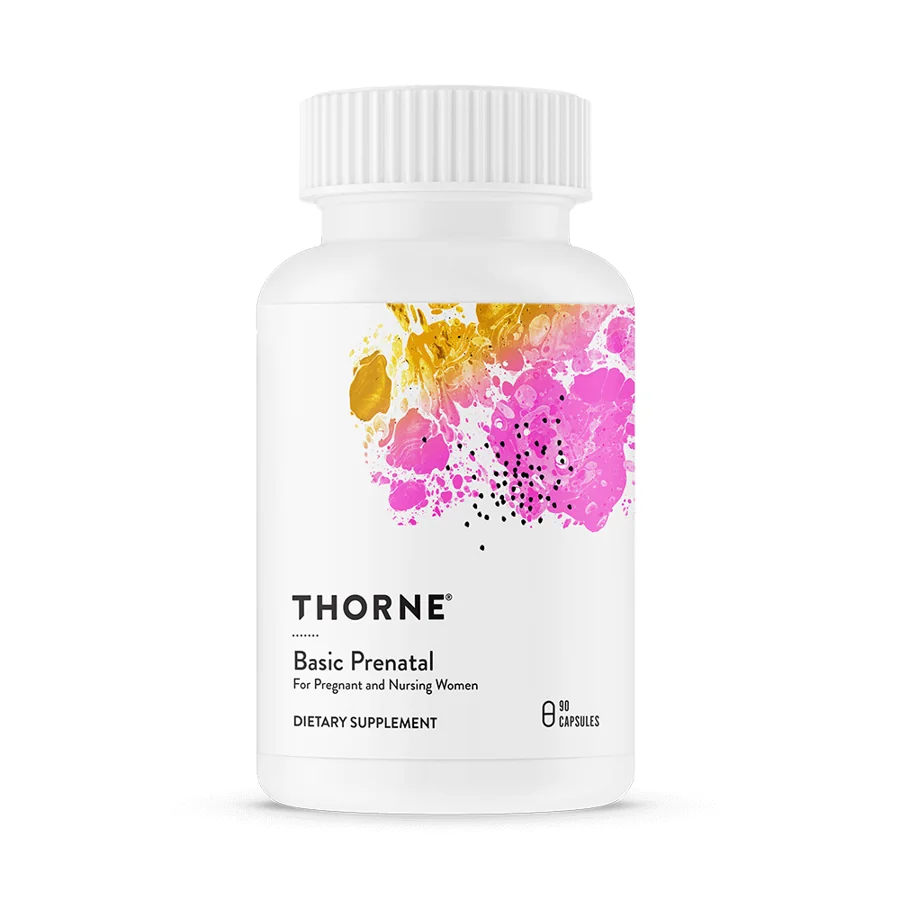
Thorne Basic Prenatal
Basic Prenatal · 90 capsules
Iron 45 mg; folate 1.7 mg DFE (1,000 mcg 5-MTHF); choline 110 mg per label serving.
- Amount
- Iron 45 mg; folate 1.7 mg DFE (1,000 mcg 5-MTHF); choline 110 mg
- Format
- Capsules
- Review basis
- Label-based analysis
Good fit
Prenatal users whose clinician approves the iron level and folate form.
Consider another option
You need less iron, fewer daily capsules, or DHA included.
The product, at a glance
Amounts for the reviewed label serving.
- Reviewed variant
- Basic Prenatal · 90 capsules
- Label serving
- 3 capsules
- Servings per reviewed pack
- 30
- Ingredients per label serving
- Iron 45 mg; folate 1.7 mg DFE (1,000 mcg 5-MTHF); choline 110 mg
- Other ingredients
- Calcium Laurate, Hypromellose (derived from cellulose) capsule
- Quality & testing
- NSF Certified for Sport · US 90 capsules · specified lots Source ↗
- Formula / pack difference
- 90 capsules ÷ 3 per serving = 30 servings; manufacturer web serving-count text is inconsistent.
Label sources & rating context
Manufacturer ↗ · Retailer label ↗ · Certification record ↗
~ means approximate; — means no published value in this record. Customer ratings are the named publisher’s snapshot and may include multiple sizes or earlier formulas. The Supplement Explained Score is our source-reviewed editorial assessment out of 25, separate from customer stars. Compare the five criteria and the same intended use; the total is not a clinical ranking. Prices are dated USD offer snapshots; cost uses the reviewed pack and label serving.
- Label clarity: 5/5
- Evidence transfer: 4/5
- Safety fit: 3/5
- Quality proof: 4/5
- Value fit: 3/5
On this pageTable of Contents
- 1Supplement Explained Score
- 2Label facts at a glance
- 3Does this formula cover your prenatal priorities?
- 4What does the evidence support—and what does it not?
- 5Will three capsules fit your daily routine?
- 6Is this iron level appropriate for you?
- 7What should you verify before choosing a prenatal?
- 8Are you buying one month or three months?
- 9Which alternatives address different needs?
- 10FAQ
Our editorial assessment
Supplement Explained Score
19/25
Thorne Basic Prenatal · Basic Prenatal · 90 capsules
Five equally weighted criteria, with a product-specific reason for every point. This is a buying-decision assessment, separate from customer stars and personal medical suitability.
- Label clarity 5/5
- Reviewed Basic Prenatal · 90 capsules: 3 capsules; 30 label servings. Iron 45 mg; folate 1.7 mg DFE (1,000 mcg 5-MTHF); choline 110 mg.
- Evidence transfer 4/5
- Prenatal nutrient support is well grounded, but CDC neural-tube prevention evidence is for folic acid; 5-MTHF is not assigned identical proof.
- Safety fit 3/5
- Iron 45 mg and other prenatal nutrients need obstetric review; avoid doubling prenatal/iron products and keep away from children.
- Quality proof 4/5
- An exact US 90-capsule NSF Certified for Sport record names specified lots; it is not a pregnancy-outcome certificate.
- Value fit 3/5
- Three capsules daily provide 30 servings; iron and choline needs still determine whether this routine fits.
Review basis: Published labels, manufacturer/retailer information, clinical sources and exact-product quality records where available. We did not buy, personally use or laboratory-test this product for this assessment.
Reviewed · Method v2.0 · How we assign points
Sources behind this score
- Manufacturer
- Retailer label
- Certification record
- NIH ODS: multivitamin/mineral supplements
- NIH ODS: iron
- CDC: MTHFR and folic acid facts
Product labels and independent directory records identify a formula or testing scope. Clinical references concern ingredients or studied regimens unless the explanation explicitly matches the finished formula.
Does this formula cover your prenatal priorities?
On the reviewed retail label, Basic Prenatal is an iron-containing multivitamin with 5-MTHF folate, not a complete pregnancy nutrition package. Its main trade-offs are substantial iron, limited choline, and no listed DHA.
Choline deserves a separate dietary check: the formula supplies 110 mg against a pregnancy target of 450 mg. Food contributes to that target, so the difference is not automatically an amount you need from another supplement. Calcium and magnesium also need to be considered alongside food rather than assumed to cover your entire intake.
The folate form is 5-MTHF, not folic acid. That distinction matters even when both products use the word folate. If you specifically want DHA included in your prenatal, this reviewed formula does not meet that preference.
What does the evidence support—and what does it not?
Ingredient guidance helps assess this formula, but the listed sources do not establish pregnancy-outcome benefits for this exact Thorne product. Research about a nutrient is not a trial of the finished prenatal.
CDC guidance specifies 400 mcg of folic acid daily for people who could become pregnant and identifies folic acid as the form shown to prevent neural tube defects. Basic Prenatal uses 5-MTHF. Its folate amount, including the DFE figure, does not by itself establish equivalent prevention evidence. Discuss that distinction with your prenatal clinician rather than automatically adding another folate product.
The NIH multivitamin overview explains that formulations vary and supplements add to intake from food and other products. A prenatal can support selected nutritional needs without replacing diet. For broader context, see our guide to what a multivitamin can and cannot replace.
Will three capsules fit your daily routine?
The label directions are three capsules daily with food. That is a meaningful capsule commitment; if taking only one pill each day is a firm priority, this format is not a good match.
If the routine leaves you feeling sick, compare prenatal vitamins and nausea and bring the exact bottle to your prenatal appointment.
Consider the whole routine, not this bottle in isolation. A separately selected nutrient product adds another step, and difficulty swallowing capsules can make a three-capsule serving impractical. Check the actual bottle’s directions rather than relying on a retailer’s summary.
Bring a complete supplement list to your prenatal care team, including separate iron, folate, vitamin D, and other combination products. The Multivitamin Overlap Map can help organize that inventory. A nutrient gap does not mean another multivitamin is the right way to fill it.
Is this iron level appropriate for you?
The main reason to pause is the 45 mg iron amount: it is not a universal prenatal requirement and should be considered alongside your iron status and other sources.
That amount can be appropriate in selected prenatal contexts, but the label alone cannot determine your need. Iron-related lab results, existing iron supplements, and gastrointestinal tolerance all matter. Iron can cause gastrointestinal effects; the bisglycinate form does not guarantee a symptom-free experience.
If your clinician has advised you to limit supplemental iron, skip this formula unless they approve it for your situation. It is also a poor default choice for someone simply seeking an everyday multivitamin outside prenatal care. Do not stack it with another multivitamin to fill gaps: doing so can increase several nutrients at once.
What should you verify before choosing a prenatal?
The important checks are the full daily serving, iron amount and folate form. Bring that panel, plus your other supplements, to your prenatal clinician rather than relying on a brand reputation or a methylated label.
Thorne provides a detailed ingredient panel, which makes those checks possible. A certification or testing badge should still be verified for the exact product and scope. It does not establish that 45 mg iron or this particular folate choice is right for every pregnancy.
Are you buying one month or three months?
Judge value as a 30-day bottle, not a 90-day supply: 90 capsules divided by the three-capsule daily serving equals 30 days.
The manufacturer page’s 90-serving entry conflicts with that arithmetic. Capsule count and label directions provide the usable comparison; the inconsistent entry should not turn a month’s supply into a three-month claim.
Compare the displayed retail price per 30-day bottle, or divide it by 30 for daily cost, excluding delivery and tax. For another prenatal, check both labeled days of supply and pills per day rather than comparing capsule counts alone.
Include any separately selected nutrient product in your total cost and daily burden. A low price does not prove effectiveness, and a higher price does not make a formula better suited to your needs.
Dated price check: HerbsPro listed the reviewed package at $46.32 on , before delivery, tax or optional discounts. This is a snapshot, not a lowest-price claim.
Comparable cost: About $1.54 per labeled day, using 30 days of supply. This is a supply calculation, not a recommended treatment duration.
Check current price at HerbsPro
Affiliate link: we may earn a commission. Confirm the package size and current label.
Which alternatives address different needs?
Two useful comparison types are a folic-acid-based prenatal and a lower-iron prenatal. They address different reasons someone might pass on Basic Prenatal, rather than simply offering a different brand name.
- A folic-acid-based prenatal: Consider this with your clinician when you want the folate form emphasized in CDC prevention guidance. Compare iron, choline, and capsule burden too; folate form alone does not settle the choice.
- A lower-iron prenatal: This is the more relevant comparison when your iron status or other supplements make 45 mg a poor match. Check whether it also meets your other nutrient priorities.
Neither type automatically supplies complete pregnancy nutrition. If DHA inclusion or fewer daily capsules is essential, check those features explicitly instead of assuming that every prenatal provides them.
FAQ
Does 1.7 mg DFE mean 1.7 mg of 5-MTHF?
No. DFE is a folate-equivalence reporting unit, not the weight of the 5-MTHF ingredient. The reviewed label lists 1.7 mg DFE from 1,000 mcg of 5-MTHF. Do not read the DFE value as the ingredient's mass.
Should I add folic acid because this uses 5-MTHF?
Do not add it automatically. Ask your prenatal clinician to review the folate form and your complete supplement list against your prevention plan. Adding another product without that review can create unnecessary overlap.
Does food count toward the choline target?
Yes. The pregnancy target includes intake from food as well as supplements. This formula's 110 mg is only part of the 450 mg target; your dietary intake affects the remaining gap.
What if the delivered bottle differs from the listing?
Check the bottle's Supplement Facts and directions, then ask the seller or manufacturer to clarify the version before using it. Do not combine nutrient amounts from one label with serving instructions from another.
Will Basic Prenatal help me get pregnant?
The listed sources do not establish a fertility benefit for this exact product. A prenatal supports nutritional planning; it should not be purchased as a fertility treatment or a guarantee of pregnancy.
References
- Reviewed retailer package and label
- Manufacturer product information
- CDC: About Folic Acid
- NIH Office of Dietary Supplements: Multivitamin/mineral Supplements
Label and listing checked October 2, 2026. Document-based review, not a hands-on test. Product versions and prices can change.
Editorial information
Continue your decision
If this product is not an obvious fit, use one of these routes instead of leaving the decision unfinished.
- All product analyses Browse the full product analysis library for alternatives and category comparisons.
- Supplement Explained Score See how label clarity, evidence transfer, safety fit, quality proof, and value fit are scored.
- Interaction checklist Check common combination risks before stacking supplements or medications.
- How we review evidence Understand how editorial evidence claims, uncertainty, and safety language are handled.