Alternative to compareSupersmart Daily 1, 60 tablets
A one-tablet multivitamin with a different nutrient profile and extra ingredients. Unlike Thorne, this formula does not list vitamin K; it is not a like-for-like replacement.
~ = approximate; — = not reported. Customer stars may cover other sizes or older formulas. Our editorial score out of 100 covers the label, evidence and buying tradeoffs, not how well a supplement will work for you. Cost per serving uses the listed pack and its price on the date shown.
Label clarity: 5/5
Research relevance: 4/5
Safety and cautions: 3/5
Testing and quality checks: 4/5
Value for money: 3/5
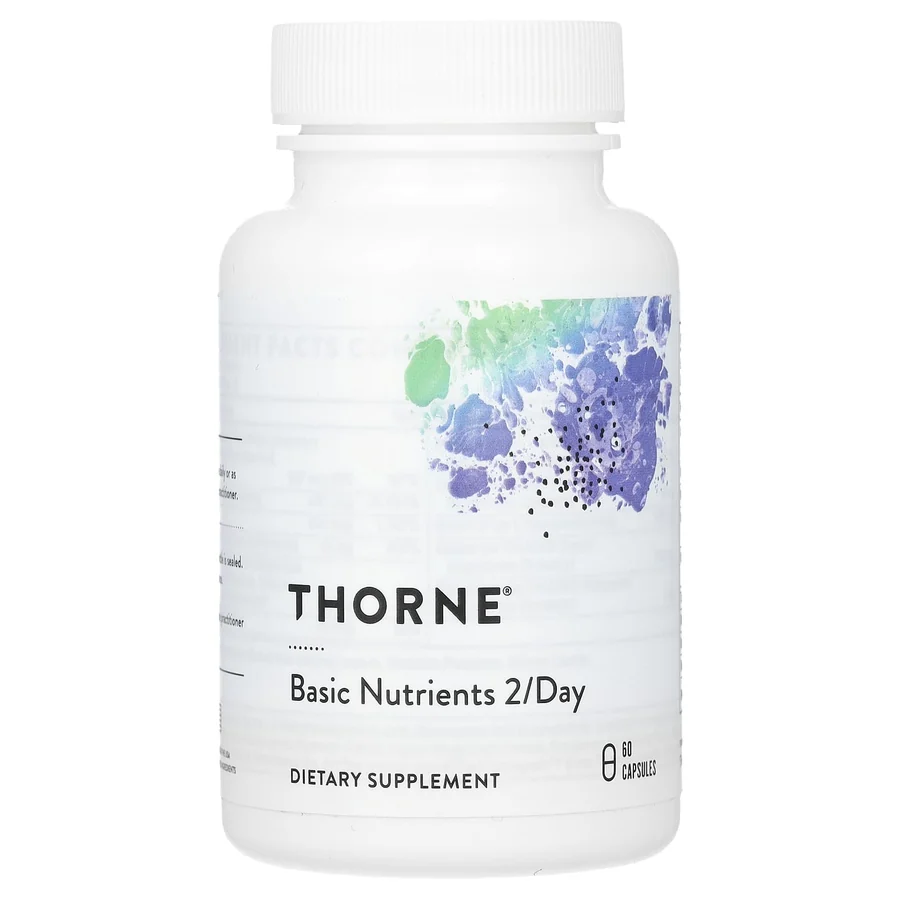
Fast verdict: This is a broad two-capsule multivitamin with clear forms and meaningful doses, but ‘basic’ does not mean low dose. Several nutrients sit well above 100% Daily Value, while calcium and magnesium remain small, so the right buyer is someone who has checked overlap rather than someone seeking automatic nutritional insurance.
Product labels and independent directory records identify a formula or testing scope. Clinical references concern ingredients or studied regimens unless the explanation explicitly matches the finished formula.
Who Thorne Basic Nutrients 2/Day 60 Capsules may fit
People who want a two-capsule multivitamin rather than a large packet.
Readers who have compared the formula with diet, fortified foods, and separate supplements.
People who specifically value methylated or active-form label choices.
Shoppers who understand that calcium and magnesium will not be meaningfully covered.
Run the label through the multivitamin overlap map before pairing it with a B-complex, vitamin D, K, selenium, zinc, or other broad formula.
Who should skip Thorne Basic Nutrients 2/Day 60 Capsules
People seeking nutrients close to 100% Daily Value across the board.
Anyone already stacking several high-dose single nutrients.
Warfarin users who have not discussed the product’s vitamin K content.
People expecting one multivitamin to provide substantial calcium or magnesium.
The label should be reviewed alongside medicines, pregnancy status, diet, fortified foods, and other supplements. Use the multivitamin selection guide before defaulting to the strongest-looking percentages.
How we reviewed this product
This is a label-based editorial review. We checked the public label, serving size, active amount, current retailer or brand information, named quality signals, ingredient evidence, and recurring public review themes. It is not a hands-on test, lab certificate, or medical recommendation.
No hands-on inspection or public batch COA was available to us. The review distinguishes a transparent label from independent proof of every finished-product claim.
What is in the formula?
The two-capsule serving includes vitamin D3 at 50 mcg, total vitamin K at 400 mcg, vitamin B6 at 20 mg, vitamin B12 at 600 mcg, selenium at 200 mcg, and chromium at 400 mcg, among other nutrients.
The label supplies only 52 mg calcium and 20 mg magnesium. That is common in multivitamins because these minerals are bulky, but it means the product cannot be evaluated as complete coverage simply because the ingredient list is long.
Other listed ingredients include a hypromellose capsule, dicalcium phosphate, and calcium laurate. The product is presented as gluten-free.
What should you count before adding another supplement?
Two capsules supply 20 mg B6, 2,000 IU D3, 400 mcg vitamin K and 200 mcg selenium. Compare those with any separate B-complex, D or selenium product. An active-form name does not cancel the amount or prove you need extra.
The same serving contains only 52 mg calcium and 20 mg magnesium; this is not a full replacement for calcium or magnesium needs. Vitamin K matters if you use warfarin. The 60-capsule bottle contains 30 two-capsule servings, not 60 daily servings.
What’s good, what’s not
What looks strong
Two-capsule convenience: broad coverage without a large packet.
Detailed label: nutrient forms and amounts are easy to inspect.
Useful for targeted gaps: the formula may fit diets missing multiple micronutrients.
Clear tradeoff visibility: low calcium and magnesium are obvious on the panel.
What may change the decision
High percentages: several nutrients exceed a basic nutritional top-up.
Overlap risk: separate D, K, B-complex, selenium, or chromium products can quickly duplicate the formula.
Premium daily cost: the product costs more than basic once-daily multis.
Red flags before you buy
Do not add a B-complex or separate high-dose nutrients without calculating totals.
Warfarin or another vitamin K antagonist requires professional guidance and consistency.
Do not assume high B-vitamin percentages create energy when no deficiency or intake gap exists.
Price and value analysis
At an observed price around $34 for 30 servings, the full two-capsule routine costs about $1.13 per day. The value case depends on replacing several separate products without creating overlap; it is weak if you need only one or two nutrients.
Use the price per effective dose calculator when package size, serving size, or active amount makes two products look more similar than they are.
Is there third-party testing or testing documentation?
The public label is detailed, and Thorne is an established supplement brand. This exact product’s reviewed source set did not show a named sport certification or a public batch COA.
For a multivitamin, formula appropriateness is part of quality. Transparent high doses are still a poor fit when they duplicate a person’s diet, fortified foods, or existing stack.
Use-case fit, evidence limits, and safety
NIH notes that multivitamins can improve nutrient intake when diet does not provide enough, but they can also push some nutrients too high. There is no standard multivitamin formula, so product-level label review matters.
Evidence about multivitamin use does not prove that this exact high-potency combination is better than a lower-dose alternative. The choice should reflect age, sex, diet, pregnancy, medicines, labs, and existing supplements.
Safety limits
Vitamin K can interfere with warfarin effectiveness.
High-dose overlap is especially relevant for vitamin A, D, B6, selenium, zinc, and other nutrients with upper-intake concerns.
Pregnancy requires a prenatal-specific assessment rather than a generic adult multi.
Persistent fatigue or cognitive symptoms should not be attributed to a missing multivitamin without appropriate evaluation.
If medicines, pregnancy, surgery, kidney or liver disease, abnormal labs, or multiple supplements are part of the picture, use the supplement interaction checklist and involve a qualified clinician or pharmacist.
Alternatives to compare
Compare this against a lower-dose multivitamin or a targeted nutrient plan rather than only against other premium multis.