
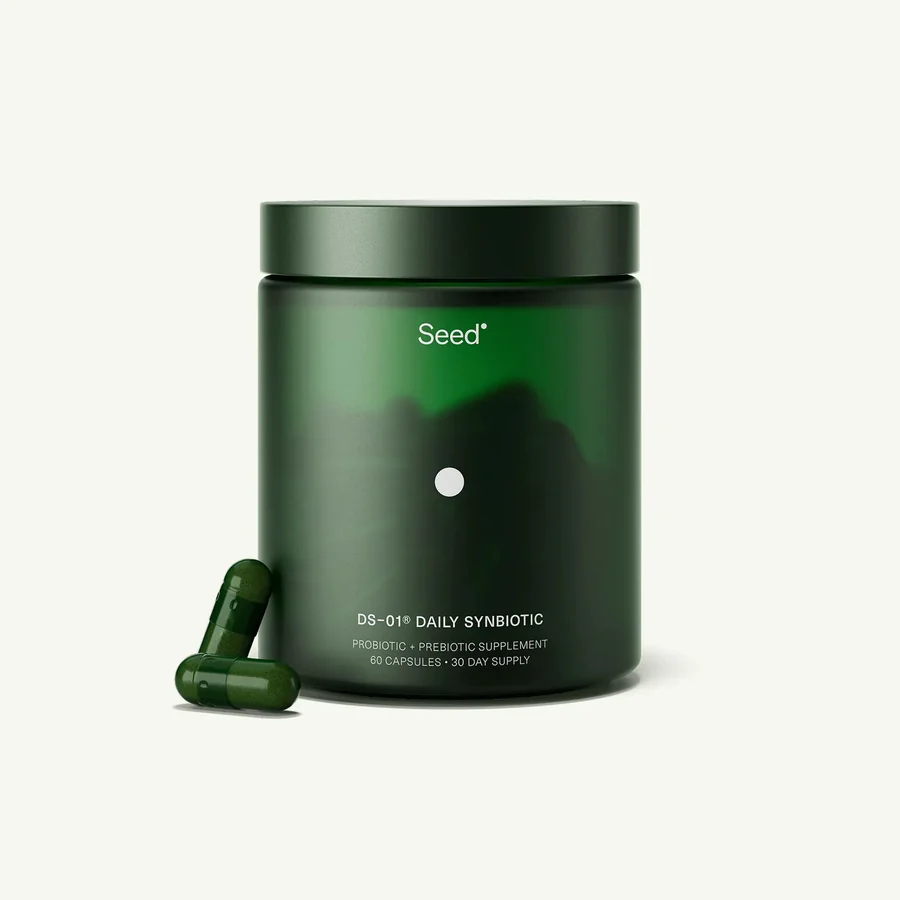
Seed DS-01 Daily Synbiotic
DS-01 Daily Synbiotic · 60 capsules
53.6 billion AFU; 24 probiotic strains; polyphenol prebiotic 400 mg per label serving.
- Amount
- 53.6 billion AFU; 24 probiotic strains; polyphenol prebiotic 400 mg
- Format
- Capsules
- Review basis
- Label-based analysis
No matched retailer offer is recorded. Use the review to check the exact label and availability.
Good fit
people who value strain-level disclosure and a premium synbiotic delivery system
Consider another option
you want a low-cost trial, one capsule, simple formulation, or affiliate retailer availability
The product, at a glance
Amounts for the reviewed label serving.
- Reviewed variant
- DS-01 Daily Synbiotic · 60 capsules
- Label serving
- 2 capsules
- Servings per reviewed pack
- 30
- Ingredients per label serving
- 53.6 billion AFU; 24 probiotic strains; polyphenol prebiotic 400 mg
- Ingredients & allergens
- Manufacturer: formulated without gluten, soy and dairy; no binders or preservatives
Label sources & rating context
Manufacturer ↗ · Label source ↗
~ means approximate; — means no published value in this record. Customer ratings are the named publisher’s snapshot and may include multiple sizes or earlier formulas. The Supplement Explained Score is our source-reviewed editorial assessment out of 25, separate from customer stars. Compare the five criteria and the same intended use; the total is not a clinical ranking. Prices are dated USD offer snapshots; cost uses the reviewed pack and label serving.
- Label clarity: 4/5
- Evidence transfer: 3/5
- Safety fit: 3/5
- Quality proof: 2/5
- Value fit: 3/5
On this pageTable of Contents
- 1Supplement Explained Score
- 2Who Seed DS-01 Daily Synbiotic may fit
- 3Who should skip Seed DS-01 Daily Synbiotic
- 4Seed DS-01 Daily Synbiotic label facts snapshot
- 5What is in the formula?
- 6Strengths, tradeoffs, and red flags
- 7Price and value analysis
- 8Is there third-party testing or quality proof?
- 9Use-case fit, evidence limits, and safety
- 10Alternatives to compare
- 11FAQ
- 12References and product sources
Our editorial assessment
Supplement Explained Score
15/25
Seed DS-01 Daily Synbiotic · DS-01 Daily Synbiotic · 60 capsules
Five equally weighted criteria, with a product-specific reason for every point. This is a buying-decision assessment, separate from customer stars and personal medical suitability.
- Label clarity 4/5
- Reviewed DS-01 Daily Synbiotic · 60 capsules: 2 capsules; 30 label servings. 53.6 billion AFU; 24 probiotic strains; polyphenol prebiotic 400 mg. The blend total does not disclose every strain contribution; version and storage remain part of identity.
- Evidence transfer 3/5
- Named strains improve traceability, but 53.6 billion AFU is not CFU and does not establish broad benefit across every marketed use.
- Safety fit 3/5
- GI tolerance and serious immune compromise need attention; a complex synbiotic is not a treatment for unexplained persistent symptoms.
- Quality proof 2/5
- Seed describes a quality-control program; an independently checked result for the purchased lot was not verified.
- Value fit 3/5
- Two capsules and a non-fiber prebiotic are clear, but neither the total AFU nor premium positioning establishes superior value.
Review basis: Published labels, manufacturer/retailer information, clinical sources and exact-product quality records where available. We did not buy, personally use or laboratory-test this product for this assessment.
Reviewed · Method v2.0 · How we assign points
Sources behind this score
Product labels and independent directory records identify a formula or testing scope. Clinical references concern ingredients or studied regimens unless the explanation explicitly matches the finished formula.
Who Seed DS-01 Daily Synbiotic may fit
- People who prioritize full strain identification over a generic CFU headline.
- Shoppers willing to use a premium direct-subscription product.
- People comfortable with a two-capsule daily routine and acclimation instructions.
- Readers who will judge success using a defined digestive outcome rather than general wellness language.
Compare strain identity using how to compare probiotic products before assuming a premium synbiotic is the right first trial.
Who should skip Seed DS-01 Daily Synbiotic
- Budget-first shoppers or people who want a one-bottle non-subscription trial.
- Anyone with a very sensitive gut who does not want a 24-strain, prebiotic-containing formula.
- Immunocompromised or seriously ill people without professional input.
- Buyers who receive visibly damaged, leaking, or compromised capsules.
Do not consume damaged capsules. Contact the company for replacement and document the lot when packaging integrity is questionable.
Proof status for this review
This is a label-based editorial review. We checked the public label, serving size, active amount, current retailer or brand information, named quality signals, ingredient evidence, and recurring public review themes. It is not a hands-on test, lab certificate, or medical recommendation.
The official practitioner guide supplies unusually detailed strain and formulation information. We did not personally inspect the product, and public damaged-capsule reports are treated as anecdotal signals rather than proof of a universal packaging defect.
What is in the formula?
DS-01 uses 24 identified probiotic strains and reports 53.6 billion AFU per daily serving. A polyphenol-based prebiotic is delivered through the ViaCap capsule-in-capsule design.
The strain detail is a real strength because probiotic evidence is strain-specific. It still does not mean all 24 strains are proven for every outcome promoted around the product.
The product is sold directly with subscription-oriented fulfillment. That model can improve continuity, but it also creates cancellation, delivery, and packaging expectations that belong in the value analysis.
Identity
Evidence-matching strength
Full strain listBetter than broad species-only labeling.
Dose language
Count method
AFUA viability estimate that should not be reduced to 'more is better.'
Prebiotic
Formula variable
PolyphenolsCan change tolerance and makes the product a synbiotic, not probiotic alone.
Operational risk
What to inspect
Capsule integrityRecent public reports make received-condition checks important.
Strengths, tradeoffs, and red flags
What looks strong
- Excellent organism identity: 24 strain IDs are disclosed.
- Specific delivery design: ViaCap has a clear formulation purpose.
- Detailed practitioner material: better evidence-mapping information than many retail blends.
- Defined routine: acclimation and two-capsule use are explicit.
What may change the decision
- Premium subscription: higher cost and more operational friction than a basic retail bottle.
- Complex formula: 24 strains plus prebiotic material creates many tolerance variables.
- Packaging reports: damaged or leaking capsules appear in recent community posts.
Red flags before you buy
- Do not consume capsules that arrive damaged, leaking, or visibly compromised.
- Do not infer that 24 strains are better for every digestive problem.
- Stop and reassess persistent nausea, gas, pain, or worsening bowel symptoms.
- Immunocompromised or seriously ill users require professional guidance.
Price and value analysis
Seed uses a premium direct-subscription model, and offer structures can change. The value case rests on strain-level disclosure, delivery design, support, and replacement handling – not simply on AFU per dollar. Check the current official price and cancellation terms before ordering.
Supply
Standard delivery
30 daysTwo capsules daily after acclimation.
Premium feature
What you pay for
Strain detail + deliveryA stronger information package than generic blends.
Value friction
Operational cost
Subscription + shippingService and packaging are part of the real product experience.
Use the price per effective dose calculator when package size, serving burden, or active amount makes two products look more similar than they are.
Is there third-party testing or quality proof?
Strain-level disclosure and a detailed practitioner guide are strong quality-of-information signals. The capsule-in-capsule design also has a clear formulation rationale.
Recent public packaging complaints do not prove a universal defect, but they make lot, seal, capsule condition, and replacement support decision-relevant. The correct response is inspection and documentation, not hiding the reports.
Use-case fit, evidence limits, and safety
NCCIH emphasizes that probiotic effects are specific to organism and condition. Seed’s strain disclosure improves evidence matching, but a large portfolio of strains does not establish broad clinical benefit for every user.
Product-sponsored research and mechanistic claims should be separated from independent evidence and from real-world outcomes in the exact person using the product.
Safety boundary
- Gas, bloating, nausea, or bowel changes can occur during use.
- Do not consume compromised capsules.
- Immunocompromised, seriously ill, pregnant, nursing, or pediatric users need individualized guidance.
- Alarm symptoms such as bleeding, severe pain, fever, weight loss, or persistent diarrhea require evaluation.
If medicines, pregnancy, surgery, kidney or liver disease, abnormal labs, or multiple supplements are part of the picture, use the supplement interaction checklist and involve a qualified clinician or pharmacist.
Alternatives to compare
Compare strain identity, formula complexity, fulfillment model, and tolerance rather than only microorganism count.
FAQ
How many strains are in Seed DS-01?
The current formula identifies 24 probiotic strains.
How many capsules are taken daily?
The standard daily serving is two capsules after the acclimation period described by the brand.
What does 53.6 billion AFU mean?
AFU is an estimated viable-cell count method. It does not establish that the product will work better for a specific outcome.
What should I do if capsules arrive damaged?
Do not consume them. Photograph the shipment and lot, contact Seed, and request replacement or resolution.
References and product sources
- Seed official DS-01 page – current formula, routine, and offer information
- Seed DS-01 practitioner guide – strain list, AFU, and formulation detail
- NCCIH Probiotics: Usefulness and Safety – strain-specific evidence and safety
- Public Reddit long-term user discussion – anecdotal benefit and tolerance themes
- Public Reddit packaging discussion – anecdotal damaged-capsule and support themes
Update note: Label, price, availability, and quality claims were checked on July 28, 2026. Retailer listings and formulas can change; use the live label before purchase.
Editorial information
Continue your decision
If this product is not an obvious fit, use one of these routes instead of leaving the decision unfinished.
- All product analyses Browse the full product analysis library for alternatives and category comparisons.
- Supplement Explained Score See how label clarity, evidence transfer, safety fit, quality proof, and value fit are scored.
- Interaction checklist Check common combination risks before stacking supplements or medications.
- How we review evidence Understand how editorial evidence claims, uncertainty, and safety language are handled.