
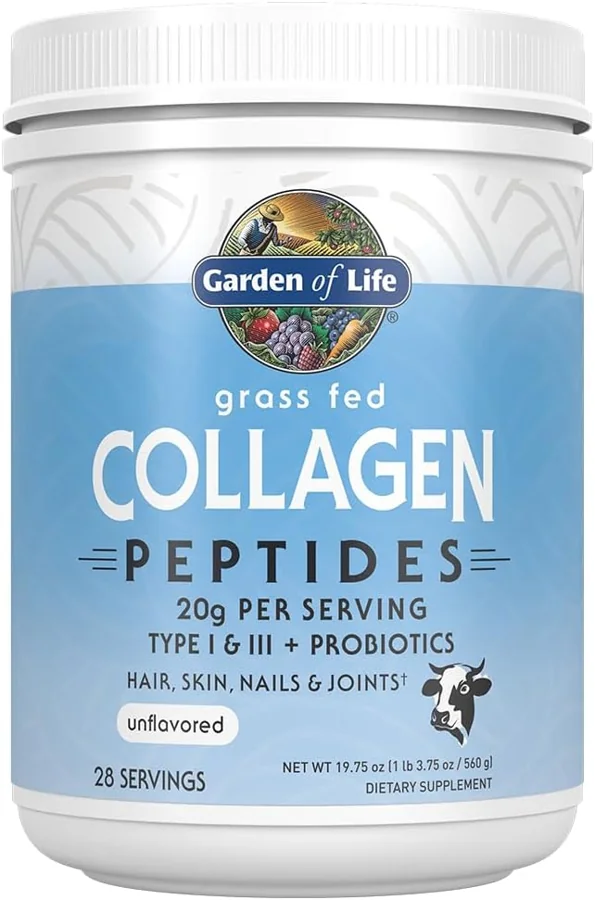
Garden of Life Grass Fed Collagen Peptides
Grass Fed Collagen Peptides · Unflavored · 560 g
Collagen 20 g; declared protein 18 g; B. coagulans SNZ 1969 250 million CFU per label serving.
- Amount
- Collagen 20 g; declared protein 18 g; B. coagulans SNZ 1969 250 million CFU
- Format
- Powder
- Review basis
- Label-based analysis
Good fit
People who want bovine collagen with an explicitly identified probiotic.
Consider another option
You need a vegan powder, complete protein, or established anti-aging benefits.
The product, at a glance
Amounts for the reviewed label serving.
- Reviewed variant
- Grass Fed Collagen Peptides · Unflavored · 560 g
- Label serving
- 1 scoop (~20 g)
- Servings per reviewed pack
- ~28
- Ingredients per label serving
- Collagen 20 g; declared protein 18 g; B. coagulans SNZ 1969 250 million CFU
- Ingredients & allergens
- Bovine hide; not vegan
- Nutrition per label serving
- 70 calories; 100 mg sodium
- Quality & testing
- Label: NSF Certified Gluten-Free; iGEN non-GMO tested Source ↗
Label sources & rating context
~ means approximate; — means no published value in this record. Customer ratings are the named publisher’s snapshot and may include multiple sizes or earlier formulas. The Supplement Explained Score is our source-reviewed editorial assessment out of 25, separate from customer stars. Compare the five criteria and the same intended use; the total is not a clinical ranking. Prices are dated USD offer snapshots; cost uses the reviewed pack and label serving.
- Label clarity: 5/5
- Evidence transfer: 3/5
- Safety fit: 3/5
- Quality proof: 3/5
- Value fit: 3/5
On this pageTable of Contents
- 1Supplement Explained Score
- 2Label facts at a glance
- 3What does Garden of Life add beyond collagen?
- 4Is there convincing evidence for skin or digestive benefits?
- 5How does a scoop fit into an ordinary routine?
- 6Who should be cautious with this collagen-probiotic formula?
- 7What do its certification labels actually establish?
- 8What does a tub cost per actual day of use?
- 9Would plain collagen or another formula fit better?
- 10FAQ
Our editorial assessment
Supplement Explained Score
17/25
Garden of Life Grass Fed Collagen Peptides · Grass Fed Collagen Peptides · Unflavored · 560 g
Five equally weighted criteria, with a product-specific reason for every point. This is a buying-decision assessment, separate from customer stars and personal medical suitability.
- Label clarity 5/5
- Reviewed Grass Fed Collagen Peptides · Unflavored · 560 g: 1 scoop (~20 g); ~28 label servings. Collagen 20 g; declared protein 18 g; B. coagulans SNZ 1969 250 million CFU.
- Evidence transfer 3/5
- Skin collagen results remain mixed; 20 g collagen is not complete protein, and 250 million SNZ 1969 does not establish digestive benefit.
- Safety fit 3/5
- Bovine source restrictions and GI tolerance matter; serious immune compromise needs review of the added live organism.
- Quality proof 3/5
- NSF Gluten-Free and iGEN claims have narrow dietary scope; no exact-pack sport or comprehensive purity record was verified.
- Value fit 3/5
- A 28-serving tub is clear, but the probiotic addition is not an established reason to pay more than plain collagen.
Review basis: Published labels, manufacturer/retailer information, clinical sources and exact-product quality records where available. We did not buy, personally use or laboratory-test this product for this assessment.
Reviewed · Method v2.0 · How we assign points
Sources behind this score
- Manufacturer
- Label source
- 2025 collagen skin-aging review: study quality and funding
- 2025 collagen hydration/elasticity meta-analysis
- NIH ODS: probiotics
Product labels and independent directory records identify a formula or testing scope. Clinical references concern ingredients or studied regimens unless the explanation explicitly matches the finished formula.
What does Garden of Life add beyond collagen?
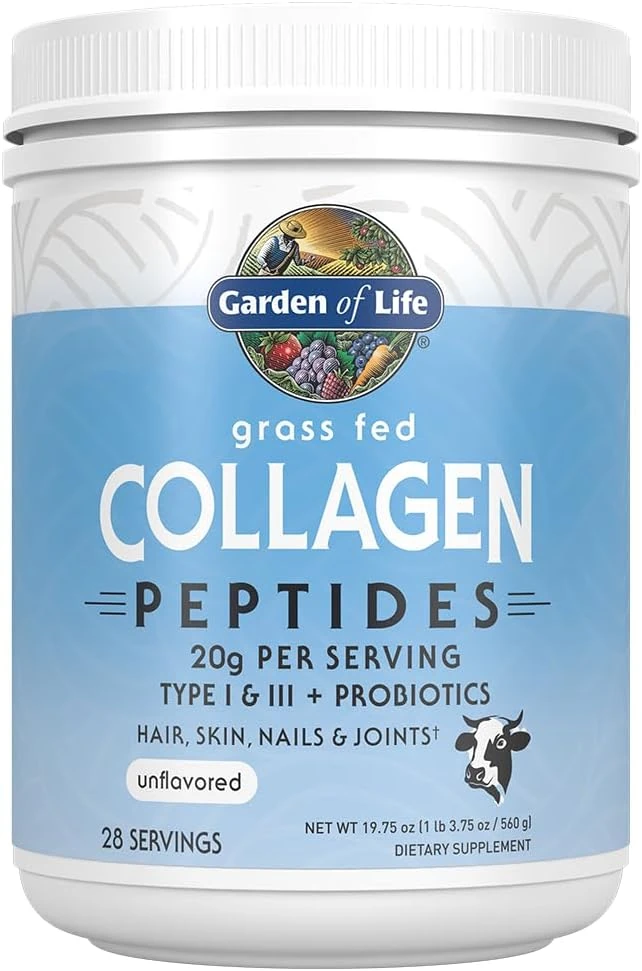
This review covers the unflavored 19.75 oz (560 g) tub. Its meaningful difference from a plain collagen powder is Bacillus coagulans SNZ 1969, labeled at 250 million CFU at expiration. Identifying the strain and stating an expiration-based count makes the probiotic easier to assess than an unnamed blend. The collagen comes from bovine hide, so the powder is not vegan. See the matched package and label.
A full scoop supplies 20 g collagen and declares 18 g protein. These describe the same material from different labeling perspectives; they are not separate ingredients to add together. You are not getting 38 g of protein.
Is there convincing evidence for skin or digestive benefits?
The strongest reason to temper skin expectations is a 2025 meta-analysis of randomized collagen trials: higher-quality studies did not show significant skin-aging benefits. This does not establish that every collagen supplement is ineffective, but it weakens confident promises about younger-looking skin. The analysis did not test this exact Garden of Life product.
The probiotic needs a separate assessment. As the NIH probiotic overview explains, effects depend on the organism, dose, and outcome studied. Evidence for another strain cannot establish what SNZ 1969 will do at this dose. An identified strain and CFU count are useful information, not proof that this powder improves digestion. The collagen analysis also cannot establish benefits from the finished collagen-plus-probiotic combination.
How does a scoop fit into an ordinary routine?
You can incorporate the powder into food or a drink you already use, following the package directions. Unflavored does not necessarily mean tasteless or texture-free. If portion consistency matters, the matched serving is about 20 g powder; weighing it avoids assuming every scoopful is identical.
The declared protein can contribute to your intake, but collagen is not a complete protein. Keep complete protein foods or an appropriate alternative in your diet rather than treating collagen as interchangeable with whey or soy. The NIH protein and exercise overview provides context on protein quality and essential amino acids.
Who should be cautious with this collagen-probiotic formula?
Avoid this bovine-derived powder if you have a relevant beef or bovine-product allergy. The added probiotic creates a separate consideration: people who are seriously ill or immunocompromised should discuss probiotic use with their clinician first. The NIH safety discussion notes that risks vary with health status and the organism used.
Probiotics can cause gas or other digestive discomfort; their inclusion does not mean the powder will prevent bloating. If new symptoms appear, pause use rather than increasing the serving or pushing through discomfort. Persistent or significant symptoms deserve medical advice. For related context, see can collagen cause bloating?
What do its certification labels actually establish?
The matched label lists NSF Certified Gluten-Free and iGEN non-GMO tested. Those address specific purchasing priorities, not whether the powder improves skin or digestion. They also are not a substitute for a public, lot-specific contaminant report. The manufacturer product information is a starting point for checking the formula and label claims.
For contaminant transparency, look for a report matching the batch that identifies the substances measured, results, and testing laboratory. A general testing assurance is less informative than those details. Our collagen and heavy metals guide explains what to check.
What does a tub cost per actual day of use?
Use the delivered price, including shipping and applicable tax, rather than an older catalog price. For this tub, cost per full serving = delivered price ÷ 28. At one full serving daily, that means about 28 days—not a 30-day month. Less frequent use extends the calendar duration without changing the cost per full scoop.
Hypothetical example: a $42 delivered price would equal $1.50 per full serving, or $0.075 per gram of collagen using approximately 560 g per tub. That is an illustration, not a current price. Compare plain powders using delivered cost per gram of collagen, then decide whether the probiotic is worth any price difference to you. Do not count the 18 g protein as an additional quantity.
Affiliate link: we may earn a commission if you buy. Confirm the selected size, label and seller.
Would plain collagen or another formula fit better?
Vital Proteins Collagen Peptides Unflavored is a relevant plain-powder comparison if the probiotic is not a priority. Compare matched labels, collagen quantities, tub sizes, and delivered prices rather than assuming equal scoop sizes.
For an added-ingredient comparison, consider Vital Proteins Collagen Peptides Advanced. Extra ingredients should serve a purpose you actually want; their presence alone does not establish better results. If your main goal is complete protein, whey, soy, or protein-rich foods address a different nutritional need than either collagen formula.
FAQ
Would half a scoop make the tub last longer?
By simple serving math, half scoops would provide about 10 g collagen and 9 g declared protein, making roughly 56 portions. That calculation does not establish half a serving as an effective skin or digestive dose.
Can hot coffee affect the probiotic?
The expiration-based CFU statement does not establish how many organisms survive hot preparation. The reviewed information does not verify survival in hot coffee. If preserving the probiotic matters to you, check the manufacturer's preparation guidance.
Does grass-fed collagen have better skin evidence?
Grass-fed describes sourcing, not a demonstrated clinical advantage. The skin-aging evidence reviewed here does not establish better results for grass-fed collagen than for other bovine collagen.
Is 250 million CFU enough?
The number alone cannot answer that. A useful probiotic dose depends on the specific strain and outcome studied. This count neither proves a digestive benefit nor establishes that the dose is inadequate.
How can I check whether a listing matches this review?
Look for the unflavored 19.75 oz (560 g) tub and Bacillus coagulans SNZ 1969 on the current package. Other sizes or formulas should not be assumed identical, even when the product names look similar.
References
- Garden of Life Grass Fed Collagen Peptides product information
- Reviewed package and label: B07K4SK9SY
- 2025 meta-analysis of collagen supplementation and skin aging
- NIH Office of Dietary Supplements: Probiotics—Health Professional Fact Sheet
- NIH Office of Dietary Supplements: Exercise and Athletic Performance—Health Professional Fact Sheet
Label details checked October 2, 2026. This is a document-based review, not a hands-on product test. Retailer prices and product versions can change.