
Berberine Phytosome vs HCl: Compare the Active Amount, Not Just the Capsule
Berberine phytosome and berberine HCl are not fairly compared by the largest milligram number on the front label. A phytosome amount can describe the entire delivery complex, while an HCl amount can describe the berberine salt. The amount of complex, amount of berberine HCl, amount of berberine free base, and amount reaching the bloodstream are different quantities. [1] [2]
On this pageTable of Contents
- 1Decode the quantities first
- 2A real label example: Solaray’s 550 mg complex
- 3What the pharmacokinetic research adds
- 4Why there is no responsible conversion table here
- 5Does better absorption mean fewer side effects?
- 6Compare the full ingredient list
- 7How to compare cost without inventing equivalent doses
- 8Questions to bring to a clinician or pharmacist
- 9The practical conclusion
A better-absorbed formulation does not automatically prove better glucose control, weight loss, or a safe dose-conversion rule. Those conclusions require evidence matching the actual formulation, population, amount, and outcome.
Decode the quantities first
| Label or research term | What the number describes | Mistake to avoid |
|---|---|---|
| Berberine phytosome / delivery complex | A formulated mixture including berberine and carrier components | Treating all of its mass as berberine |
| Berberine HCl | The hydrochloride salt amount, when specified that way | Calling it the same mass of free-base berberine |
| Standardization percentage | The stated fraction measured or specified in the complex | Ignoring what the percentage is standardized to |
| Blood concentration or exposure | A pharmacokinetic measurement after administration | Calling it the swallowed amount or clinical success |
This distinction is central to interpreting both product labels and the available formulation study. [1] [2]
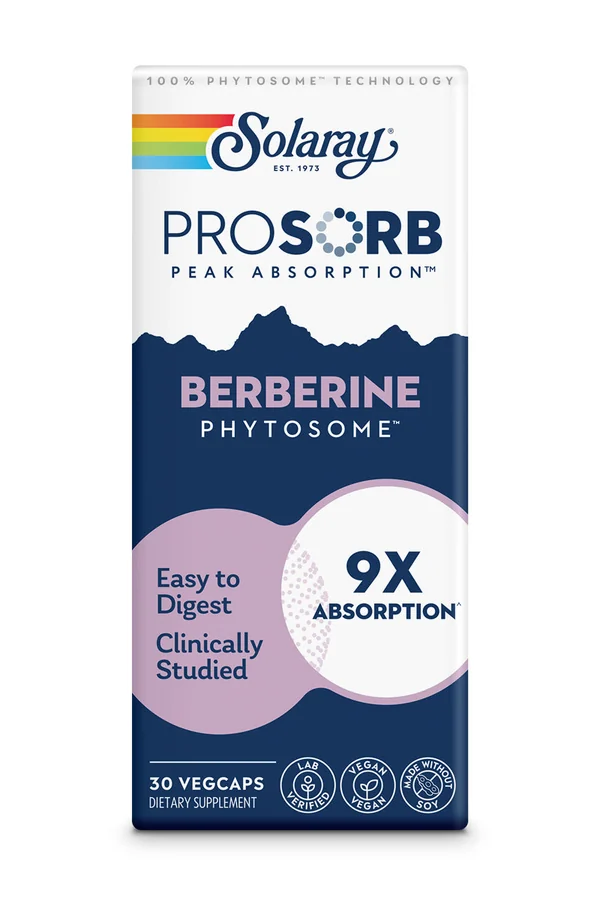
Solaray Berberine Phytosome 550 mg
550 mg complex, 30% berberine HCl. 30 capsules. Not a replacement for prescribed treatment.
Check price at HerbsProWe may earn a commission from this link.A real label example: Solaray’s 550 mg complex
The reviewed Solaray Berberine Phytosome label states a 550 mg complex standardized to 30% berberine HCl. The arithmetic is 550 × 0.30 = 165 mg of the component labeled berberine HCl. That should not be silently renamed 165 mg free-base berberine or 165 mg absorbed berberine. [1]
It is also not 550 mg berberine HCl. The complex includes formulation components, and the full mass is not a direct like-for-like comparator to a plain HCl amount.
This calculation helps prevent a label-reading error. It does not establish what amount should replace a different supplement or a prescribed medicine.
What the pharmacokinetic research adds
A 2021 formulation study involved 12 healthy volunteers and short-term measurements after administration. It compared a berberine delivery formulation with conventional berberine HCl and reported higher exposure for the formulated product; the magnitude depended on the exposure measure and normalization for berberine content. The researchers included Indena-affiliated authors. [2]
The work did not establish that the retail Solaray capsule improves patient outcomes more than a particular HCl supplement. “9x” messaging should not be read as nine times the glucose reduction, nine times the weight loss, or permission to take an arbitrary fraction of another dose.
Why there is no responsible conversion table here
A conversion such as “one phytosome capsule equals three HCl capsules” would need more than an absorption result. It would require sufficiently matched products and relevant clinical evidence showing comparable benefits and risks at the proposed amounts.
Even the chemical basis needs to match: comparing a percentage of HCl with a free-base amount can change the denominator. So can comparing total exposure with free-compound exposure. A simplistic multiplier hides these distinctions rather than solving them.
For someone already using berberine within a medically supervised plan, changing formulation is a reason to discuss the actual products and amounts, not an invitation to improvise a conversion from marketing copy.
Does better absorption mean fewer side effects?
Not necessarily. A higher exposure measurement does not establish a better overall safety profile. A formulation might differ in its ingredients and in how it behaves, but that needs appropriate evidence; it cannot be assumed from the word phytosome.
Berberine can cause gastrointestinal adverse effects and can interact with medicines. NCCIH also cautions that the evidence for weight-loss claims remains limited. A delivery technology does not make those questions disappear. [3]
Compare the full ingredient list
Solaray’s reviewed formula includes sunflower lecithin, pea protein isolate, grape-seed extract, cellulose and capsule-related ingredients, stearic acid, and silica. These are part of the formulation to assess, not additional proof of clinical benefit. [1]
A plain HCl product can have its own capsule ingredients and added components. “HCl” and “phytosome” therefore are not enough to describe every bottle in either category. Anyone with a specific restriction should check the exact current panel rather than the category name.
How to compare cost without inventing equivalent doses
You can compare confirmed bottle price, capsules per bottle, labeled complex amount, and the stated standardized fraction. You cannot responsibly label the result “cost per effective dose” when clinical dose equivalence has not been established.
Solaray’s 30-capsule product displayed a promotional one-time price of $22.99 during the September 27, 2026 check, with a crossed reference price of $24.99. The promotional figure should not be mixed with another product’s ordinary price as though the conditions were identical. [4]
No current, fully matched HCl retail comparator was established for a price-equivalence table in this review. That comparison is deliberately left unranked rather than filled with an old or mismatched SKU price.
Questions to bring to a clinician or pharmacist
Bring photographs of the complete labels and the reason you are considering the change. Ask whether there is evidence for the intended outcome at the actual amount, whether the formulation affects interactions with your medicines, and whether the proposed use needs monitoring.
That is especially important when a person is using medicines for blood sugar or has a treatment plan that should not be displaced by a supplement. A supplement review cannot determine from a product name that it can replace prescribed care. [3]
The practical conclusion
Choose neither category solely from a front-label milligram contest. First identify whether the amount refers to a complex, HCl salt, or another basis. Then examine formulation-matched evidence and the actual clinical purpose.
The defensible difference is that some delivery formulations can change pharmacokinetic exposure. The unsupported leap is turning that difference into universal superiority, fewer risks, or a simple capsule-for-capsule conversion. The Solaray product review applies this distinction to one specific label without treating it as a medication substitute.
Related reading
For the arithmetic behind capsules, servings, and nutrient quantities, see our serving-size and dose guide.