
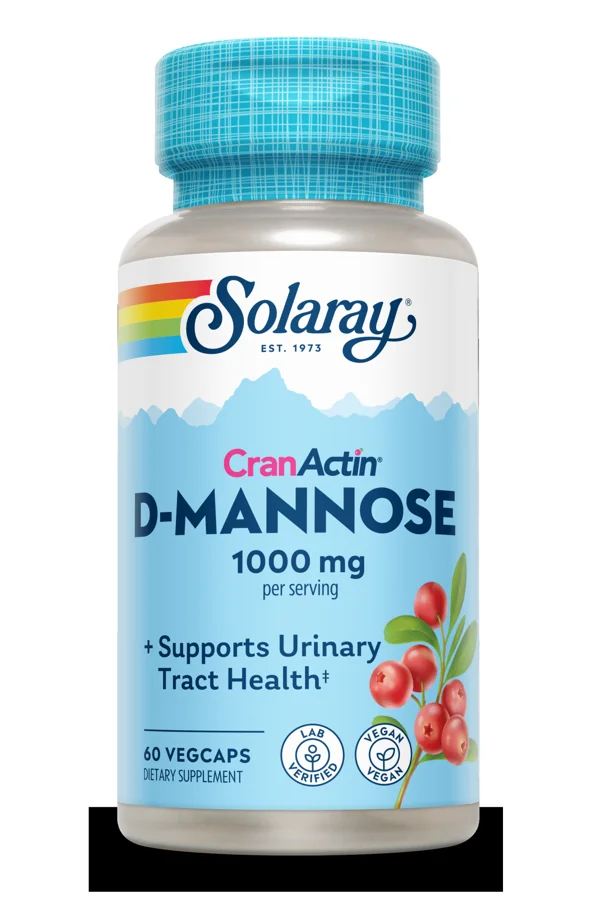
Solaray D-Mannose with CranActin 1000 mg
D-Mannose with CranActin · 60 VegCaps
D-mannose 1,000 mg; cranberry extract 400 mg; C 30 mg per label serving.
- Amount
- D-mannose 1,000 mg; cranberry extract 400 mg; C 30 mg
- Format
- Capsules
- Review basis
- Label-based analysis
Good fit
Adults seeking both ingredients in capsules who understand that prevention benefit is unproven
Consider another option
You want dependable UTI prevention or are trying to manage current urinary symptoms
The product, at a glance
Amounts for the reviewed label serving.
- Reviewed variant
- D-Mannose with CranActin · 60 VegCaps
- Label serving
- 2 capsules
- Servings per reviewed pack
- 30
- Ingredients per label serving
- D-mannose 1,000 mg; cranberry extract 400 mg; C 30 mg
- Ingredient list
- Vitamin C (as Ascorbic Acid), D-Mannose Cranberry (Vaccinium macrocarpon) (berry extract) (as CranActin® Cranberry AF™M Extract), Vegetable Cellulose Capsule, Maltodextrin (from Non-GMO Corn), Organic Rice Bran Extract, Tricalcium Phosphate, Magnesium Hydroxide, Silica and Cellulose.
- Nutrition per label serving
- 5 calories; 1 g sugar per two capsules
- Storage
- Store in a cool, dry place
Label sources & rating context
~ means approximate; — means no published value in this record. Customer ratings are the named publisher’s snapshot and may include multiple sizes or earlier formulas. The Supplement Explained Score is our source-reviewed editorial assessment out of 100, separate from customer stars. Five criteria are scored 1–5; their sum is multiplied by four. The total is not a clinical ranking or an effectiveness percentage. Prices are dated USD offer snapshots; cost uses the reviewed pack and label serving.
- Label clarity: 5/5
- Evidence transfer: 1/5
- Safety fit: 3/5
- Quality proof: 2/5
- Value fit: 2/5
On this pageTable of Contents
- 1Supplement Explained Score
- 2Label facts at a glance
- 3What does a two-capsule serving of Solaray actually supply?
- 4Does the research support this D-mannose blend?
- 5What do Solaray's directions mean for daily use?
- 6When should urinary symptoms take priority over this supplement?
- 7How transparent is the CranActin formula?
- 8How should you calculate the real cost of this bottle?
- 9Would separate ingredients—or no supplement—make more sense?
- 10FAQ
Check price at HerbsProHerbsPro: $28.79 for Cranactin D-Mannose, 1000 mg, 60 Veg Caps, checked October 5, 2026. Price and stock can change; confirm the current bottle label.We may earn a commission from this link.
Our editorial assessment
Supplement Explained Score
52/100
Solaray D-Mannose with CranActin 1000 mg · D-Mannose with CranActin · 60 VegCaps
Five equally weighted criteria, with a product-specific reason for every point. This is a buying-decision assessment, separate from customer stars and personal medical suitability.
- Label clarity 5/5
- Reviewed D-Mannose with CranActin · 60 VegCaps: 2 capsules; 30 label servings. D-mannose 1,000 mg; cranberry extract 400 mg; C 30 mg.
- Evidence transfer 1/5
- A large 2024 trial found no recurrent-UTI prevention benefit for 2 g/day D-mannose; this 1 g blend has no verified contrary outcome evidence.
- Safety fit 3/5
- Urinary symptoms, fever or flank pain require care; a supplement must not delay UTI diagnosis or treatment.
- Quality proof 2/5
- CranActin branding identifies an extract, but this label lacks a verified PAC amount and independent finished-capsule result.
- Value fit 2/5
- One gram requires two capsules; unquantified cranberry PACs and weak prevention evidence make comparison less useful.
Review basis: Published labels, manufacturer/retailer information, clinical sources and exact-product quality records where available. We did not buy, personally use or laboratory-test this product for this assessment.
Reviewed · Method v2.0 · How we assign points
Sources behind this score
Product labels and independent directory records identify a formula or testing scope. Clinical references concern ingredients or studied regimens unless the explanation explicitly matches the finished formula.
What does a two-capsule serving of Solaray actually supply?
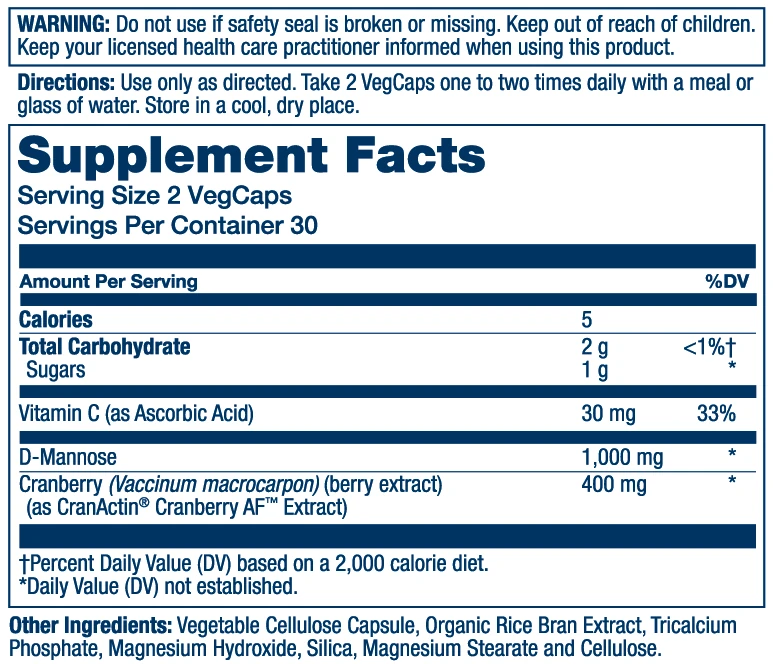
The central label detail is easy to miss: 1,000 mg of D-mannose is the amount in two capsules, not one. That serving also contains 400 mg of CranActin cranberry extract and 30 mg of vitamin C, according to the manufacturer’s product information. This is a combination formula, so compare it with other products ingredient by ingredient rather than by the largest number on the front label.
The pictured panel does not state a standardized proanthocyanidin, or PAC, amount. You cannot equate 400 mg of cranberry extract with 36 mg of PACs: total extract weight and measured PAC content are different quantities. That missing detail limits comparisons with cranberry products that disclose their PAC content.
Does the research support this D-mannose blend?
In a 2024 randomized trial published in JAMA Internal Medicine, 598 women with recurrent UTIs in primary care received 2 g of D-mannose daily or placebo for six months. The study found no significant prevention benefit on its primary outcome. This was not a trial of Solaray or its cranberry combination, but it directly challenges the main reason many people buy D-mannose.
Cranberry has a different evidence picture. NCCIH describes possible prevention benefit in some groups, not treatment for an existing UTI. That does not establish that this particular 400 mg extract works, especially without a stated PAC amount. Cranberry deserves assessment on its own evidence; its presence should not be assumed to rescue an otherwise unconvincing D-mannose formula.
What do Solaray's directions mean for daily use?
Solaray’s directions are two VegCaps once or twice daily with a meal or water. For the reviewed 60-capsule bottle, that means 30 days at once daily or 15 days at twice daily. These are manufacturer directions, not a recommendation to increase intake.
The twice-daily schedule supplies 2 g of D-mannose—the amount studied in the negative trial—but matching an ingredient dose does not validate the combination. There is no established reason here to expect better prevention from the higher schedule.
The capsule format means swallowing two capsules per dose, or four per day on the twice-daily schedule. Consider that practical burden before committing to a larger bottle.
When should urinary symptoms take priority over this supplement?
- Current symptoms: Burning with urination, urgency, or worsening urinary symptoms call for clinical assessment. Do not wait for a supplement to help.
- Fever or flank pain: Seek prompt medical care.
- Pregnancy or recurrent problems: Get individualized guidance rather than relying on a supplement-only plan.
If you take warfarin, ask the prescribing clinician before adding this cranberry-containing product. NCCIH notes conflicting findings on the interaction; that makes it a question to review, not proof that every cranberry product will cause a problem. Bring the label to that discussion.
How transparent is the CranActin formula?
The key transparency gap is cranberry standardization. A branded name identifies the extract, but it does not tell you its PAC content or make it interchangeable with another cranberry ingredient. The serving amounts are useful; the name alone cannot fill in the missing measurement.
This review does not verify independent batch testing. If that matters to your purchase, ask Solaray for documentation tied to the current lot and check what was measured. Testing for ingredient identity, content, or contaminants addresses product quality. It is separate from demonstrating that the finished blend prevents UTIs.
How should you calculate the real cost of this bottle?
Use the delivered checkout total divided by actual days of use, including shipping and any applicable tax. For 60 capsules, divide by 30 for the once-daily label schedule or 15 for the twice-daily schedule. A bottle that appears inexpensive may look less attractive when its shorter supply is accounted for.
A hypothetical delivered-cost calculation
For illustration only, a hypothetical $30 delivered price would mean $1 per day at once daily or $2 per day at twice daily. This is not a current price quote or a reason to use more.
The 60-count bottle provides 30 g of D-mannose in total, calculated from its labeled servings. Compare that quantity as well as daily cost. Paying for more grams is not the same as buying demonstrated prevention.
Confirm the selected size, label and seller.
Would separate ingredients—or no supplement—make more sense?
If you are choosing between ingredients, start with the D-mannose vs. cranberry comparison rather than assuming a combination is better. A cranberry-only product with a stated PAC amount is easier to compare with other cranberry products, though clearer labeling does not guarantee benefit. A D-mannose-only product simplifies the formula without solving the negative prevention findings.
For broader brand context, see the Solaray brand page. Evaluate each bottle separately rather than treating brand familiarity as proof. Choosing no supplement is also reasonable if your purchase depends on reliable prevention from this blend.
FAQ
Is the 120-count option equivalent to the reviewed bottle?
A 120-count option exists; this review matches the 60-count bottle. Check the larger bottle's current formula and directions before assuming it is identical. More capsules change supply, not the strength of the prevention evidence.
Is vitamin C a reason to choose this formula?
The serving includes 30 mg, but the research discussed here does not establish an added UTI prevention benefit from that addition. Treat it as a labeled ingredient, not proof that the blend works better.
Can I combine it with separate cranberry or D-mannose products?
That would overlap ingredients already present. Add up the amounts across labels and discuss the complete list with a clinician or pharmacist. Combining products does not establish better prevention and can make intake harder to track.
Does the VegCap description confirm vegan certification?
VegCaps describes the capsule format; it does not by itself verify independent vegan certification or the sourcing of every ingredient. Ask the manufacturer if strict dietary requirements are central to your purchase.
What should I bring to a visit about recurrent urinary problems?
Bring the supplement label, your medication and supplement list, and a record of symptom dates and previous treatments. Those details help put the recurring problem in context without treating this bottle as a substitute for evaluation.
References
- Solaray D-Mannose with CranActin 1000 mg product information
- D-mannose for recurrent UTI prevention: 2024 randomized clinical trial
- Cranberry — National Center for Complementary and Integrative Health
Label details checked October 2, 2026. This is a document-based review, not a hands-on product test. Retailer prices and product versions can change.