
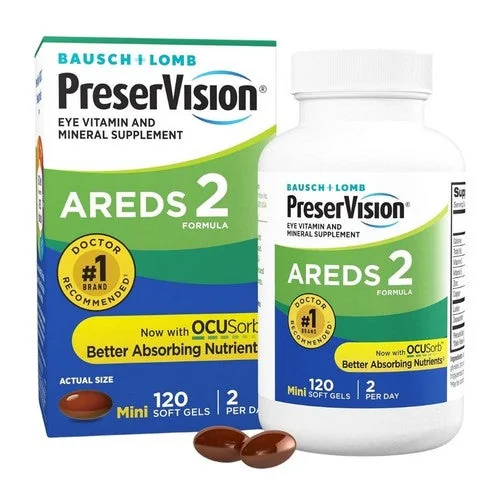
PreserVision AREDS 2 Mini Soft Gels
AREDS 2 MiniGels · 120 soft gels
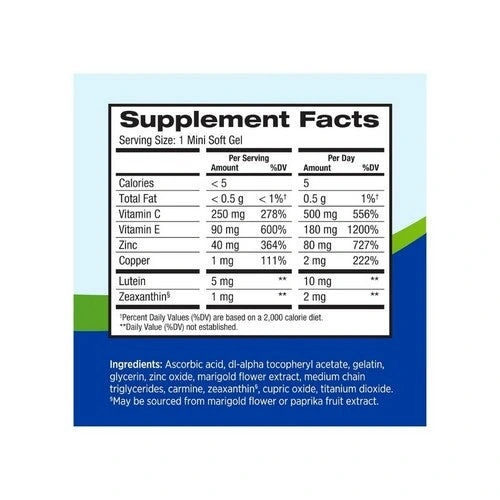
C 500 mg; E 180 mg; zinc 80 mg; copper 2 mg; lutein 10 mg; zeaxanthin 2 mg per label serving.
- Amount
- C 500 mg; E 180 mg; zinc 80 mg; copper 2 mg; lutein 10 mg; zeaxanthin 2 mg
- Format
- Softgels
- Review basis
- Label-based analysis
Good fit
Adults with intermediate AMD or advanced AMD in one eye, following eye-care guidance.
Consider another option
Healthy-eye or cataract-prevention use, a vegan requirement, or unresolved medication or supplement overlap.
The product, at a glance
Amounts for the reviewed label serving.
- Reviewed variant
- AREDS 2 MiniGels · 120 soft gels
- Label serving
- 2 mini soft gels (daily total)
- Servings per reviewed pack
- 60
- Ingredients per label serving
- C 500 mg; E 180 mg; zinc 80 mg; copper 2 mg; lutein 10 mg; zeaxanthin 2 mg
- Ingredient list
- Ascorbic acid; dl-alpha tocopheryl acetate; gelatin; glycerin; zinc oxide; marigold flower extract; MCTs; carmine; zeaxanthin; cupric oxide; titanium dioxide
- Storage
- Room temperature
- Formula / pack difference
- Current MiniGels manufacturer directions: 2 daily. Linked retailer text says 4 daily; cost per serving is withheld for this conflicting listing.
Label sources & rating context
~ means approximate; — means no published value in this record. Customer ratings are the named publisher’s snapshot and may include multiple sizes or earlier formulas. The Supplement Explained Score is our source-reviewed editorial assessment out of 25, separate from customer stars. Compare the five criteria and the same intended use; the total is not a clinical ranking. Prices are dated USD offer snapshots; cost uses the reviewed pack and label serving.
- Label clarity: 4/5
- Evidence transfer: 5/5
- Safety fit: 3/5
- Quality proof: 2/5
- Value fit: 3/5
On this pageTable of Contents
- 1Supplement Explained Score
- 2Label facts at a glance
- 3What makes this different from a regular eye vitamin?
- 4Is your AMD stage the reason to choose it?
- 5Which directions apply to the reviewed MiniGels?
- 6Who should pause before buying?
- 7What should match an AREDS2 label?
- 8How should you compare the cost of this bottle?
- 9What else is worth comparing before you buy?
- 10FAQ
Our editorial assessment
Supplement Explained Score
17/25
PreserVision AREDS 2 Mini Soft Gels · AREDS 2 MiniGels · 120 soft gels
Five equally weighted criteria, with a product-specific reason for every point. This is a buying-decision assessment, separate from customer stars and personal medical suitability.
- Label clarity 4/5
- Reviewed AREDS 2 MiniGels · 120 soft gels: 2 mini soft gels (daily total); 60 label servings. C 500 mg; E 180 mg; zinc 80 mg; copper 2 mg; lutein 10 mg; zeaxanthin 2 mg. Current MiniGels manufacturer directions: 2 daily. Linked retailer text says 4 daily; cost per serving is withheld for this conflicting listing.
- Evidence transfer 5/5
- The AREDS2 nutrient pattern closely matches evidence for eligible AMD patients; it is not prevention for otherwise healthy eyes.
- Safety fit 3/5
- The 80 mg zinc regimen and high-dose vitamins belong in ophthalmology care; avoid overlapping supplements.
- Quality proof 2/5
- The named AREDS2 formula supports evidence matching, but does not itself verify an independent purity result for this lot.
- Value fit 3/5
- Manufacturer two-per-day and retailer four-per-day directions conflict; cost per clinical regimen is not inferred.
Review basis: Published labels, manufacturer/retailer information, clinical sources and exact-product quality records where available. We did not buy, personally use or laboratory-test this product for this assessment.
Reviewed · Method v2.0 · How we assign points
Sources behind this score
Product labels and independent directory records identify a formula or testing scope. Clinical references concern ingredients or studied regimens unless the explanation explicitly matches the finished formula.
What makes this different from a regular eye vitamin?
This is a targeted AREDS2 nutrient combination, not an ordinary multivitamin or a stand-alone lutein pill. Its antioxidant vitamins, minerals, and carotenoids should be assessed as a combination rather than as interchangeable ingredients carrying an eye-health claim.
Original AREDS and AREDS2 are not identical. Original AREDS used beta-carotene; this AREDS2 version uses lutein and zeaxanthin without it. The beta-carotene lung-cancer concern for current and former smokers makes that distinction important when comparing packages.
Vitamin E units can also create an apparent formula difference where there is none. The 180 mg listed here corresponds to the older 400 IU listing for synthetic vitamin E, not 180 IU. Compare both the form and the units before deciding that another package is stronger or weaker. Conversely, a product containing only the carotenoids does not reproduce the complete AREDS2 formula.
Is your AMD stage the reason to choose it?
AREDS2 is intended for eye-care-directed use in intermediate AMD or advanced AMD in one eye. It is not an eye vitamin for healthy eyes, all early AMD, or cataract prevention, and it is not a cure.
The AREDS/AREDS2 evidence concerns nutrient regimens. That is different from evidence establishing a clinical outcomes advantage for this exact 120-count MiniGels package over another product with matching daily ingredients. The mini format should therefore be judged primarily as a practical feature, not as proof of better protection.
The manufacturer promotes OCUSorb absorption. Absorption and clinical outcomes are different measures: better uptake alone would not demonstrate better preservation of vision. When deciding whether a delivery system deserves a premium, the useful questions are whether the formula matches your eye-care recommendation and whether its format fits your routine—not whether its marketing sounds more advanced.
Which directions apply to the reviewed MiniGels?
The reviewed label directions are one mini soft gel in the morning and one in the evening, with food. That is a split schedule, not a single daily capsule; its fit with your routine matters before choosing this format.
The retailer’s prose says four per day, but the photographed package and Supplement Facts agree with the manufacturer’s two-per-day MiniGels directions. The four-per-day sentence should not be treated as the current directions for this reviewed version. Check the actual package when it arrives rather than combining instructions from inconsistent parts of a listing.
A mini format may be worth considering when larger pills are a barrier, but the name does not guarantee easy swallowing or comfortable use. Capsule format and inactive ingredients deserve attention when comparing variants; a matching nutrient formula does not make every capsule physically interchangeable.
Who should pause before buying?
Anyone using other supplements or medications should resolve overlap before buying this high-dose formula. Its daily zinc amount is 80 mg, above the routine adult upper limit of 40 mg. That amount is intentional in this formula, not a reason to stack additional zinc.
Bring your medication and supplement list to your clinician or pharmacist. Zinc-containing multivitamins, immune-support products, and separate vitamin E supplements can add overlapping ingredients. Our zinc guide and vitamin E overview provide context for reviewing those ingredients individually.
The presence of copper does not eliminate the need for that review. People requiring a vegan product should skip this version because it contains gelatin and carmine. If swallowing or tolerability is already a concern, compare suitable formats rather than assuming that a smaller soft gel will solve the problem.
What should match an AREDS2 label?
Match the complete daily nutrient combination, not just the lutein amount or the word eye on the box. The package photograph and manufacturer directions agree on two MiniGels daily for this version.
OCUSorb is an absorption claim. It should not be presented as proof that this particular delivery system preserves vision better than another matching AREDS2 formula. If you want an independent certification, verify the exact product and the scope of that certification rather than inferring it from the brand name.
How should you compare the cost of this bottle?
Judge value by the 120-count bottle’s 60-day supply at the verified two-per-day label use, not by capsule count alone. Divide the displayed dated retail price by 60 to compare cost per labeled day, excluding delivery and tax.
A larger bottle is not automatically cheaper per day. Likewise, an alternative requiring more capsules may cost less per labeled day while creating a greater daily pill burden. Compare both the daily schedule and the number of days supplied; neither bottle size nor the word “mini” establishes better effectiveness.
If you already use a multivitamin, consult the Multivitamin Overlap Map before treating this as an inexpensive add-on. A low price does not prove effectiveness, and duplicated nutrients can make an apparently economical purchase a poor fit.
Dated price check: HerbsPro listed the reviewed package at $49.60 on , before delivery, tax or optional discounts. This is a snapshot, not a lowest-price claim.
Comparable cost: About $0.83 per labeled day, using 60 days of supply. This is a supply calculation, not a recommended treatment duration.
Check current price at HerbsPro
Affiliate link: we may earn a commission. Confirm the package size and current label.
What else is worth comparing before you buy?
Two concrete comparison types are a standard-size AREDS2 soft gel and a lutein/zeaxanthin-only supplement. They serve different purposes, so the choice should follow the reason for use rather than the word “eye” on the bottle.
- Standard-size AREDS2 soft gels: Compare the complete daily nutrient profile, labeled capsule burden, inactive ingredients, and cost per day. This is the closer alternative when the goal is the same formula in a different format.
- Lutein/zeaxanthin-only supplements: These are narrower products to discuss when the full combination is not the intended choice. They omit other AREDS2 components and are not equivalent substitutes for an AREDS2 recommendation.
If there is no eye-care reason for supplementation, not buying an eye vitamin is also reasonable. A familiar brand or lower price does not turn an AMD-oriented formula into routine nutrition.
FAQ
Is this a replacement for a regular multivitamin?
No. It supplies a selected nutrient combination rather than comprehensive multivitamin coverage. That does not make adding a multivitamin automatically appropriate; overlapping ingredients still need review.
Can I open the soft gels if swallowing is difficult?
The listed sources do not establish opening them as a supported use method. Ask a pharmacist about an appropriate formulation rather than assuming this soft gel can be modified.
Does the label say how long I should continue using it?
The 60-day supply describes bottle duration, not a personal treatment timeline. Whether continued supplementation is appropriate belongs in the discussion with the eye-care clinician following your AMD.
Does every PreserVision product have this formula?
Do not assume that from the brand name. Check the exact variant’s daily nutrient amounts, serving size, capsule format, and inactive ingredients, especially when switching between MiniGels and another package.
What if the delivered package has different directions?
Treat it as a label difference to verify before use. Contact the retailer or manufacturer to clarify which version you received rather than combining the delivered label with inconsistent online instructions.
References
- Reviewed retailer package and label
- Manufacturer product information
- National Eye Institute: AREDS/AREDS2 Frequently Asked Questions
Label and listing checked October 2, 2026. Document-based review, not a hands-on test. Product versions and prices can change.