
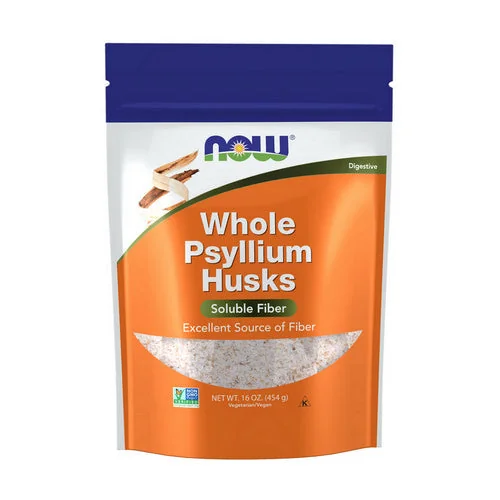
NOW Whole Psyllium Husks
Whole psyllium husks · 1 lb (454 g)
Fiber 7 g: soluble 6 g; insoluble 1 g per label serving.
- Amount
- Fiber 7 g: soluble 6 g; insoluble 1 g
- Format
- Powder
- Review basis
- Label-based analysis
Good fit
Buyers seeking unflavored whole-husk fiber who can manage its liquid-and-mixing routine.
Consider another option
Swallowing difficulty, suspected obstruction, severe abdominal pain, or inability to follow the liquid requirements.
The product, at a glance
Amounts for the reviewed label serving.
- Reviewed variant
- Whole psyllium husks · 1 lb (454 g)
- Label serving
- 2 level tablespoons (10 g)
- Servings per reviewed pack
- ~45
- Ingredients per label serving
- Fiber 7 g: soluble 6 g; insoluble 1 g
- Other ingredients
- Psyllium husks (husk/seed)
Label sources & rating context
Retailer label ↗ · Label source ↗
~ means approximate; — means no published value in this record. Customer ratings are the named publisher’s snapshot and may include multiple sizes or earlier formulas. The Supplement Explained Score is our source-reviewed editorial assessment out of 25, separate from customer stars. Compare the five criteria and the same intended use; the total is not a clinical ranking. Prices are dated USD offer snapshots; cost uses the reviewed pack and label serving.
- Label clarity: 5/5
- Evidence transfer: 4/5
- Safety fit: 4/5
- Quality proof: 2/5
- Value fit: 3/5
On this pageTable of Contents
- 1Supplement Explained Score
- 2Label facts at a glance
- 3Is this interchangeable with psyllium powder?
- 4What benefits does the evidence support here?
- 5How demanding is the mix-and-drink routine?
- 6Who should avoid this purchase?
- 7What should a plain psyllium label tell you?
- 8How should you compare the bag's value?
- 9Would a different fiber type or format fit better?
- 10FAQ
Our editorial assessment
Supplement Explained Score
18/25
NOW Whole Psyllium Husks · Whole psyllium husks · 1 lb (454 g)
Five equally weighted criteria, with a product-specific reason for every point. This is a buying-decision assessment, separate from customer stars and personal medical suitability.
- Label clarity 5/5
- Reviewed Whole psyllium husks · 1 lb (454 g): 2 level tablespoons (10 g); ~45 label servings. Fiber 7 g: soluble 6 g; insoluble 1 g.
- Evidence transfer 4/5
- Psyllium has direct human evidence for bowel function and cholesterol lowering; the labeled 7 g fiber is a useful comparison amount.
- Safety fit 4/5
- A full glass of water is essential; swallowing problems and timing with oral medicines limit suitability.
- Quality proof 2/5
- The exact NOW whole-husk size and serving are identified; no independent finished-pack testing record was verified.
- Value fit 3/5
- The approximately 45-serving 454 g pack is straightforward; volume and mixing tolerance matter alongside price.
Review basis: Published labels, manufacturer/retailer information, clinical sources and exact-product quality records where available. We did not buy, personally use or laboratory-test this product for this assessment.
Reviewed · Method v2.0 · How we assign points
Sources behind this score
- Retailer label
- Label source
- MedlinePlus: psyllium use and precautions
- Randomized trial: psyllium and serum cholesterol
Product labels and independent directory records identify a formula or testing scope. Clinical references concern ingredients or studied regimens unless the explanation explicitly matches the finished formula.
Is this interchangeable with psyllium powder?
No. Whole husks and finely milled powder are different formats, and their tablespoon measures are not interchangeable. A powder or capsule serving does not establish the weight or directions for this package.
The reviewed retail label is not independent confirmation of the latest manufacturer label. If a newer label or your delivered package differs, confirm that it is the same whole-husk variant rather than assuming a powder label is an update.
For comparisons, use labeled fiber rather than total material weight. The soluble portion is included in total fiber, not an extra amount to add on top. Package weight is not pure soluble fiber. Our psyllium husk guide explains the ingredient in more detail.
What benefits does the evidence support here?
The support here is general fiber nutrition guidance, not a clinical trial of this exact NOW product. NIDDK’s constipation guidance recommends fiber-containing foods, enough liquids to help fiber work, and a gradual increase in fiber. That supports a cautious rationale for filling a fiber gap, not a guaranteed result from this bag.
Ingredient-level discussion of soluble fiber should not be presented as proof that this product delivers a particular cholesterol reduction. The referenced nutrition guidance does not establish a cholesterol-specific amount to use, either. The label describes what is in a serving; it does not demonstrate a clinical outcome.
The purchase makes more sense if you have an identifiable reason to add fiber and can assess tolerance. It makes less sense if you want a proven branded treatment or expect it to replace fiber-containing meals.
How demanding is the mix-and-drink routine?
It requires measuring, mixing with enough liquid, and drinking promptly; this is not a dry scoop or a drink to leave standing. The retailer’s label directions specify 1–2 level tablespoons in at least 12 ounces of liquid. Those are label directions, not a personalized amount to use.
Psyllium thickens quickly after mixing, so prepare it when you are ready to drink it. If you prefer something you can prepare well in advance, this format is an awkward fit.
Introduce added fiber gradually, and treat the liquid requirement as part of the routine rather than an optional extra. The fiber timing and tolerance guide offers practical considerations without turning the retailer’s range into a universal daily schedule.
Who should avoid this purchase?
People with difficulty swallowing or a known or suspected obstruction should not choose this as routine bulk fiber. Severe abdominal pain needs medical care, not an attempt to solve it by adding husks.
Never take psyllium dry. Its liquid requirement is a safety issue, not merely a preference about texture. Someone who cannot reliably follow the mixing directions should avoid this format rather than reduce the liquid to make the serving easier.
Bloating can also make ongoing use difficult. Gradual introduction matters, but discomfort should not automatically be interpreted as proof that a product is working. See Can Psyllium Cause Bloating? for more on tolerance.
If you take medicines, ask a pharmacist about timing with this particular product and follow its instructions. Do not apply one spacing interval to all medications.
What should a plain psyllium label tell you?
The useful facts are whole husks, fiber grams and mixing directions. This product lists psyllium husks without a flavored vitamin blend. That makes ingredient comparison straightforward, but whole husks and fine powder still differ by spoonful.
If a contaminant question matters to you, request a current lot-specific certificate of analysis. An organic, natural or plain-fiber description would not by itself prove a particular heavy-metal result. Do not confuse a general retailer warning with a measured finding for this bag.
How should you compare the bag's value?
Compare the item price per 100 g, excluding delivery and tax, rather than guessing a cost per serving. This bag contains 454 g, so divide its displayed item price by 4.54 for that comparison.
A reliable serving count needs a verified gram weight for the labeled volume serving. That weight is not established here, so neither a serving yield nor a month’s supply should be inferred. Another whole-husk bag can be compared by net weight; a different fiber formula also needs its own fiber-per-serving comparison.
The recurring burden is measuring, mixing, and drinking promptly with sufficient liquid. That matters if a cheaper bag will sit unused because you dislike the preparation. A smaller package may be more practical for an uncertain buyer even if its unit cost is higher. A lower price does not establish effectiveness or better tolerance.
Dated price check: HerbsPro listed the reviewed package at $11.98 on , before delivery, tax or optional discounts. This is a snapshot, not a lowest-price claim.
No matched fresh USD serving-cost benchmark was available for the score review. The reviewed Whole psyllium husks · 1 lb (454 g) supplies ~45 label servings of Fiber 7 g: soluble 6 g; insoluble 1 g, using 2 level tablespoons (10 g) per serving. The approximately 45-serving 454 g pack is straightforward; volume and mixing tolerance matter alongside price.
Check current price at HerbsPro
Affiliate link: we may earn a commission. Confirm the package size and current label.
Would a different fiber type or format fit better?
Two concrete types worth comparing are finely milled psyllium powder and inulin powder. The first changes psyllium’s physical format, while the second changes the fiber ingredient itself. Neither should be substituted by matching tablespoons.
- Finely milled psyllium powder: Consider it if the whole-husk format is the sticking point. Check that product’s own directions and labeled fiber amount. A smaller-looking spoonful does not necessarily mean less fiber, and psyllium powder is not a dry-scoop option.
- Inulin powder: Consider it if you want to compare a different fiber, not merely a different grind. Do not assume it is a bloating-free substitute. Compare actual labeled fiber grams rather than the weight of a scoop or blend.
Our psyllium-versus-inulin comparison examines those choices. If minimizing preparation is the priority, neither powder automatically solves that problem; read its directions before buying.
Related formula reviews: Garden of Life Dr. Formulated Organic Fiber. Compare the full label; these are not automatically equivalent substitutes.
FAQ
How long will one bag last?
That cannot be calculated reliably from the reviewed information. The bag's weight is known, but the gram weight of the volume-based serving is not verified. Duration also depends on the actual use schedule. Avoid month-supply claims derived from an assumed tablespoon weight.
Can I mix it the night before?
The retailer directs prompt drinking, so this is not a prepare-and-leave mixture. Psyllium thickens quickly after contact with liquid. Follow the received package's instructions rather than assuming preparation methods used for another fiber powder also apply to these whole husks.
Can it replace fiber-rich foods?
No. Adding one fiber source is not equivalent to eating a varied diet. NIDDK highlights foods such as whole grains, beans, fruits, and vegetables in its constipation nutrition guidance. Consider the supplement as a possible addition, not a complete substitute for those foods.
Can I take it at the same time as my medicine?
Ask a pharmacist to check your specific medicine and this product's instructions before combining their timing. There is no universal spacing interval to recommend for every medication. Do not copy a timing rule from an unrelated supplement or change prescribed medicine timing on your own.
What if my delivered package has different directions?
First confirm that you received the intended whole-husk variant rather than powder or capsules. If the format matches but nutrition or directions differ, ask the retailer or manufacturer to clarify the label version. Use the confirmed package's own instructions; do not merge amounts from different labels.
References
Label and listing checked October 2, 2026. Document-based review, not a hands-on test. Product versions and prices can change.
Editorial information
Continue your decision
If this product is not an obvious fit, use one of these routes instead of leaving the decision unfinished.
- All product analyses Browse the full product analysis library for alternatives and category comparisons.
- Supplement Explained Score See how label clarity, evidence transfer, safety fit, quality proof, and value fit are scored.
- Interaction checklist Check common combination risks before stacking supplements or medications.
- How we review evidence Understand how editorial evidence claims, uncertainty, and safety language are handled.