
Liposomal Vitamin C vs Regular Vitamin C: Is the Added Cost Justified?
Some liposomal vitamin C formulations have produced higher blood or cell vitamin C measurements than standard vitamin C in absorption studies. That is not the same as showing fewer infections, better long-term health, or superiority of every product labeled “liposomal.” The useful buying question is whether a particular formula offers a benefit relevant to you—not whether a technology name sounds more advanced. [1]
On this pageTable of Contents
Regular vitamin C usually means ascorbic acid in this comparison. Buffered mineral ascorbates and liposomal products are separate formulation choices, and their labels should be compared rather than treated as one interchangeable category. [2]
What the labels can tell you
| Type | What to verify | What the name alone cannot establish |
|---|---|---|
| Standard ascorbic acid | Vitamin C amount, unit count, other ingredients | Whether you need that amount |
| Mineral ascorbate | Vitamin C amount and any accompanying mineral | Guaranteed better tolerance or health outcomes |
| Liposomal formulation | Vitamin C amount, carrier ingredients, exact formulation evidence | That all liposomal products perform alike |
The nutrient amount and the carrier amount are different quantities. A product containing 500 mg vitamin C plus a separate lipid blend does not thereby contain more than 500 mg vitamin C. [3]
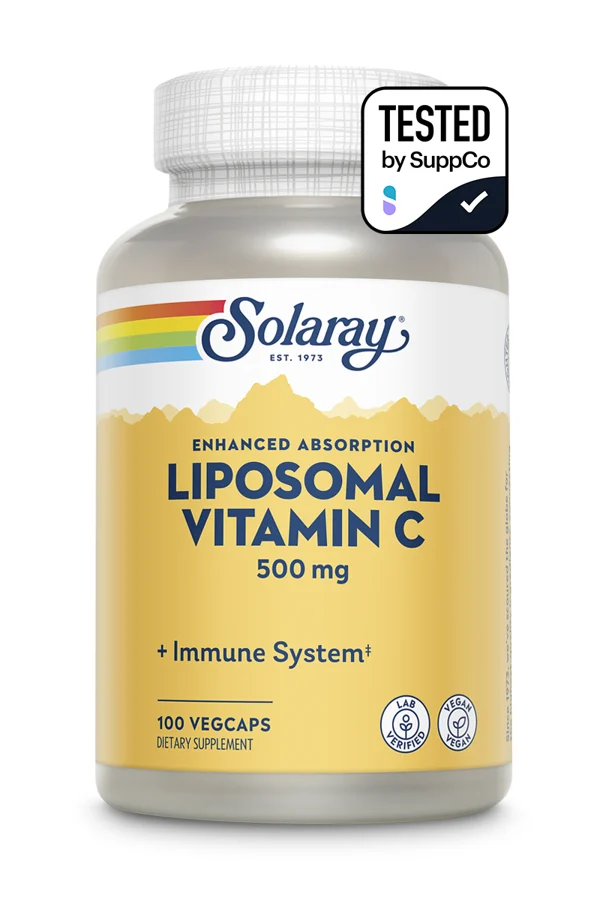
Solaray Liposomal Vitamin C 500 mg
500 mg vitamin C per capsule. 100 capsules.
Check price at HerbsProWe may earn a commission from this link.What a relevant absorption study actually measured
A 2024 randomized crossover study in 27 adults compared single 500 mg amounts of standard vitamin C, a named LipoVantage formulation, and placebo. It measured vitamin C in plasma and leukocytes over 24 hours and reported higher pharmacokinetic measures for the liposomal formulation. It did not test whether participants caught fewer colds, and it did not test the retail Solaray capsule. [1]
This supports a formulation-specific absorption finding. It does not provide a conversion rule such as “take half as much of any liposomal product,” nor does it establish that a higher concentration necessarily improves an outcome important to a particular person.
Why formulation matching matters
Two products can use the same broad delivery term while differing in their vitamin C amount, lipid ingredients, manufacturing process, physical form, and stability. A study of one named formulation is therefore not automatically evidence for another brand’s capsule.
To assess an absorption claim, ask which finished formulation was studied, what comparator and amounts were used, whether the work involved people, and what outcome was measured. A short-term concentration difference should remain a short-term concentration difference in the claim. Clinical superiority needs suitable clinical evidence.
The Solaray example: separate C from its carrier
Solaray Liposomal Vitamin C lists 500 mg vitamin C per capsule and a separate 241 mg lipid blend containing sunflower-derived phosphatidylcholine, palmitic acid, and oleic acid. The correct vitamin C amount is 500 mg—not 741 mg. [3]
At the checked manufacturer price of $29.59 for 100 capsules, the cost is about $0.296 per labeled 500 mg vitamin C serving. That is a dated product-specific calculation, excluding tax, shipping, subscriptions, and coupons. It is not a market-wide statement about the average liposomal price. [4]
A matching current standard-ascorbic-acid SKU was not established for a reliable retailer-to-retailer price comparison here. Consequently, we do not invent an exact price premium or claim a specific dollar saving.
How to compare the added cost yourself
Use bottle price ÷ (servings × vitamin C milligrams per serving), then multiply by the common amount you wish to compare. Keep purchase conditions consistent. A sale subscription on one side and a full-price one-time purchase on the other are not the same comparison.
Then ask what the extra cost buys. It might buy a particular physical format or an ingredient preference. An absorption claim may be relevant, but it should be matched to the exact formula and should not be priced as a guaranteed improvement in immunity when that outcome was not demonstrated.
A product with a larger carrier blend is not automatically a product with more vitamin C. Nor is the largest vitamin C amount automatically appropriate simply because it lowers cost per milligram.
Where buffered vitamin C fits
Mineral ascorbates, such as sodium or calcium ascorbate, are among the forms described by NIH. They should be checked for their actual vitamin C amount and any accompanying nutrient. The word “buffered” is not enough to establish that the product will solve gastrointestinal symptoms for every person. [2]
Someone who is concerned about tolerance should distinguish formulation preference from dose-related effects and the reason symptoms occur. Switching to a more expensive category is not a substitute for checking how much vitamin C is being consumed overall.
More absorption is not a reason to ignore safety
The US adult upper limit for vitamin C is 2,000 mg daily from all sources. High intakes can cause diarrhea, nausea, and cramping. People with iron-overload conditions and those receiving certain cancer treatments have additional reasons to discuss supplementation with their healthcare team. [2]
A delivery system does not cancel the need to assess total intake or interactions. The amount appropriate to correct a deficiency, the amount used in an absorption experiment, and a routine supplement amount are not necessarily the same.
Common questions
Is regular vitamin C ineffective?
No. A study showing higher measurements for one formulation does not show that ordinary ascorbic acid provides no vitamin C or no nutritional value. NIH recognizes ascorbic acid as the usual form in supplements. [2]
Does liposomal vitamin C prevent more colds?
The absorption trial discussed here did not measure that outcome. It cannot support that claim for the tested delivery system, much less for every brand carrying the word liposomal. [1]
Should the carrier blend be included in a vitamin C cost calculation?
No. Use the declared vitamin C amount as the denominator. Carrier ingredients may affect formulation preferences, but their mass is not additional vitamin C. [3]
A defensible purchase can be based on a particular formula and a price you consider acceptable. A defensible health claim needs more than higher short-term measurements or a delivery-system label.
Related reading
For the separate vitamin C and lipid-blend quantities, see our Solaray liposomal vitamin C review.
For the arithmetic behind capsules, servings, and nutrient quantities, see our serving-size and dose guide.