
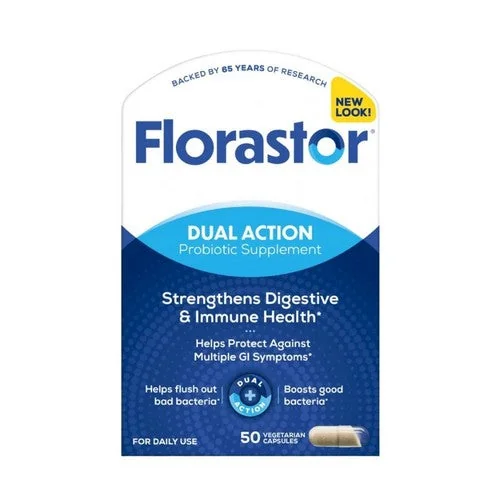
Florastor Dual Action Probiotic 250 mg
Florastor Dual Action · 50 capsules
S. boulardii CNCM I-745 500 mg (250 mg per capsule) per label serving.
- Amount
- S. boulardii CNCM I-745 500 mg (250 mg per capsule)
- Format
- Capsules
- Review basis
- Label-based analysis
Good fit
Buyers specifically seeking a named yeast probiotic who can accommodate its ingredients and capsule burden.
Consider another option
You want added prebiotic fiber, must avoid lactose, or have high-risk medical conditions without professional assessment.
The product, at a glance
Amounts for the reviewed label serving.
- Reviewed variant
- Florastor Dual Action · 50 capsules
- Label serving
- 2 capsules
- Servings per reviewed pack
- 25
- Ingredients per label serving
- S. boulardii CNCM I-745 500 mg (250 mg per capsule)
- Other ingredients
- Lactose; magnesium stearate; cellulose capsule
- Ingredients & allergens
- Contains lactose; vegetarian capsule
- Probiotic species / strains
- Saccharomyces boulardii CNCM I-745 (probiotic yeast)
- Storage
- Room temperature; do not refrigerate
Label sources & rating context
Manufacturer ↗ · Retailer label ↗
~ means approximate; — means no published value in this record. Customer ratings are the named publisher’s snapshot and may include multiple sizes or earlier formulas. The Supplement Explained Score is our source-reviewed editorial assessment out of 25, separate from customer stars. Compare the five criteria and the same intended use; the total is not a clinical ranking. Prices are dated USD offer snapshots; cost uses the reviewed pack and label serving.
- Label clarity: 5/5
- Evidence transfer: 4/5
- Safety fit: 3/5
- Quality proof: 2/5
- Value fit: 3/5
On this pageTable of Contents
- 1Supplement Explained Score
- 2Label facts at a glance
- 3Is this the yeast formula or a prebiotic blend?
- 4What benefit does the research support?
- 5How does yeast change use during an antibiotic course?
- 6Who should not buy it without professional assessment?
- 7What identifies the original Florastor capsules?
- 8How long will this bottle last for the price?
- 9Would a bacterial probiotic or a fiber supplement fit better?
- 10FAQ
Our editorial assessment
Supplement Explained Score
17/25
Florastor Dual Action Probiotic 250 mg · Florastor Dual Action · 50 capsules
Five equally weighted criteria, with a product-specific reason for every point. This is a buying-decision assessment, separate from customer stars and personal medical suitability.
- Label clarity 5/5
- Reviewed Florastor Dual Action · 50 capsules: 2 capsules; 25 label servings. S. boulardii CNCM I-745 500 mg (250 mg per capsule).
- Evidence transfer 4/5
- CNCM I-745 yeast has condition-specific diarrhea evidence; results do not establish treatment for every digestive complaint.
- Safety fit 3/5
- Avoid unsupervised use with severe immune compromise or central lines; antifungals, lactose and persistent symptoms matter.
- Quality proof 2/5
- The yeast strain and 250 mg capsule are identified; a current independent finished-pack quality record was not verified.
- Value fit 3/5
- The labeled two-capsule serving makes 50 capsules 25 servings; milligrams of yeast are not converted to a guessed CFU count.
Review basis: Published labels, manufacturer/retailer information, clinical sources and exact-product quality records where available. We did not buy, personally use or laboratory-test this product for this assessment.
Reviewed · Method v2.0 · How we assign points
Sources behind this score
Product labels and independent directory records identify a formula or testing scope. Clinical references concern ingredients or studied regimens unless the explanation explicitly matches the finished formula.
Is this the yeast formula or a prebiotic blend?
The reviewed Dual Action package is a yeast probiotic, not a bacterial blend or a Florastor Advanced probiotic-plus-prebiotic formula. Its named strain, Saccharomyces boulardii CNCM I-745, is the useful comparison point; “probiotic” alone is too broad to identify an equivalent alternative.
The reviewed retailer listing uses “maximum strength” wording, while the manufacturer page uses “Dual Action.” Do not treat that retail label as a guarantee of the ingredients in every current bottle. Advanced versions with added prebiotics are different formulas, so confirm the exact product name and ingredient panel before ordering.
Milligrams and colony-forming units (CFU) answer different questions. The label’s weight declaration cannot be converted into a viable yeast count from the information reviewed. A larger milligram or CFU number on another product does not, by itself, establish a better match.
What benefit does the research support?
The most relevant evidence concerns S. boulardii and antibiotic-associated diarrhea, not a promise of better digestion for everyone. The NIH Office of Dietary Supplements summarizes research suggesting that some probiotic preparations can reduce antibiotic-associated diarrhea risk. Effects depend on the strain, setting, and population studied; results for one preparation do not validate every probiotic sharing its species name. This is ingredient- and strain-level evidence, not a trial of the exact retail bottle reviewed here.
That distinction matters when comparing a named yeast with an unspecified blend. A defined reason for considering supplementation is more useful than a broad digestive-support claim. Our probiotics guide explains the category without treating all probiotics as interchangeable.
How does yeast change use during an antibiotic course?
Its yeast identity matters when comparing use alongside antibacterial antibiotics: ordinary antibacterial antibiotics do not target yeast in the same way they target bacteria. That distinction does not guarantee diarrhea prevention.
The reviewed retailer’s label directions are two capsules once or twice daily. These are label directions, not a recommendation to choose either schedule; they imply a two- or four-capsule daily burden. If you are considering it during prescribed antibiotic use, discuss suitability rather than changing the antibiotic course.
Use the directions on the version you receive, rather than borrowing a timing rule, course length, or mixing instruction from an Advanced product or a different package. Because this is yeast, antifungal medicines need a separate medication check.
Who should not buy it without professional assessment?
People with severe illness, impaired immunity, or a central venous catheter should not self-select this product. Rare invasive yeast infection is a real concern in these groups, so professional assessment matters more than the product’s supplement status or its availability online.
The reviewed ingredient list includes lactose. If lactose avoidance is essential, choose another formula or verify a suitable version before purchasing. Lactose intolerance and milk allergy are different concerns; the vegetarian capsule description is not evidence that this product is safe for someone with a milk allergy.
Florastor is not a treatment for C. difficile infection and does not replace prescribed antibiotics. If digestive discomfort is your main concern, our Can Probiotics Cause Bloating? article addresses that separate question.
What identifies the original Florastor capsules?
The useful identifiers are S. boulardii CNCM I-745, 250 mg per capsule and the Dual Action formula. An Advanced version with added prebiotics should be evaluated separately.
Check the full ingredient list and storage directions on the bottle, particularly if lactose is a concern. Milligrams declare the ingredient mass; they cannot be converted into a viable yeast count without more information. Compare the same formula and serving before comparing different bottle sizes.
How long will this bottle last for the price?
For the reviewed 50-capsule bottle, value depends on whether the applicable label schedule uses two or four capsules daily, not simply on the bottle price.
- Two capsules per day: 25 days of supply, using one labeled serving daily.
- Four capsules per day: 12.5 days of supply, using two labeled servings daily.
For cost per two-capsule serving, divide the displayed bottle price by 25. For cost per day, divide by 25 or 12.5 according to the label schedule being compared. Exclude delivery and tax.
Those supply figures are not recommended course lengths. A product requiring fewer daily capsules may be more convenient, but it is not automatically equivalent. A low price does not prove effectiveness, and a higher price does not offset an unsuitable formula.
Dated price check: HerbsPro listed the reviewed package at $52.82 on , before delivery, tax or optional discounts. This is a snapshot, not a lowest-price claim.
Comparable cost: About $1.06 per capsule; $2.11 per day at two capsules or $4.23 at four. These illustrate the listed directions, not a choice of regimen.
Check current price at HerbsPro
Affiliate link: we may earn a commission. Confirm the package size and current label.
Would a bacterial probiotic or a fiber supplement fit better?
Two alternative types worth comparing are a strain-identified bacterial probiotic and a prebiotic fiber supplement. Neither is a direct substitute for this yeast formula.
- A bacterial probiotic may be more relevant when a specific bacterial strain has evidence for your intended purpose. Compare that strain and its labeled serving rather than choosing the blend with the longest species list. Its medication considerations and other ingredients need their own review.
- A prebiotic fiber supplement is a different choice for someone specifically seeking fiber rather than live yeast. Compare the actual fiber amount and ingredient list; the word “prebiotic” does not make it an equivalent probiotic.
If lactose is the main obstacle, compare ingredient panels rather than assuming every bacterial option is lactose-free. Our How to Compare Two Probiotic Products guide helps separate formula differences from marketing.
Related formula reviews: Align Probiotic Capsules. Compare the full label; these are not automatically equivalent substitutes.
FAQ
What if the bottle and retailer directions differ?
Use the directions for the exact product in hand, not a different version's online listing. Ask the manufacturer or pharmacist to resolve a mismatch before use; do not combine conflicting schedules.
How many bottles cover a 30-day comparison?
At two capsules daily, 30 days requires 60 capsules, or two reviewed bottles. At four daily, it requires 120 capsules, or three bottles. This is purchase arithmetic, not a recommended course length.
Does this review establish a children's serving?
No pediatric serving is established here. A child's suitability and instructions require age-specific labeling and professional guidance, rather than simply reducing the retailer's listed capsule count.
Does it need to be refrigerated?
The reviewed information does not establish a refrigeration requirement. Follow your exact package's storage directions, and request the current label if a retailer leaves them out.
How quickly should I expect a result?
The reviewed sources do not establish a guaranteed time to benefit for this package. A claim of relief within a particular number of days should not decide the purchase.
References
- Reviewed retailer package and label
- Manufacturer product information
- NIH Office of Dietary Supplements: Probiotics—Health Professional Fact Sheet
Label and listing checked October 2, 2026. Document-based review, not a hands-on test. Product versions and prices can change.
Editorial information
Continue your decision
If this product is not an obvious fit, use one of these routes instead of leaving the decision unfinished.
- Probiotics guide Compare CFU, strain labeling, capsule vs food tradeoffs, and use-case fit.
- All product analyses Browse the full product analysis library for alternatives and category comparisons.
- Supplement Explained Score See how label clarity, evidence transfer, safety fit, quality proof, and value fit are scored.
- Interaction checklist Check common combination risks before stacking supplements or medications.